

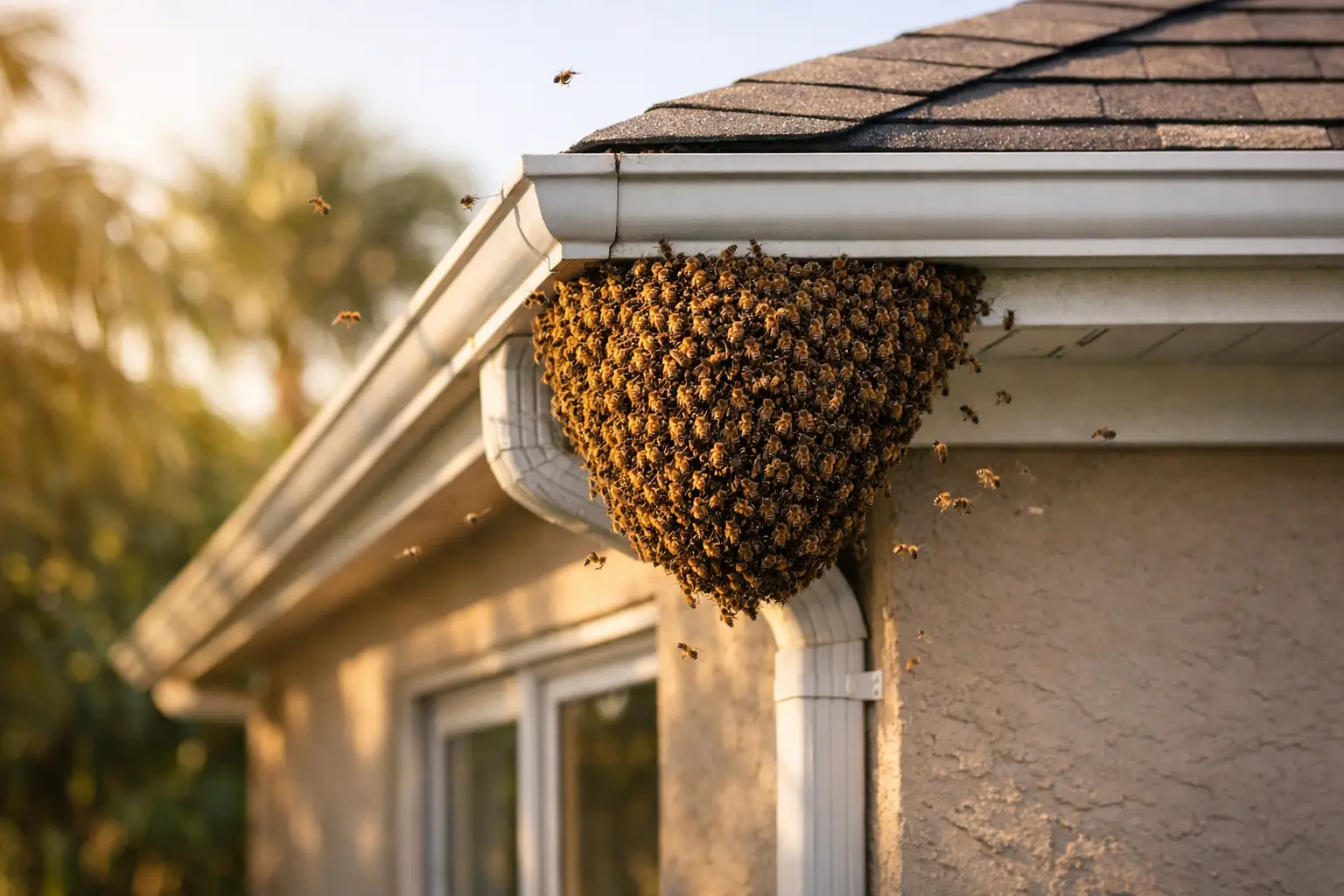

A can of spray and a ladder can look a lot cheaper than calling a live bee removal specialist. That is the heart of the false economy of DIY bee removal. What seems like a money-saving shortcut often turns into a larger bill, more structural damage, and a more dangerous situation for the people living or working nearby.
For homeowners, the mistake usually starts with a hopeful assumption: if the bees go away, the problem is solved. For property managers and HOAs, it can start as a budget decision made under pressure. In both cases, the visible bees are only part of the issue. The colony, comb, brood, stored honey, and the cavity they occupied all matter. If those pieces are not handled correctly, the cost does not disappear. It simply shows up later in a less convenient form.
Why DIY looks cheaper than it is
DIY bee removal feels affordable because the first number is small. A spray product, sealant, protective clothing, or a borrowed extension ladder may cost far less than a professional removal invoice. On paper, that looks efficient.
But bee removal is not just about getting insects out of sight. In structural removals, bees are often inside soffits, block walls, attics, chimneys, rooflines, or other hidden voids. Killing or driving off the foragers without removing the comb leaves behind wax, pollen, brood, and honey. That material breaks down, melts, leaks, stains surfaces, and attracts other pests. Ants, roaches, beetles, moths, rodents, and even a new swarm can move into the same cavity.
The false economy of DIY bee removal comes from treating a colony like a surface problem when it is actually a structural and biological one. The cheap fix handles the symptom. The expensive consequences come from everything left behind.
What DIY bee removal usually misses
A healthy colony is organized deep inside the space it has claimed. Even when the entrance looks small, the interior footprint can be surprisingly large. Homeowners often see a cluster at the eaves and assume it is a simple removal. Once opened, the cavity may contain multiple combs attached to framing, insulation, or masonry.
That matters because removal has two parts: getting the bees out safely and correcting the habitat they built. If either step is skipped, the site remains vulnerable.
Bees are not the only thing in the wall
Comb holds honey, pollen, larvae, and pheromones. Those pheromones matter more than most people realize. They can draw new bees back to the same location even after the original colony is gone. A cavity that still smells right to scout bees can become an invitation for reinfestation.
This is one reason poisoned colonies often create future problems instead of ending them. Dead bees inside a wall do not remove the attractants. Neither does sealing an active entrance while colony material remains inside. In fact, sealing too early can force bees deeper into the structure or into living spaces.
The structure can become part of the repair bill
Honey is heavy, sticky, and destructive in the wrong place. In Southwest Florida heat, comb can soften and collapse. Honey can seep into drywall, soffits, ceilings, and insulation. Once that happens, the repair is no longer about bee removal alone. It becomes a restoration issue.
A homeowner who tried to save money may now be paying for drywall replacement, repainting, insulation removal, odor cleanup, pest treatment, and a second contractor to finish what the first attempt did not solve. That is why the lowest upfront price is often the highest total cost.
Safety is where the budget argument falls apart
The financial risk is only one part of the story. Bee behavior can change quickly during a removal attempt, especially if the colony is established, stressed, or located in a difficult access point.
A person standing on a ladder, working near a roof edge, and trying to manage defensive bees is taking on more than a pest problem. They are taking on a fall hazard, sting risk, and in some cases a public safety issue. Children, pets, neighbors, tenants, customers, and passersby can all be affected if the colony becomes agitated.
For commercial properties, this is not just inconvenient. It can become a liability event. A rushed DIY effort around storefronts, pool areas, HOA common spaces, or municipal structures can expose multiple people at once. Even if nobody is seriously injured, the disruption itself can be costly.
It also depends on the colony. Some removals are relatively straightforward swarms resting temporarily on a branch. Others involve established colonies in buildings, with brood and comb extending through concealed areas. Those are not equivalent situations, and treating them the same is where people get into trouble.
Humane removal and real resolution are not the same as extermination
There is another cost that does not fit neatly on an invoice. Honey bees are valuable livestock. They pollinate food crops, support local ecosystems, and can often be rescued and relocated rather than destroyed.
From an agricultural and ecological standpoint, killing a colony when it could have been removed alive is wasteful. From a practical standpoint, extermination without full cut-out and cleanup often fails to resolve the structure issue anyway. So the property owner may pay twice – once to kill bees and again to repair the aftermath.
A proper live removal addresses the colony as a whole. That means locating the nest, removing bees and comb, cleaning the area, and reducing the chances of another colony moving into the same void. It is a more complete process because the problem is being handled at its source.
The hidden math behind repeat infestations
When people think DIY saved them money, they often stop counting too early. The real calculation should include the chance of recurrence.
If an entrance is patched but the cavity is still attractive, bees may return during the next swarm season. If honey remains inside the wall, secondary pests may show up long after the original colony is gone. If moisture and staining develop, repairs may spread beyond the original access area.
A professional removal may cost more at the start because it includes labor, access work, bee handling, comb removal, and site correction. But that higher first cost can be lower than the combined cost of repeated treatments, cosmetic repairs, pest cleanup, and emergency call-backs.
That is especially relevant for HOAs and commercial managers. A cheap first attempt that fails is not just a maintenance issue. It can become a pattern of complaints, vendor rework, and exposure to claims. Predictable resolution is often more economical than a series of low-cost guesses.
When a homeowner should call right away
Not every bee sighting means a colony is inside the structure. A swarm hanging briefly on a tree branch may move on or be collected safely by a trained beekeeper. But steady traffic entering the same hole in a wall, roofline, meter box, or soffit usually points to an established nest.
That is the point where waiting can make the job bigger. Colonies grow. Comb expands. More honey gets stored. More of the structure becomes involved. A small opening can hide a large problem, and the repair window tends to get cheaper earlier, not later.
In Southwest Florida, heat and weather add urgency. Structural cavities can turn into messy cleanup situations quickly once comb softens or storm conditions disturb the nest. If there is regular bee activity at one entry point, or if aggressive behavior appears near entrances and walkways, it is time to stop experimenting.
What professional value actually looks like
Good bee removal is not expensive because bees are mysterious. It costs what it costs because it is specialized work. The technician has to read bee behavior, understand how colonies use cavities, open structures carefully, remove comb methodically, and leave the site in a condition that does not invite the same problem back.
That expertise is where real savings show up. You are paying to avoid preventable damage, reduce safety risk, and solve the whole problem instead of the visible tip of it. In some cases, a same-place-removal warranty also matters because it reflects whether the provider stands behind the correction, not just the bee pickup.
For property owners in Cape Coral and the wider Southwest Florida area, that practical difference is often what separates a one-time service from a drawn-out repair story.
The cheapest bee removal is not the one with the lowest invoice. It is the one that keeps your family safe, protects the structure, and prevents you from paying again for the same cavity six weeks later.

No responses yet