

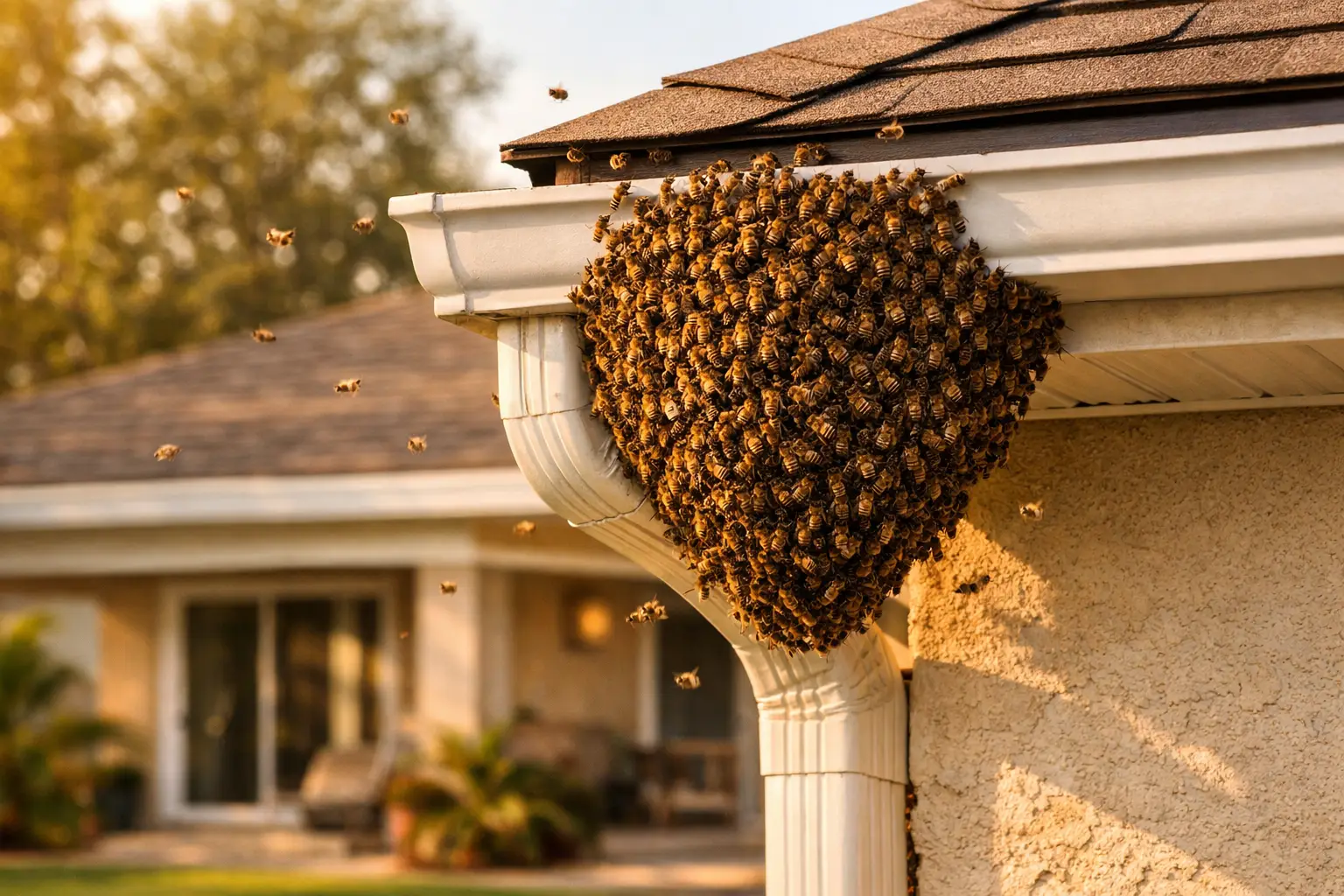

A cloud of bees on a tree branch can look dramatic. A colony inside a wall is the one that causes real trouble. That is where bee removal stops being a simple nuisance call and becomes a safety and property issue.
For homeowners, the immediate concern is usually stings. For property managers, it is liability. For both, the hidden risk is structural damage after the wrong treatment. When bees are poisoned inside a soffit, chimney, roofline, or block wall, the insects may die, but the wax, honey, brood, and scent remain. That can mean melting comb, staining, fermentation, ants, roaches, rodents, and sometimes a new swarm moving right back into the same cavity.
What bee removal actually means
True bee removal is not the same as spraying insects on sight. In the best cases, it means identifying whether you are looking at a temporary swarm or an established colony, then using the right method to remove the bees and address the nest site.
A swarm is usually a traveling cluster. These bees are often resting while scout bees search for a permanent home. A swarm hanging on a branch or fence may be removable with relatively little disturbance if handled quickly and correctly.
An established colony is different. If bees are flying in and out of one gap in your siding, fascia, roof tile, soffit, chimney, or concrete block, they have likely moved in. At that point, humane removal often requires opening the structure, taking out the comb, recovering the queen when possible, and cleaning the cavity so the location does not keep attracting bees.
That distinction matters because the work, time, and risk are not the same. A good operator will explain which situation you have before promising a price or a timeline.
Why poison is usually the expensive shortcut
People often assume the fastest answer is to kill the bees and move on. On the surface, that sounds practical. Inside a structure, it often creates the bigger bill.
Honeycomb is not just a stack of tidy hexagons. It holds honey, pollen, developing brood, and wax that softens under Florida heat. If the colony is left inside the wall after treatment, gravity and temperature take over. Honey can seep through drywall or stucco. Wax can slump. Dead brood can rot. Other pests can move in.
There is also a biological problem. Bees choose cavities that meet certain conditions: darkness, shelter, defensible entry points, and enough internal space. If those conditions remain and the old comb scent is still present, another swarm may see the site as a ready-made home. What looked like a one-time fix turns into repeat activity.
That is why live removal and proper cleanup usually make more sense when bees are established in a building. It deals with the colony and the reason the colony stayed.
How live bee removal works
Every removal is site-specific, but the process tends to follow the same logic. First comes identification and access planning. Honey bees are not the only stinging insects people call “bees.” Wasps, hornets, bumble bees, and honey bees behave differently and require different approaches.
Once the insects are confirmed as honey bees, the next step is locating the colony footprint. The visible entrance does not always show the full nest location. Bees can enter through a tiny gap and build several feet away inside a cavity. Experienced removal work depends on reading flight patterns, listening for colony activity, and understanding common nest sites in roofs, eaves, walls, and masonry.
Bee removal from a swarm
Swarm removal is often the most straightforward scenario. The cluster is collected, the queen is secured if visible, and the bees are transferred into transport equipment for relocation. Even then, technique matters. Rough handling can scatter the swarm and turn a calm job into a chaotic one.
Bee removal from a structure
Structural removals are more technical. The goal is not only to collect the bees but to remove the comb and residue from the cavity. Depending on the building, that may mean opening soffits, fascia boards, wall sections, roof areas, sheds, utility boxes, or masonry voids.
The bees are carefully removed, comb is cut out, salvageable brood and resources may be secured for relocation, and the interior is cleaned as thoroughly as conditions allow. Afterward, exclusion work becomes critical. If entry points are left open or improperly repaired, the problem can return.
This is where humane bee work and property protection overlap. Saving the colony matters, but so does leaving the structure in a condition that does not invite another colony next season.
When to act fast
Not every bee sighting is an emergency, but some situations should move to the top of the list. If bees are entering a home, school, clubhouse, restaurant patio area, or utility space where people gather, time matters. The same is true when pets, children, elderly residents, or anyone with sting allergies may be exposed.
Aggression also changes the equation. Honey bees are not automatically dangerous, but a disturbed colony defending a nest can behave very differently from a calm swarm resting on a branch. Mowers, hedge trimmers, pressure washers, and roof work commonly trigger defensive responses. If a colony is in a high-traffic area, delaying action can raise the risk.
In Southwest Florida, weather and heat add another layer. Warm conditions support year-round bee activity, and structural comb can soften quickly. Waiting often gives the colony more time to expand deeper into the building.
What a good bee removal company should explain
A professional should be able to tell you what they see, what they do not yet know, and what may change once the structure is opened. That kind of honesty matters because hidden comb can be larger than expected.
They should also explain whether the job is a swarm collection or a structural removal, whether the comb will be removed, what parts of the structure may need to be opened, and what happens after the bees are out. If a provider talks only about making the insects disappear, ask more questions.
For commercial properties and HOAs, documentation, insurance, and safety procedures are part of the service. The issue is not just removal. It is reducing risk for residents, guests, tenants, and staff while preventing a repeat event in a common area.
Can all colonies be relocated?
Usually, live removal and relocation are possible, but not every job is simple. Colony health, accessibility, height, weather, and building materials all affect the outcome. Some removals are physically complex. Others require balancing urgent public safety concerns with the goal of saving as many bees as possible.
That is the trade-off people rarely hear about. Humane work does not mean careless work. It means using methods designed to preserve the colony when feasible, while still putting human safety first.
For companies that also maintain apiaries, relocation has a practical endpoint. The bees are not just removed from a problem site and abandoned. They are rehomed into managed environments where they can continue doing what bees do best. That model makes ecological sense because it treats the colony as livestock worth preserving, not waste to be discarded.
What you should do if you find bees
The safest first step is distance. Keep children and pets away, and do not block the entrance the bees are using. Avoid spraying water, using store-bought insecticides, poking at the opening, or sealing it shut. Sealing a live colony into a wall often pushes bees into interior spaces as they search for another exit.
Try to observe from a safe distance. Are the bees clustered outside in one mass, or are they flying in and out of a crack repeatedly? That simple detail helps determine whether you are seeing a swarm or an established colony.
If the site is near a doorway, walkway, playground, pool equipment area, or business entrance, keep traffic away until a professional evaluates it. In many cases, a calm scene stays calm if left undisturbed. Most bad outcomes start when someone tries to fix it with a can, a broom, or a ladder.
Bee removal is really about what happens after
The visible bees get your attention. The real quality of a removal shows up later. No leaking honey in the wall. No lingering odor pulling in ants. No fresh swarm taking over the same cavity two months from now.
That is why proper bee removal is part biology, part construction awareness, and part risk management. It protects people in the moment, protects the structure over time, and gives a living colony a chance to keep pollinating instead of being destroyed.
If bees have moved onto your property, the goal is not panic and it is not delay. It is getting the situation identified correctly and handled in a way that respects both the building and the bees. Around Cape Coral and the wider Southwest Florida area, that approach is what makes live removal worth doing right the first time.

No responses yet