

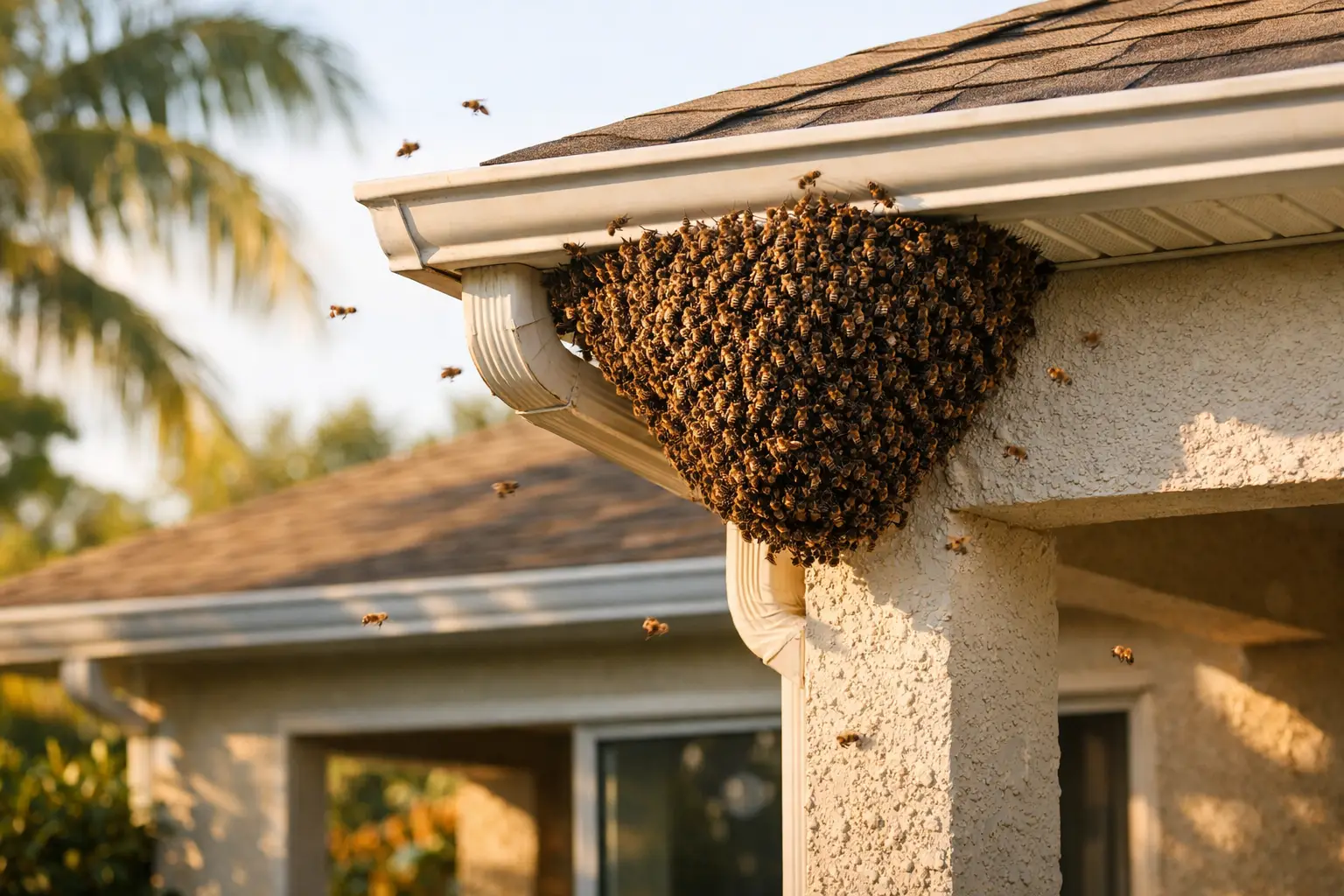

That search for bee removal near me usually happens fast – right after you notice a swarm on a tree, bees slipping into a soffit, or steady traffic disappearing behind a wall. In that moment, most people are balancing two concerns at once: keep everyone safe now, and avoid making the problem worse inside the structure.
That second part matters more than many homeowners realize. A visible cluster outside may be temporary, but a colony that has moved into a wall, roofline, shed, or meter box can become a building issue as much as a bee issue. Honey, wax, brood, and trapped dead bees can lead to staining, odor, ants, roaches, rodents, and repeat infestations if the job is handled halfway. Good bee removal is not just about making the insects disappear from view.
When bee removal near me is actually urgent
Not every bee sighting calls for the same response time. A swarm hanging from a branch or fence is often in transition. It can still be dangerous if people get too close, especially around pets, children, or heavy foot traffic, but it may not mean bees have established a permanent nest there.
A structural colony is different. If you see bees entering the same crack, vent, fascia gap, or block wall opening over and over, there is a good chance they are building comb inside. In Southwest Florida, warm weather extends bee activity, so colonies can expand quickly. The longer they stay, the larger the comb can become, and the more expensive the repair side of the work may be.
Urgency also changes if the bees are defensive. Aggressive behavior, repeated stinging, or a colony near doorways, pool equipment, walkways, schools, playgrounds, or restaurant seating should be treated as a safety issue. In those cases, waiting to see what happens is rarely the right call.
What to do before the removal team arrives
The safest first move is simple: create distance. Keep people and pets away from the area, and do not try to test whether the bees are calm. Vibrations from lawn equipment, pressure washing, trimming, hammering, or even slamming doors can trigger a defensive response if a colony is established nearby.
If bees are entering a wall or roofline, do not seal the opening. That sounds logical, but it often pushes bees deeper into the structure or forces them to find another way into living spaces. It also leaves comb and honey behind, which is where many of the secondary problems begin.
You should also avoid spraying store-bought pesticides, soap solutions, foam, or water. Poison can kill part of the colony without removing the comb. That leaves contaminated honey and dead bees in the cavity, and surviving bees may become more agitated. For a humane live removal, chemicals can also make rescue and relocation impossible.
A few clear photos taken from a safe distance can help a removal specialist assess whether you are dealing with a swarm, an exposed colony, or bees entering a structural void. That can speed up response and improve planning.
Why live bee removal is different from pest control
Bees are not just another nuisance insect. They are managed livestock in agriculture, critical pollinators, and part of a much larger ecological system. That does not mean you should tolerate a colony in your home or business. It means the right solution is removal with a full understanding of bee biology, structure access, and what happens after the bees are taken out.
Traditional pest control is often designed around elimination. Live bee removal focuses on safely extracting the colony, removing comb when needed, and relocating viable bees to managed apiaries or safe farm sites. That approach protects the building better and gives the colony a chance to survive.
It also addresses a hard truth that many property owners are never told: killing bees inside a wall is often the start of the real mess, not the end of it. As wax softens and honey absorbs heat, materials can leak through drywall or siding. Pests follow food sources. New swarms may be attracted back by old comb scent. A proper structural removal is more work up front, but it prevents a much bigger cleanup later.
How professionals determine the right approach
A credible bee removal service should start by identifying where the bees are, how they are using the space, and whether they can be removed intact. That means looking at flight patterns, entry points, structural materials, height, accessibility, and whether the colony is newly established or mature.
Swarm collection is usually the most straightforward scenario. If the bees are clustered out in the open and have not built comb, they may be gently collected and relocated with minimal disruption.
Cut-outs are more involved. This is the process used when bees have built comb inside a structure such as a wall, eave, soffit, chimney, or roof cavity. In a true cut-out, the removal team accesses the colony, removes the bees and comb, cleans the area, and helps reduce the chance of re-infestation. If comb is left behind, the job is incomplete.
There are also times when access is difficult and the plan has to balance ideal bee preservation with public safety and structural limits. That is where experience matters. The best answer is not always the fastest or cheapest one, but it should be honest.
What homeowners and property managers should ask
If you are comparing local companies, ask whether they perform live removal or simply exterminate. That distinction affects the result. You can also ask whether they remove comb from structures, whether they handle repairs or coordinate them, and whether they are familiar with bee behavior specific to Florida conditions.
For commercial sites, HOAs, and municipalities, documentation matters too. Liability, tenant safety, response time, and site access all become part of the job. A colony over a storefront entrance requires a different level of planning than a swarm on a backyard citrus tree.
Price matters, of course, but so does scope. A low quote may only cover killing visible bees. A more complete quote may include access work, comb removal, cleanup, relocation, and recommendations for sealing the site afterward. Those are not equal services, even if they sound similar on the phone.
What to expect after removal
After a proper removal, the most important next step is exclusion. Bees found the space because it offered shelter, dryness, and a workable entry point. If gaps, voids, or old access holes stay open, another swarm may eventually investigate the same area.
This is especially true with structural removals. Residual scent from old comb can attract scout bees. Cleaning and sealing matter. In some cases, stained or damaged material may need repair. If honey has spread into insulation or wall cavities, that should be addressed promptly before heat and moisture create a larger issue.
You may also notice a few lingering bees for a short time after the main colony is removed. That does not always mean the job failed. Foragers can return to the original location before dispersing. A good provider will explain what is normal and what would require follow-up.
Bee removal near me in Southwest Florida
Local experience helps because bee behavior is shaped by climate, bloom cycles, and building styles. In Southwest Florida, bees frequently use rooflines, block walls, sheds, utility boxes, and soffits because those spaces stay sheltered and warm. Fast growth is common in our region, so delays can change a manageable job into a structural one.
That is one reason specialized local services matter. A company like Beeswild.com LLC approaches removals from both sides of the issue: public safety and bee preservation. That means understanding how to get bees out of the wrong place without treating them as disposable.
If you are searching for help, the best local service is usually the one that explains the process clearly, responds with urgency when safety is involved, and tells you plainly whether the colony can be rescued, how the structure will be accessed, and what needs to happen after removal.
The right outcome is not just fewer bees in sight today. It is a safer property, less damage behind the walls, and one more colony given a chance to keep doing the work bees were meant to do.

No responses yet