
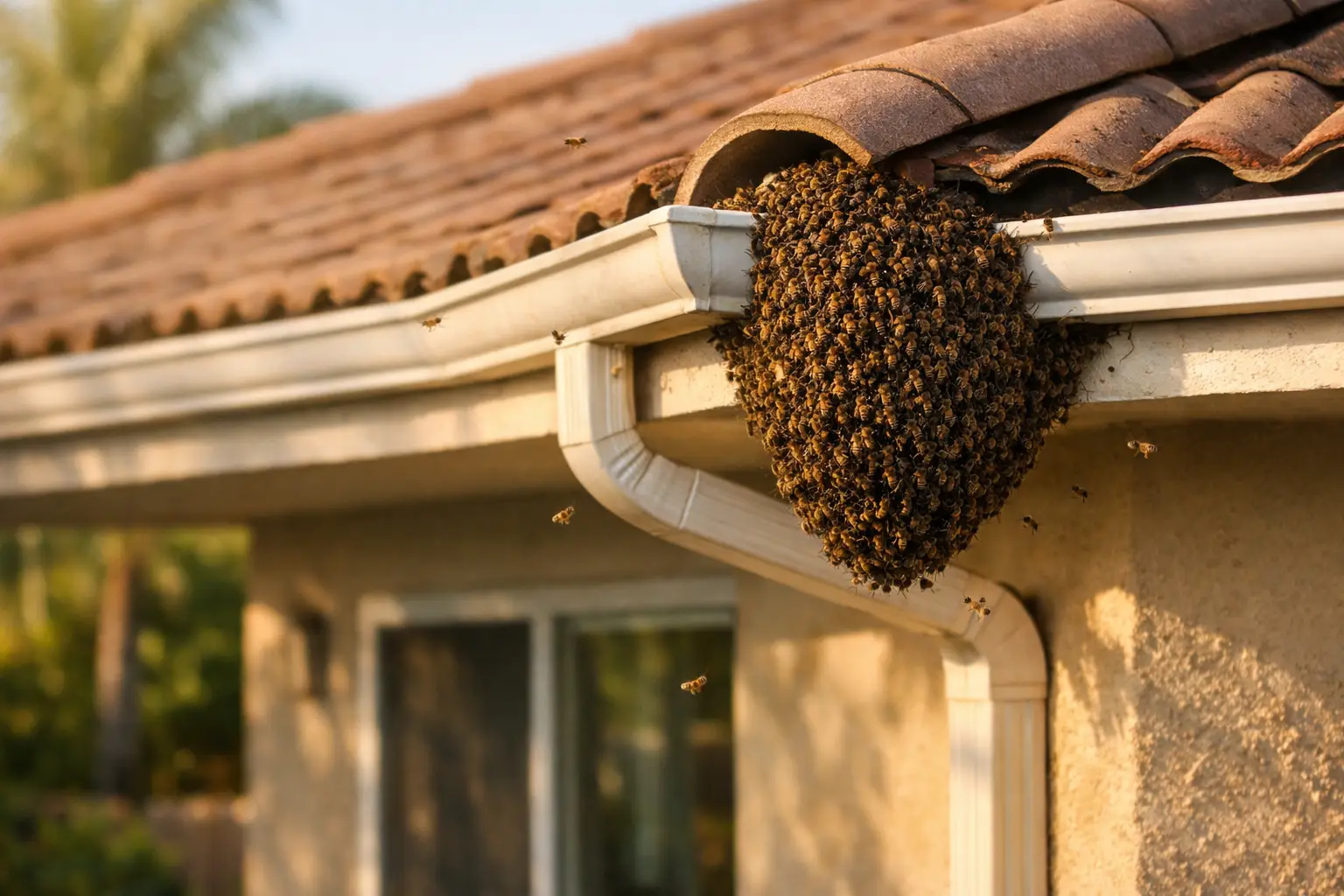

A cluster of bees under an eave can turn a normal afternoon into a panic fast. But the first decision should not be, “Who can get rid of them today?” The better move is to slow down long enough to ask the essential questions before bee removal, because the answers affect safety, cost, wall damage, and whether the problem comes back a month later.
For homeowners, HOAs, and property managers, the real issue is rarely just the bees you can see. It is what is hidden behind stucco, soffits, fascia, block walls, chimneys, or rooflines. A rushed treatment may quiet activity for the moment, but if honeycomb, brood, and stored honey remain inside the structure, the property can keep suffering long after the bees are gone.
Why the right questions matter before bee removal
Bee removal is not all the same. A swarm hanging on a tree branch is very different from an established colony inside a wall. One may be collected with minimal disruption. The other may require opening part of the structure, removing comb, cleaning the cavity, and closing likely entry points.
That is why a low price or a same-day promise should never be the only filter. Humane live removal often takes more skill than spraying, because it addresses the colony, the comb, and the conditions that attracted the bees in the first place. If those parts are ignored, the property owner may end up paying twice.
Essential questions before bee removal
1. Are these actually honey bees?
This sounds basic, but it is the first question that changes everything. Many people confuse honey bees with wasps, hornets, or bumble bees. The removal method depends on correct identification, and so does the level of risk.
Honey bees may be candidates for live relocation. Yellowjackets and other stinging insects require a different plan. A reputable specialist should ask for photos if possible and explain what they are seeing, rather than assuming every flying insect is the same problem.
2. Is this a swarm or a colony inside the structure?
A visible cluster on a fence, branch, mailbox, or shrub is often a swarm. Swarms are usually temporary while scouts search for a permanent home. They can still sting if disturbed, but they often behave differently from a colony that has already moved into a wall or roof.
An established colony is a bigger structural issue. If bees are entering through a crack and disappearing into the building, they are likely building comb inside. That means removal is not just about catching bees. It is about getting the nest materials out before they melt, ferment, attract ants, roaches, rodents, or future swarms.
3. Will you remove the comb and honey too?
This is one of the most important questions before bee removal, and it separates temporary treatment from complete correction. If a company only kills or vacuums visible bees but leaves comb behind, the cavity can become a mess.
In Florida heat, abandoned honeycomb can slump and leak into drywall or soffits. Honey can stain finishes and create odor. Wax and brood can attract pests. Even worse, the scent of old comb can draw a new swarm back to the same spot.
The right answer is not always “full removal” in every situation, because access differs from one structure to another. But the provider should clearly explain what will be removed, what may remain, and what that means for the building.
4. Are you doing live removal and relocation, or extermination?
Property owners deserve a straight answer here. Live removal and relocation aim to preserve the colony when feasible. Extermination kills bees, but it often does not solve the full structural problem unless comb removal follows.
There are cases where behavior, location, or public safety complicates the decision. Aggressive colonies in high-traffic areas require careful judgment. Still, any professional should explain why a certain method is recommended, what the trade-offs are, and whether the bees can be rescued.
For many customers, this question is also ethical. Bees are valuable livestock and important pollinators. If a colony can be safely relocated instead of destroyed, that matters.
5. What parts of the structure may need to be opened?
People often imagine bee removal as something done entirely from the outside. Sometimes it is. Often it is not. If bees are nesting behind stucco, inside a soffit, beneath a roof tile edge, or inside a block wall, access may require cutting or opening a section of the structure.
That should not be treated like bad news hidden until arrival. A trustworthy company explains likely access points up front, how much demolition may be needed, and whether cosmetic repair is included or separate. For commercial clients and HOAs, this is also a planning issue because building appearance, tenant access, and liability all matter.
6. How will you prevent bees from returning to the same spot?
Removal is only half the job. Bee-proofing is what protects the property afterward. Once a cavity has housed a colony, it is more attractive to future bees unless the site is properly cleaned and sealed.
Ask what steps are taken after removal. That may include removing comb, cleaning residue, screening vents, sealing gaps, or identifying construction features that allowed access. In Southwest Florida, where structures offer year-round shelter, re-entry prevention matters more than most people realize.
A same-place-removal warranty can also be worth asking about because it shows the company is standing behind the correction, not just the visit.
Questions about safety, liability, and urgency
7. What should we do before the crew arrives?
Good bee removal starts before anyone climbs a ladder. Residents may need to keep children and pets away from the area, close nearby windows, avoid lawn equipment, and stay clear of the flight path. In commercial settings, staff may need to redirect foot traffic or rope off a zone.
This question is especially important if anyone on site has a known sting allergy. The right provider should give simple, direct instructions and take the concern seriously.
8. Are you insured and experienced with structural removals?
Not every company that handles insects is built for live structural bee removal. Working around roofs, walls, soffits, and occupied spaces requires a specific mix of bee knowledge and building awareness.
Ask whether the team regularly removes colonies from structures, not just catches swarms. Ask whether they are insured for this type of work. For HOAs, municipalities, and commercial properties, this is not a formality. It is a risk-management issue.
9. What will the full cost include?
Price matters, but only if you know what is being priced. Does the quote include locating the colony, opening the area, removing bees, removing comb, cleaning the cavity, sealing access points, and follow-up if bees reappear at the same spot?
The cheapest option can become the most expensive if it leaves honey in the wall or allows re-infestation. On the other hand, not every situation needs extensive repair. A simple swarm collection should not be priced like a wall cut-out. A clear estimate should reflect the actual condition, not a one-size-fits-all package.
Red flags when evaluating answers
If a provider avoids specifics, that is a warning. Bee removal should come with plain explanations, not vague promises. Be cautious if someone says poison is the only solution without discussing comb removal, or if they guarantee no opening will be needed before even assessing where the bees are nesting.
Another red flag is treating all bee situations as emergencies of the same kind. Some are urgent, especially aggressive activity near entrances, playgrounds, or public walkways. Others allow enough time for a thoughtful plan. A professional should know the difference and explain it calmly.
What a good bee removal conversation sounds like
A strong provider asks questions too. They want to know where bees are entering, how long activity has been happening, whether bees are clustering outside or disappearing into the structure, and whether anyone has tried spraying already.
They should also explain what they can and cannot confirm before seeing the site. That honesty matters. It means the company is diagnosing the problem, not just selling the fastest service call.
In a region like Southwest Florida, where bee activity can stay active through much of the year, that level of care protects both the structure and the colony. That is the difference between simply making bees disappear and actually solving the problem.
Beeswild approaches removal with that long view because rescue only works when the home is protected too. If you ask better questions at the start, you are far more likely to end up with a safer property, a cleaner repair, and a colony that gets a second chance somewhere it belongs.
When bees show up where people live or work, speed matters – but clarity matters more. The right questions buy you both.

No responses yet