
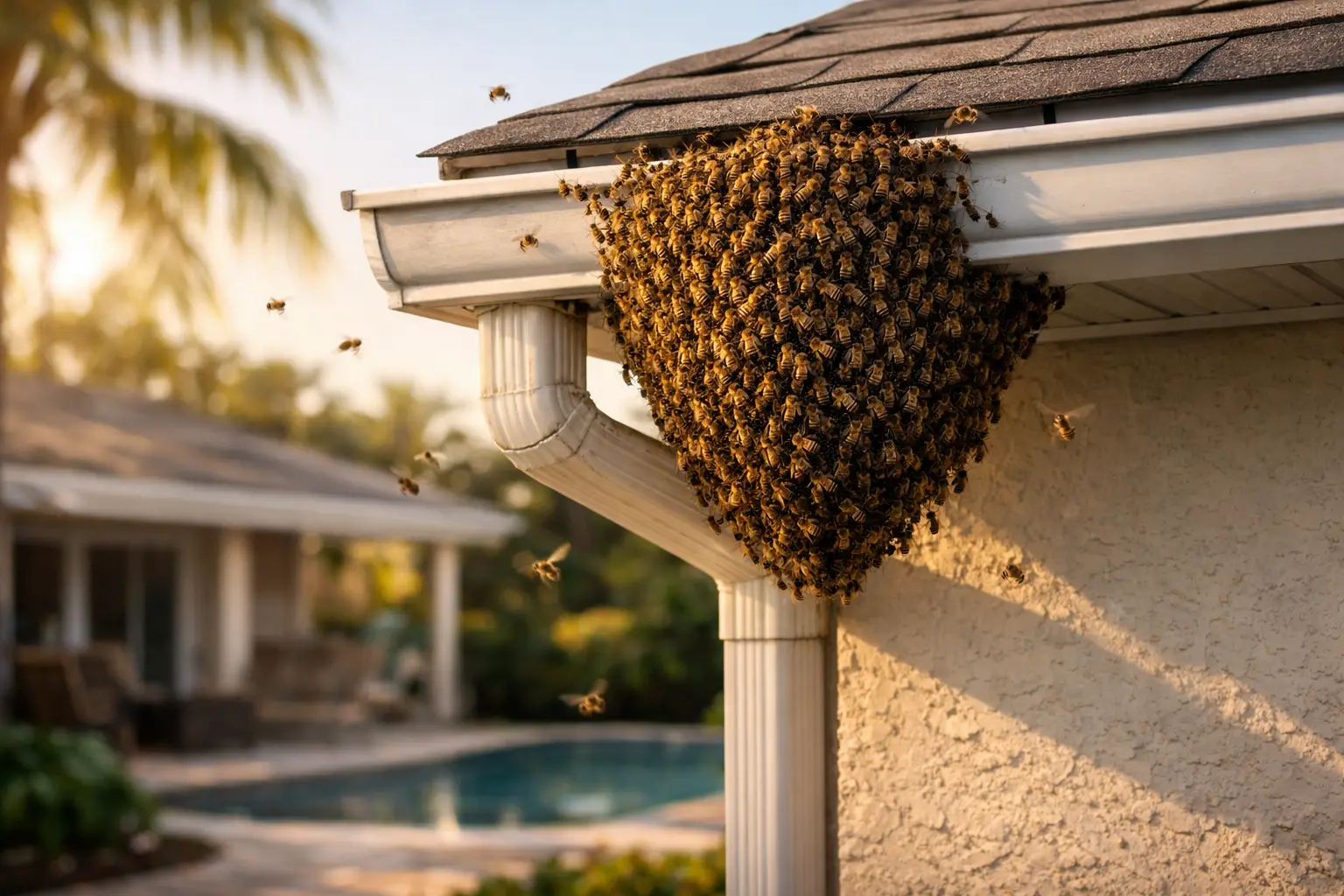

A colony in a clubhouse soffit is not just a nuisance. For an HOA, it can become a claims problem, a resident safety issue, and a building maintenance issue all at once. That is why hoa bee liability management needs to start before someone gets stung, before honey leaks into a wall, and before well-meaning DIY efforts make the colony defensive.
For boards and property managers, the hard part is not recognizing that bees can be risky. The hard part is knowing which risks matter most, what response is reasonable, and when delay creates more exposure than action. Bee activity around shared amenities, mail kiosks, pool equipment areas, entry monuments, and rooflines can put an association in a difficult position where safety, cost, and environmental responsibility all matter.
What HOA bee liability management really means
In practical terms, hoa bee liability management is the process of reducing foreseeable risk tied to swarms, established colonies, and structural bee infestations on common property. It is not only about removing insects. It is about showing that the association acted responsibly once a hazard was reported or discovered.
That distinction matters. A temporary swarm hanging from a tree branch near a walking path presents one kind of concern. A long-established colony inside a wall cavity presents another. The first may be visible and urgent but short-lived. The second may be quieter at first, then become more expensive as comb grows, honey accumulates, and the colony expands deeper into the structure.
An HOA that treats every bee call the same can either overreact or wait too long. Neither approach is ideal. The better approach is to evaluate the location, behavior, access points, occupancy patterns, and structural impact before deciding on next steps.
Where liability usually starts
Most bee-related liability for HOAs does not begin with the insects alone. It begins with notice. Once residents, vendors, or staff report recurring bee traffic in a common area, the association has information suggesting a potentially hazardous condition.
At that point, the question becomes whether the HOA responded in a timely and reasonable way. If a child is stung near the pool gate after repeated complaints about bees entering a wall nearby, the issue is no longer just pest activity. It becomes a record of what the association knew, how it evaluated the risk, and whether it hired a qualified professional.
There is also a second layer of exposure that many boards underestimate: property damage. A live colony inside a building can produce wax, brood, and stored honey. If the bees are killed but the nest remains in place, melting honey can soak insulation and drywall, attract ants and roaches, and create staining and odor problems. In that scenario, a cheap fix can become the expensive one.
The hidden difference between a swarm and a structural colony
Boards are often told, “They are just swarming, so they will leave.” Sometimes that is true. A swarm is typically a cluster of bees temporarily resting while scouts search for a permanent home. Swarms can still be unsafe in high-traffic areas, but they are not the same as a colony established inside a structure.
A structural colony shows consistent flight in and out of a crack, vent, soffit, utility box, roofline, or wall penetration. You may notice bees using the same opening all day. That usually means comb is already being built inside. Once that happens, the issue shifts from relocation alone to removal plus structure-aware cleanup.
This is where many HOA decisions go wrong. If a vendor treats a structural colony like a simple exterior problem, the bees may die but the comb remains. That can lead to secondary damage and future pest activity. Humane live removal is not only an ecological option in many cases. It can also be the more responsible building-management option when done correctly.
Why quick action matters, but panic does not
A fast response is important, especially in shared communities, but speed without assessment can create new problems. Spraying visible bees near an entryway may scatter the colony, increase defensiveness, or leave the nest hidden inside a wall. Blocking the entry hole before removal can force bees into interior spaces.
Reasonable action usually starts with a site inspection, documentation, and immediate safety controls. That may include restricting access to a walkway, posting temporary warnings, or adjusting landscaping or maintenance schedules around the affected area until removal is completed.
For HOAs, the goal is to lower immediate risk while preserving the ability to solve the root problem properly. That balance matters because an association is expected to protect people, but it is also expected to avoid careless remediation that causes preventable building damage.
How to approach HOA bee liability management step by step
The best process is boring on purpose. It creates a clear record and reduces guesswork.
First, document the report. Note where bees were seen, when activity was observed, whether any stings occurred, and whether the area serves children, pets, pool users, or heavy foot traffic. Photos and short videos can help distinguish a swarm from repeated entry into a structure.
Second, assess urgency. Aggressive behavior, repeated stings, or activity in high-use common areas should move quickly. A quiet colony in a remote perimeter wall may still require prompt action, but access control may buy a little planning time. It depends on who could encounter the bees and how likely contact is.
Third, bring in a qualified bee removal specialist, not just a general pest spray approach. For an HOA, this is partly about outcome and partly about defensibility. You want a provider who understands colony behavior, structural access, safe removal, and what must happen after the bees are out.
Fourth, confirm the scope of work. If bees are inside a wall, roof, or soffit, ask whether comb and honey will be removed, whether sanitation is included, and whether exclusion or repairs are needed afterward. Liability does not end when the visible bees disappear.
Fifth, keep records. Board members and managers should retain inspection notes, vendor invoices, recommendations, photos, and communication with residents. If questions arise later, a clean record shows the association responded responsibly.
Vendor selection matters more than many boards realize
Not every company that handles insects is equipped for live bee removal from structures. For HOAs, this distinction is important because shared properties create complex risk. There may be pedestrians nearby, maintenance staff on site, roof access issues, and the need to coordinate with residents.
A qualified provider should be able to explain what type of bee issue is present, what risks exist today, what the removal process involves, and what follow-up repairs or sealing steps are needed. Clear explanations are a good sign. Vague promises of a quick spray-and-go solution are usually not.
In Southwest Florida, where warm conditions support year-round bee activity, delays can also make colonies larger and removals more invasive. Beeswild.com works in this space because rescue and relocation are part of the operating model, not an afterthought. That matters when an association wants a solution that protects both people and the structure.
Prevention is part of liability control
The strongest hoa bee liability management plan is not reactive only. It includes routine attention to the places bees like to occupy. Gaps around utility penetrations, unsealed soffits, damaged vents, hollow monument signs, irrigation enclosures, and aging roof transitions can all become attractive entry points.
This does not mean an HOA needs constant bee patrols. It means maintenance teams and community managers should know what recurring bee traffic looks like and report it early. A small opening with steady bee movement is easier to address than a mature colony that has been active for months.
Resident communication also helps. People do not need a lecture on pollinators when they are worried about their kids. They need simple guidance: do not disturb the area, do not spray, report the exact location, and avoid blocking bee entry points. Calm, practical communication lowers the chance of a bad DIY decision.
The trade-off boards should understand
Every bee situation has trade-offs. Immediate extermination may look cheaper at first, but it can leave behind comb and honey that damage the structure. Full structural removal may cost more upfront, but it often addresses the underlying issue more completely. Temporary barriers may reduce short-term exposure, but they are not a final solution.
That is why one-size-fits-all policies usually fail. A swarm on a tree limb near the perimeter may call for one response. A colony above a mail kiosk or inside a condo wall calls for another. The right decision depends on public access, structural involvement, bee behavior, and how long the problem has likely been there.
For HOA boards, the safest mindset is simple: treat bee reports as a property risk with biological and structural consequences, not as a minor nuisance. When the response is timely, documented, and handled by the right specialist, liability usually becomes much easier to manage.
A good outcome is not just bees gone by the afternoon. It is a community that stays safe, a building that stays intact, and a board that can show it acted with care when it mattered.

No responses yet