
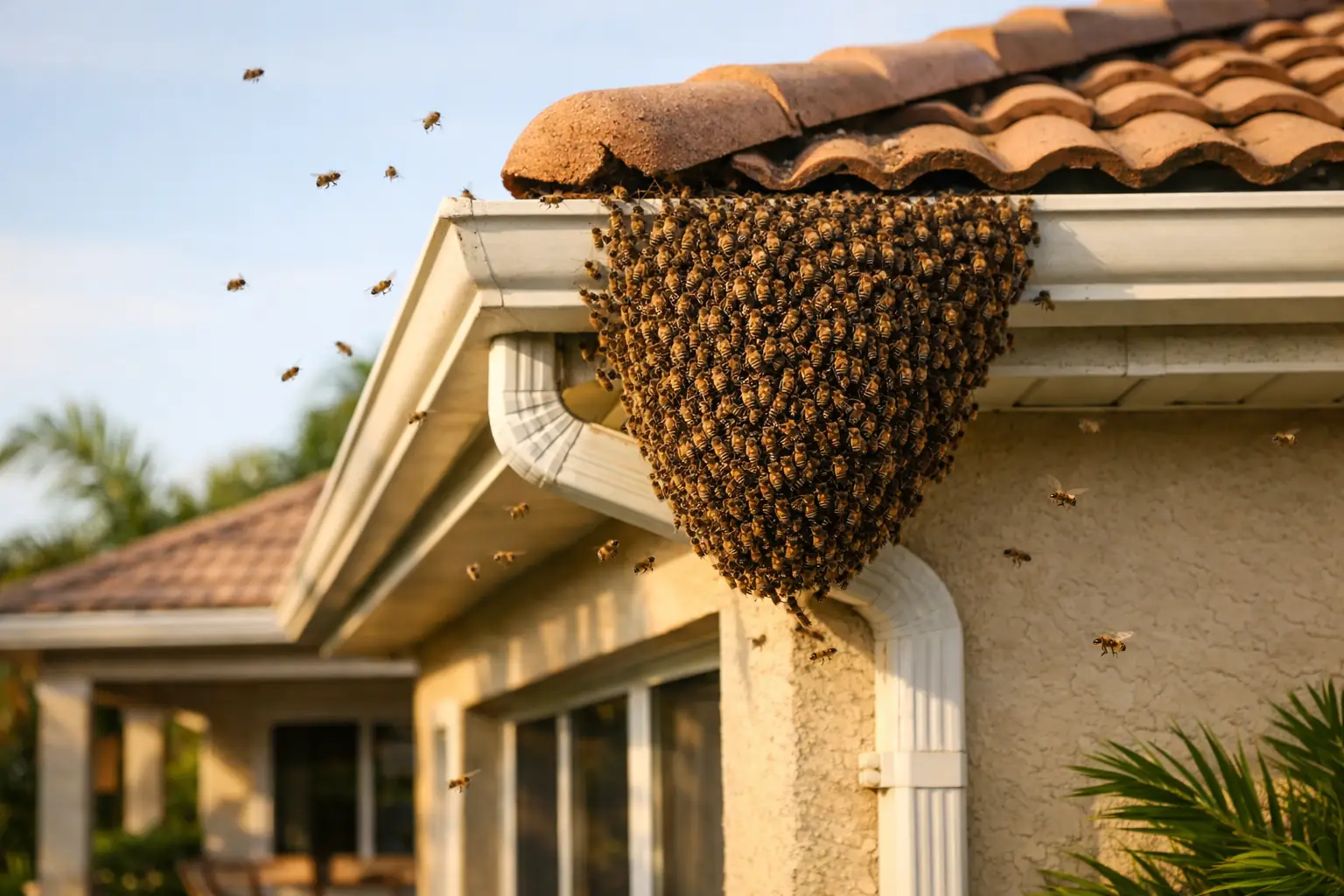

A buzzing wall is easy to ignore for a day or two. Then the sound gets louder, bees start showing up near a soffit or meter box, and suddenly it is not a small problem anymore. If you are searching for bee removal Fort Myers property owners can rely on, the real question is not just how to get bees off your property. It is how to solve the issue without leaving honey, brood, and future damage behind.
In Southwest Florida, bees do not need much encouragement to move in. Warm weather, wall voids, sheds, water meter boxes, rooflines, and hollow block structures can all become nesting sites. A fresh swarm hanging from a tree branch is one situation. A colony that has already built comb inside a wall is something very different.
That difference matters because the wrong response can make the problem worse.
Why bee removal in Fort Myers needs a live, structural approach
Many people call any bee problem a swarm, but not every bee event is temporary. A swarm is usually a cluster of bees resting while scouts look for a new home. In some cases, a swarm can be collected before it enters a structure. Once bees establish inside a wall, soffit, roof, or block column, the job becomes a structural removal.
Structural removal means the colony has to be physically taken out. That includes the bees, the comb, the brood, and the stored honey. If those materials are left inside the structure, they can melt, ferment, attract ants and roaches, stain drywall, and draw in a new colony later.
This is one reason poison is often a poor answer. Killing bees inside a wall does not remove the nest. It leaves behind the very material causing long-term property problems. For homeowners, that often turns a bee issue into a repair issue.
Live removal is different. The goal is to safely remove the colony, extract the comb, clean the cavity as needed, and reduce the chance of reinfestation. For a company rooted in beekeeping and relocation, that approach protects both the structure and the bees whenever conditions allow.
What makes a bee situation urgent
Not every colony is aggressive, but urgency should be judged by location and behavior, not wishful thinking. Bees near front doors, play areas, pool equipment, school walkways, dog runs, or commercial entrances can quickly become a safety concern. A calm colony today can become defensive tomorrow if disturbed by lawn equipment, pressure washing, roofing work, or even heavy vibration.
In Florida, there is also the reality that some colonies may be more defensive than typical managed honey bees. You do not need to identify the strain yourself. If large numbers of bees are entering and exiting a fixed opening, or if bees are reacting strongly to nearby activity, it is smart to treat it as a professional removal situation.
Homeowners usually call when they notice one of three things. They see a cluster of bees that appeared suddenly. They spot steady bee traffic entering a crack or hole. Or they hear humming inside a wall or ceiling. Property managers often notice the same patterns, just with the added pressure of public safety and liability.
Bee removal Fort Myers residents often misunderstand
The biggest misunderstanding is that bees can simply be sprayed and forgotten. That may seem cheaper in the moment, but it often ignores what is happening behind the surface. Honeycomb is architecture. It holds brood, pollen, and honey, and all of it remains in the cavity unless someone physically removes it.
Another misunderstanding is that all bee removal is the same. A visible swarm on a branch is generally simpler than a colony inside stucco, fascia, or cinder block. The tools, time, and repair considerations vary. Accessibility matters. So does height. So does how long the colony has been there.
There is also the question of whether the removal includes same-place prevention. A proper job does not stop with collecting bees. It looks at entry points, leftover scent, and whether the area is likely to be reoccupied. This is where experience matters, because bees tend to prefer locations that already worked once.
That is also why a same-place warranty has real value. If a company offers a 3-month same-place-removal warranty, it shows they understand recurrence is part of the problem, not a separate issue.
What the removal process usually looks like
A professional bee removal begins with identifying where the bees are living, how active the colony is, and whether the structure has to be opened. Sometimes the entry point is obvious. Sometimes the visible bee traffic is only the tip of a much larger nest hidden deeper inside a wall or roofline.
If the colony is established, the removal team usually secures the area first. That protects residents, pets, customers, or staff nearby. The next step is gaining access to the nest with the least destructive opening possible. Once exposed, the bees are collected, the comb is cut out, and the cavity is cleared.
This stage is critical. Leaving comb behind can invite wax moths, ants, beetles, rodents, and future swarms. In hot weather, leftover honey can also liquefy and seep into building materials. A proper cleanup lowers those risks.
After removal, the opening may be closed or prepared for repair, depending on the scope of work and the structure. Some jobs need only minor sealing. Others require coordination with a handyman, roofer, or contractor. Good providers explain this upfront rather than pretending every removal ends with a perfectly restored surface.
Why relocation matters
Honey bees are not just insects on a nuisance list. They are managed livestock in agriculture, essential pollinators, and part of a larger food system. That does not mean they belong in your wall. It means the solution should be smarter than destruction when live removal is possible.
Relocation allows healthy colonies to keep working in a safer setting, often in apiaries where they can be properly managed. For a company that also operates as a honey farm, that is not a marketing angle. It is part of the operating model. The bees are removed from a dangerous or unsuitable site and rehomed where they can survive and contribute.
That said, every situation has limits. Severely compromised colonies, inaccessible locations, or major public safety risks may affect what is possible. Honest bee removal includes those trade-offs. No ethical provider should promise that every colony can be rescued under every condition.
For homeowners, timing is everything
People often wait because the bees seem quiet. The problem is that established colonies grow. What begins as a modest nest can become a larger structural issue with more comb, more honey, and more repair complexity. Waiting can also increase the chance that bees expand into additional cavities.
If bees have just arrived as a visible swarm, acting quickly may make the job simpler. If they are already entering a wall, soffit, chimney, or utility box, quick action still helps limit damage. Either way, early assessment usually gives you better options.
This is especially true if anyone on the property has sting sensitivity, or if the bees are near a routine traffic area. In those cases, a wait-and-see approach is not practical.
For HOAs, businesses, and public properties
Commercial and community properties face a different kind of pressure. A colony near a storefront, sidewalk, clubhouse, school-adjacent area, or maintenance path creates liability even if no one has been stung yet. Residents and customers rarely distinguish between a calm colony and a dangerous one. They see bee activity and assume risk.
That is why response speed and clear documentation matter. Property managers need a vendor who understands structures, can communicate what was found, and can explain why removal is more effective than a quick spray treatment. In shared spaces, preventing repeat occupation matters almost as much as the initial removal.
For municipal or emergency contexts, the stakes are higher. Colonies in high-traffic public areas need controlled handling, not improvised fixes.
Choosing the right bee removal service
When evaluating bee removal in Fort Myers, ask whether the company performs live removals, whether they remove the comb and not just the insects, and whether they understand structural nesting. Ask what happens if bees return to the same location. Ask who handles the bees after removal.
Those questions reveal a lot. A true removal service should be able to explain the biology, the building implications, and the practical limits of the job. If the answers are vague, the work may be superficial.
A bee problem is stressful, but the fix should be clear. Safe containment, real removal, proper cleanup, and relocation when possible is the standard worth looking for. In Southwest Florida, where bees can settle fast and build faster, the best time to address a colony is before your wall starts storing honey.
If you hear buzzing where there should be silence, trust that instinct and get it checked. Fast, humane action protects your family, your structure, and a species worth preserving when it can be moved safely.

No responses yet