
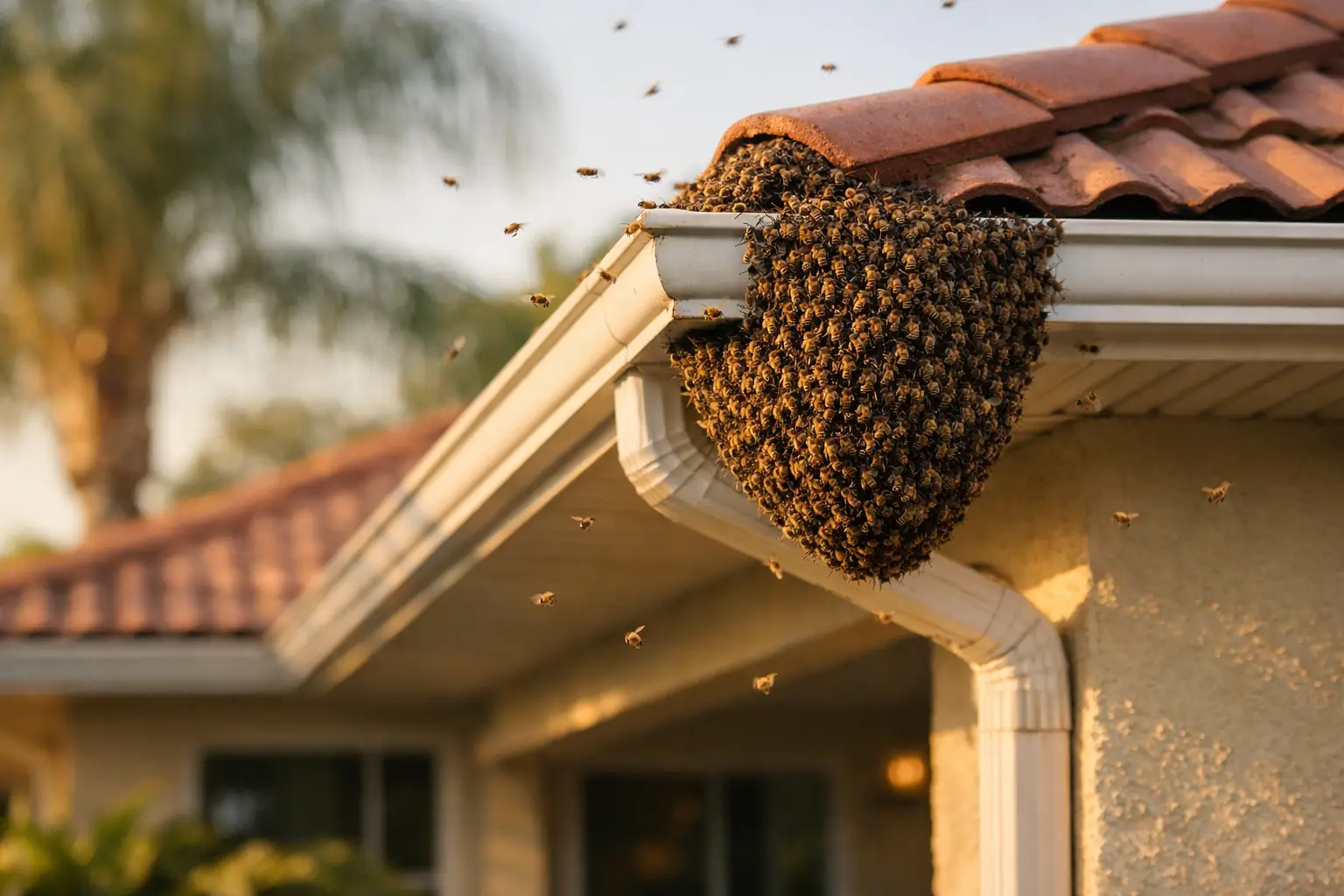

A city crew gets a call about “a lot of bees” near a playground, and within minutes the situation can split in two very different directions. If the insects are simply passing through as a swarm, the risk may be temporary and manageable. If they are defending an established colony near people, pets, sidewalks, or utility areas, the municipal response to aggressive bees needs to be fast, structured, and informed by more than fear.
For municipalities, this is not just a nuisance issue. It is a public safety issue, a liability issue, and in many cases an environmental stewardship issue. The challenge is that those goals can pull against each other. A city has to protect residents right away, but it also needs to avoid reflexive actions that make the problem worse, leave comb inside structures, or destroy pollinators that could have been safely relocated.
Why municipal response to aggressive bees is different
Aggressive bee incidents are not handled well by guesswork. Public works staff, code enforcement, parks teams, police, and fire departments may all be pulled into the first response, yet not all of them are trained to tell the difference between a resting swarm and a defensive colony established inside a wall, tree cavity, utility box, or park structure.
That distinction matters. A swarm is often clustered and relatively calm because it has no brood or stored honey to defend. An established colony behaves differently, especially when disturbed by lawn equipment, vibrations, pruning, construction, or curious bystanders. Municipal crews that treat every bee report the same way can either overreact and waste resources or underreact and expose the public to unnecessary danger.
In regions like Southwest Florida, where warm weather supports year-round bee activity, response planning has to assume that incidents will occur in residential corridors, stormwater infrastructure, school zones, medians, and public recreation spaces. This is one reason local governments increasingly work with specialist live-removal professionals instead of relying on general pest control alone.
What a strong municipal protocol should include
The best response starts before the first emergency call. Municipalities need a written protocol that tells dispatchers, field crews, and supervisors what to do in the first ten minutes, the first hour, and the first day. Without that structure, people improvise, and improvisation around aggressive bees can lead to injuries.
At the reporting stage, staff should gather simple but useful facts. Where are the bees located, and how close are they to regular foot traffic? Are people being stung, or are they only observing flight activity? Did the bees appear suddenly in a hanging cluster, or are they entering and exiting a fixed opening? Has landscaping, mowing, trimming, or construction just taken place? Those details help determine urgency and the right responder.
Initial scene control is often more important than immediate treatment. In many cases, the first municipal action should be creating distance, redirecting pedestrians, restricting access, and stopping the activity that triggered defensive behavior. A park does not always need to be fully closed, but a buffer zone may be necessary until a specialist arrives.
A good protocol also defines what municipal staff should not do. Spraying an accessible cluster without identifying whether a colony is inside a wall, pole, vault, or soffit can leave a much bigger problem behind. Dead bees may be visible, but wax, brood, and honey remain. That residue attracts ants, roaches, rodents, and future swarms. It can also melt and damage structures.
Triage should drive the response
Not every incident requires the same level of intervention. Cities benefit from a tiered system.
Low-risk reports may involve a transient swarm in a low-traffic area, where monitoring or relocation can be scheduled without a full emergency response. Moderate-risk incidents might include colonies near sidewalks, bus stops, or athletic fields where access restrictions are needed until removal. High-risk incidents include active stinging events, repeated attacks, locations near schools or senior housing, or colonies disturbed during utility or maintenance work.
When municipalities classify incidents this way, they use resources more efficiently and communicate more clearly with the public.
The role of humane removal in public safety
There is a persistent misconception that humane removal is a softer option. In practice, it is often the more complete one. Live removal and relocation, when performed by an experienced bee specialist, addresses the colony itself rather than just knocking down visible activity.
That means identifying the nest site, removing bees and comb where feasible, reducing the chance of reinfestation, and relocating viable colonies to managed apiary environments. For municipalities, this approach can reduce repeat calls from the same property or structure. It also aligns public safety with ecological responsibility, which matters in communities that value pollinators but still need practical outcomes.
This is where expertise makes a real difference. A contractor who understands bee behavior, structural access, and safe relocation can make decisions that a general responder cannot. Some situations still call for lethal control, especially when immediate danger is extreme or access makes live removal impossible. But that should be a decision based on site conditions, not panic.
Communication can calm a scene or make it worse
Residents often report bees in emotionally loaded terms. To them, a visible cluster may look like an attack waiting to happen. For municipalities, public communication has to be calm, plainspoken, and specific.
People need to know what to do right now. Move away from the area. Keep children and pets back. Do not throw objects, spray water, or attempt DIY treatment. Report the exact location. If stinging is occurring, seek immediate help and avoid entering vehicles or buildings with bees following.
They also need to know what the city is doing. If a park entrance is temporarily closed or a trail is rerouted, posting a vague warning creates frustration. A short notice explaining that a bee specialist has been dispatched and the area is restricted for safety builds trust. It shows the municipality is responding with purpose rather than simply putting up tape.
Public education reduces unnecessary emergencies
Cities that provide seasonal education often see better outcomes. Residents who understand the difference between swarming and nesting are less likely to provoke bees or flood emergency channels with low-risk sightings. At the same time, they become more likely to report true hazard conditions early, before a routine colony becomes a public incident.
That education does not need to be flashy. It needs to be accurate. Explain that swarms are not automatically aggressive, that established colonies in structures should never be ignored, and that spraying over-the-counter products into a wall void usually creates a larger and more expensive problem.
Vendor selection matters more than many cities realize
A municipality can have a solid internal protocol and still struggle if its outside contractor is not equipped for structural bee work. Aggressive bee incidents often happen in places that are hard to access and harder to restore properly. Light poles, utility boxes, masonry walls, rooflines, soffits, and hollow trees all present different challenges.
The right partner should understand bee biology, public safety procedure, and the mechanics of extracting colonies from structures. Insurance, response time, and documentation matter, but so does the method. If the contractor’s only tool is chemical kill, the city may solve the visible emergency while setting up a second problem that resurfaces days or weeks later.
For municipal and HOA clients in Florida, this is especially relevant because year-round warmth supports colony persistence and repeat occupation. A specialist live-removal company such as Beeswild may be brought in not just to remove bees, but to prevent the cycle of kill, residue, reinfestation, and another emergency call.
What municipalities should document after each incident
Post-incident review is where a city gets better. Every aggressive bee call should generate usable information. Where was the colony found? What triggered the event? How quickly was the area secured? Was there a structural cavity involved? Were there injuries? Did the removal method prevent recurrence?
Over time, that data reveals patterns. A city may discover repeated issues at pump stations, playground shade structures, monument signs, irrigation boxes, or neglected wall voids. Those patterns can guide preventive maintenance. Sealing entry points, adjusting mowing schedules in known hotspots, and training crews to spot early colony establishment can reduce future emergencies.
This kind of documentation also helps with budget conversations. Bee response is often treated as an occasional nuisance line item until one serious incident forces attention. Good records show whether the municipality needs a standing contract, better staff training, or seasonal public notices.
The best municipal response to aggressive bees is balanced
A credible municipal response to aggressive bees protects people first, but it does not stop there. It recognizes that bees are not interchangeable with wasps, and that a colony hidden in public infrastructure is not solved just because activity drops for a day. It also accepts a harder truth: the cheapest immediate action is not always the lowest-cost outcome once repeat calls, property damage, cleanup, and liability are counted.
Cities do best when they build a response system that is clear, fast, and technically grounded. That means smart triage, safe perimeter control, qualified specialists, and enough public education to keep a bee sighting from turning into a preventable emergency. When that framework is in place, municipalities can protect residents without treating every bee as disposable.
The most useful question for any city is not “How do we get rid of bees quickly?” It is “How do we solve the actual risk completely and responsibly?”

No responses yet