
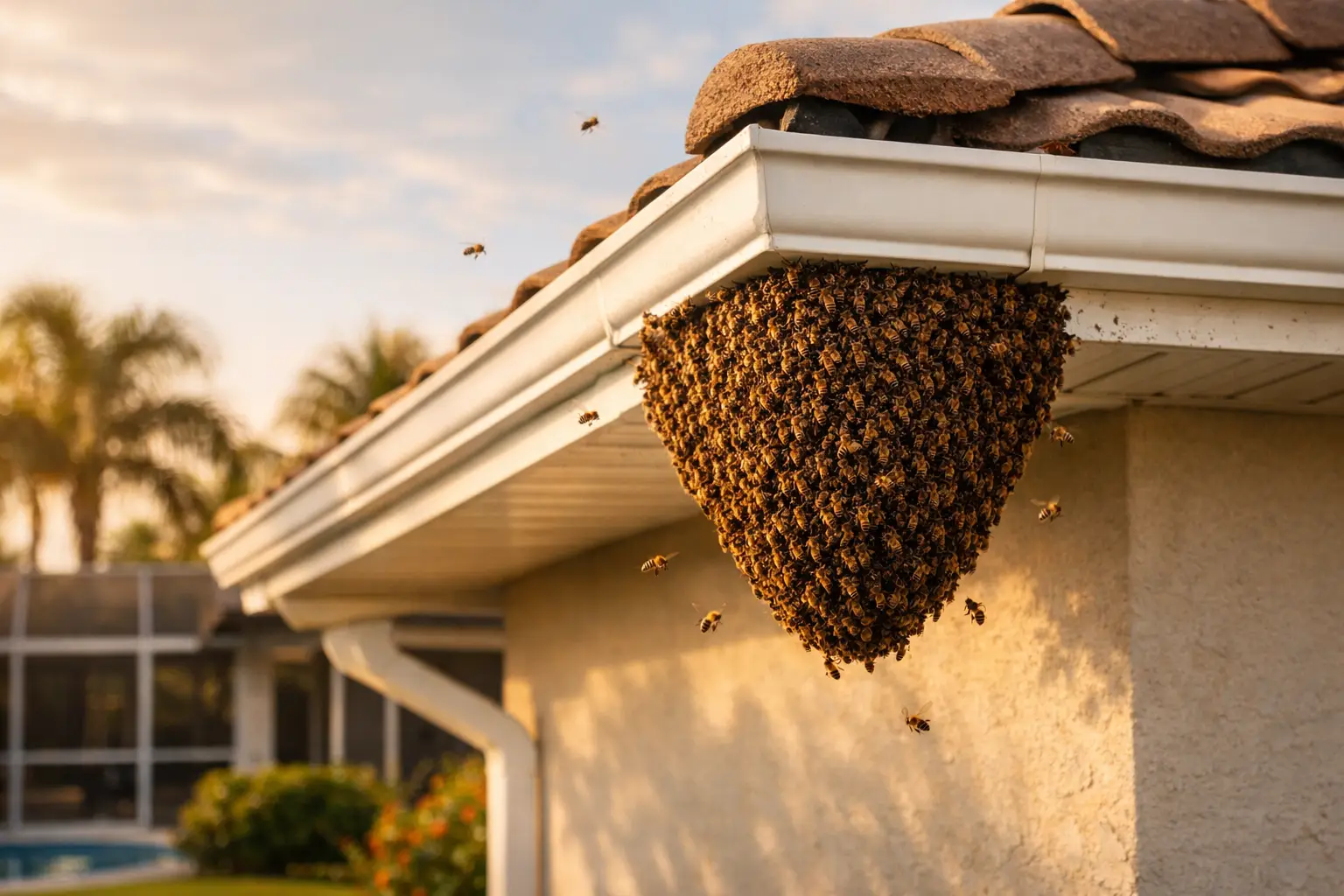

A dark, humming cluster on a palm frond, fence, soffit, or mailbox can be alarming, especially when children, pets, or outdoor guests are nearby. But bee swarm removal Punta Gorda property owners need is not automatically an extermination job. A swarm may be a temporary stop for honey bees searching for a new home, and a careful live-removal response can protect people while giving the bees a chance to continue their essential work.
The first priority is always safety. Keep your distance, bring pets indoors, and avoid trying to spray, knock down, smoke, or hose the bees yourself. The right next step depends on whether you are seeing a resting swarm or an established colony already living inside part of the building.
Is It a Swarm or an Established Colony?
A swarm is usually a visible mass of honey bees hanging outdoors. It can look like a large brown-and-gold football made of moving insects. Swarming is how a healthy colony reproduces: the original queen leaves with part of the workers while scout bees search for a suitable cavity. During this transition, the bees are often focused on finding a home rather than defending one.
That does not mean a swarm should be handled casually. Any group of bees can sting when disturbed, and Southwest Florida has areas where more defensive honey bee genetics may be present. It is impossible to judge a colony’s behavior safely from a distance. Give the bees space and let a trained removal professional assess the situation.
An established colony is different. You may notice a steady flight path of bees entering a crack in a wall, roofline, soffit, utility box, chimney, or tree cavity. There may be visible wax comb, staining near an entrance, a honey-like odor, or activity that continues day after day. Once bees have built comb and stored honey, simply removing the visible insects is not enough.
Why Bee Swarm Removal in Punta Gorda Needs a Different Approach
Punta Gorda’s warm climate and long flowering season can support honey bee activity for much of the year. Buildings also provide tempting nesting spaces. Gaps around soffits, roof penetrations, wall cavities, sheds, and older structures can resemble the protected hollow spaces bees seek in nature.
A temporary swarm hanging in a tree may leave on its own once scouts settle on a new location. If it is isolated, high off the ground, and not near people, observation may be reasonable for a short period. However, a swarm near an entryway, playground, pool area, business patio, or heavily used walkway creates a safety concern and should be evaluated promptly.
Waiting is usually a poor strategy when bees are entering a structure. The colony can expand its comb, store more honey, and create a more involved removal project. The longer a colony remains inside a wall or roof, the greater the possibility of honey leakage, wax moth activity, ants, rodents, odors, or staining after the bees are gone.
The goal of live removal is not merely to make the entrance quiet. It is to remove the bees, queen when possible, comb, brood, and honey stores, then help prevent another colony from moving into the same void.
What Not to Do When You Find Bees
A can of insect spray may seem like the fastest answer, but it can turn a manageable situation into a property problem. Agitated bees may move deeper into a wall, scatter into nearby openings, or defend the area more aggressively. Poison also does not remove wax comb and stored honey from the structure.
Do not seal an active bee entrance before the colony has been removed. Trapped bees may search for another route into the building, sometimes emerging through interior walls, light fixtures, or vents. Sealing too early can also leave honey and comb behind, which can attract other pests.
Avoid amateur vacuuming, burning, smoking, or striking the cluster. These actions place the person doing them directly in the bees’ defensive zone. They can also cause unnecessary harm to a colony that may be safely relocated.
For commercial properties and HOAs, the same caution applies. An employee attempting a quick fix can create a sting risk and complicate the eventual removal. Restrict access to the area, notify occupants as needed, and arrange a professional assessment.
How Humane Removal Protects the Building
A proper structural removal begins with identifying where the bees are living and how far the comb extends. The visible entrance rarely reveals the full size of the colony. Professionals may inspect exterior activity, construction details, and accessible areas before determining the least disruptive way to reach the hive.
When access is necessary, a controlled opening is made in the appropriate exterior surface or interior area. The bees are carefully collected, and the comb is removed from the cavity. This matters because comb contains pollen, brood, wax, and honey. Leaving it behind can lead to melting honey in Florida heat, damage to drywall or insulation, and recurring pest activity.
The cavity is then cleaned as thoroughly as the construction allows. Openings that gave the colony access should be identified for repair or exclusion once bee activity has stopped. The exact repair responsibility can depend on the structure and the removal agreement, so homeowners should ask clear questions before work begins.
Live removal also has an agricultural purpose. Relocated honey bee colonies can be placed in managed apiaries where they have shelter, oversight, and forage opportunities rather than being destroyed as a nuisance. Beeswild.com combines live removal with bee farming, allowing rescued colonies to be rehomed in safe farm areas when conditions permit.
Questions to Ask Before Scheduling Service
Not every bee situation requires the same method, price, or timeline. A qualified provider should be able to explain what they see, what they expect to remove, and what may be required to protect the structure afterward.
Ask whether the bees appear to be a temporary swarm or an established colony. Ask if comb and honey will be removed during a structural job, whether access openings will be created, and who will handle repairs. If the bees return to the same location, ask whether a warranty applies. Beeswild.com offers a three-month same-place-removal warranty, which can provide added reassurance when a previously active area needs follow-up.
It is also reasonable to ask about urgency. A high, isolated swarm may allow for scheduled service, while bees near a doorway, occupied building, school area, or public space may need faster attention. If anyone has been stung repeatedly or the colony is behaving defensively, keep people away and treat the situation as urgent.
Protecting People While the Bees Are Still There
Until removal is complete, create a buffer around the area. Close nearby windows, keep lawn crews and contractors away, and postpone activities that create vibration or noise near the colony. Power equipment, ladders, pruning, and pressure washing can provoke defensive behavior.
If bees are using an entrance near a door, use another entrance whenever possible. For a business, place clear temporary notices and redirect foot traffic. For an HOA or community space, restrict access instead of asking residents to inspect the colony themselves.
A few bees visiting flowers, water sources, or fruit trees are not the same as a nesting problem. Honey bees foraging across a yard are generally best left alone. Removal is appropriate when a swarm or colony is creating a direct safety concern or occupying a structure where it can cause damage.
A calm response gives both people and bees a better outcome. Keep your distance, avoid quick chemical fixes, and have the location evaluated before a temporary swarm settles into a wall or roof. Acting early can preserve the building, reduce risk around the property, and give a working honey bee colony a safer place to live.

No responses yet