

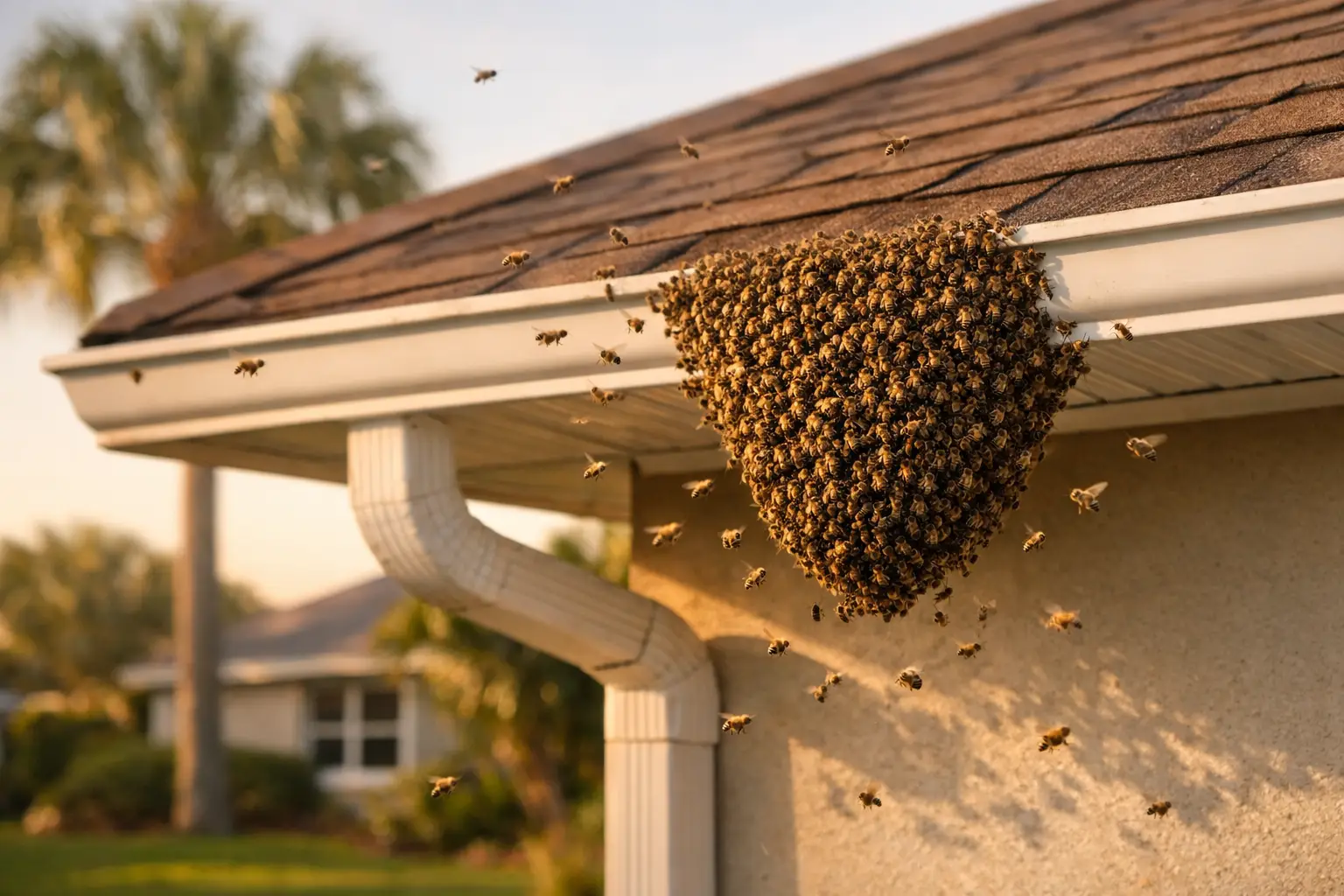

A can of bug spray feels like a fast answer when bees show up near your door, roofline, or pool cage. But if you’re wondering what happens if you spray bees, the real answer is usually more complicated – and more expensive – than most people expect.
For a few minutes, spraying may seem to solve the problem. Some bees may die. Others may scatter. The nest might go quiet. Then the next phase begins: agitated survivors, hidden comb left inside the structure, melting honey, dead brood, and a colony problem that often comes back in a different form. For homeowners and property managers, that is where the real risk starts.
What happens if you spray bees right away
If you spray a cluster of bees on the outside of a building, the first effect is stress and disruption. Depending on the product, some bees die quickly, some become disoriented, and some fly off before the spray reaches them. That sounds straightforward, but bee colonies are not like a few wandering insects on a patio. If there is a hive inside a wall, soffit, chimney, shed, or roof cavity, the visible bees are only a fraction of the problem.
When bees detect a threat, they can become defensive. That does not mean every colony will instantly attack, but spraying absolutely raises the chances of a dangerous response. This matters even more if the colony is large, the entrance is near a walkway, or the bees have already been established for a while. In Southwest Florida, warm weather allows colonies to grow fast, and a large colony can contain thousands of bees.
There is also the issue of incomplete kill. Consumer sprays rarely solve a structural hive cleanly. You may hit foragers at the entrance while the queen and much of the colony remain protected deeper inside. If the queen survives, the colony may recover. If she dies, the remaining bees may still linger while the wax, honey, pollen, and brood stay in place inside the structure.
Why spraying bees often makes a property problem worse
The chemical is only one part of the story. The bigger issue is what gets left behind.
A live colony builds wax comb packed with honey, pollen, and developing brood. Once bees are killed without a full removal, that material remains in the wall or ceiling void. In Florida heat, comb can soften and collapse. Honey can leak through drywall, stucco, soffits, or trim. It can stain surfaces and create odors. It can also attract ants, roaches, rodents, and other insects looking for sugar or protein.
Dead bees inside a cavity create another sanitation problem. At first, homeowners notice fewer bees outside and think the situation is fixed. A week or two later, they may see dark seepage, smell fermentation, or hear other pests moving into the same void. This is one reason poison treatments often seem cheaper on day one and much more expensive by day thirty.
There is another trade-off. Removing a live colony allows a professional to take out the bees, the comb, and the attractants. Spraying typically addresses only the insects you can reach, not the physical hive materials causing the long-term damage.
Spraying bees outside is different from spraying a hive inside a structure
Not every bee situation is the same. A resting swarm hanging on a tree branch is very different from an established colony inside a block wall.
A swarm is usually in transit. These bees are searching for a permanent home. They often appear suddenly and can look alarming, but many swarms are relatively calm compared with a colony defending brood and honey. Spraying a swarm destroys a colony that may not even be established yet, and it removes the chance to relocate it safely.
A structural colony is the more serious building issue. These bees have moved in, started comb, and invested in the space. If you spray the entrance and leave the hive behind, you have not removed the real source. In fact, you may make later removal more difficult because disturbed or dying bees can retreat deeper into the void.
That is why professionals evaluate where the bees are, how long they have been there, how active they are, and whether comb is already present. The right response depends on the biology of the colony and the construction of the building.
Safety risks people underestimate
The obvious risk is stings. But there are several less obvious ones.
The first is exposure during application. Most over-the-counter insecticides are not meant to be sprayed casually around occupied spaces, HVAC intakes, children, pets, or food areas. If a nest is near a front entry, playground, dog run, restaurant patio, or pool equipment area, the hazard is not just the bees. It is also the chemical and the possibility of forcing defensive behavior in a public space.
The second risk is falling or structural injury. People often try to spray bees from ladders, rooftops, or attic openings. A defensive colony plus poor footing is a bad combination.
The third is misidentification. Many people say “bees” when they are actually seeing wasps, hornets, bumble bees, or honey bees. Treatment decisions should change based on the insect. Honey bees are valuable pollinators and livestock. They also leave behind substantial comb and honey in structural spaces, which makes proper removal especially important.
What happens after the bees die
This is the stage most DIY articles skip.
Once a colony is poisoned, the surviving workers stop maintaining temperature and order in the hive. Brood dies. Wax can sag. Honey becomes vulnerable to fermentation, leakage, and scavengers. If the cavity is accessible to robber bees from another colony, you can trigger a new wave of bee activity as outside bees arrive to steal the honey.
Even if the first colony is gone, the scent of old wax and honey can attract another swarm later. Bees are drawn to places that have successfully housed bees before. So a sprayed colony can turn into a repeat infestation if the comb is not removed and the access point is not sealed correctly.
That is the practical difference between killing bees and solving a bee problem. They are not the same thing.
Why live removal is often the smarter fix
Live removal is not about sentimentality. It is a building and land-management decision.
A proper live removal process focuses on getting the colony out, removing comb and honey, and reducing the chance of reinfestation. That usually means identifying entry points, opening the affected area if needed, vacuuming or gently collecting the bees, cutting out comb, cleaning the cavity, and repairing or sealing access routes. When the colony can be relocated, the bees continue serving an agricultural purpose instead of being wasted.
For homeowners, the advantage is cleaner resolution. For HOAs, restaurants, retail sites, and municipalities, the advantage is liability control and documented corrective action. A dead hive hidden in a wall is not a clean outcome just because the flying activity stopped for a while.
This is where a company like Beeswild has a practical edge. A bee farmer and live remover looks at both sides of the issue: public safety today and colony preservation where possible. Those goals are not in conflict when the work is done correctly.
When spraying might still be discussed
There are cases where chemical intervention enters the conversation. If bees are highly aggressive, located in a dangerous public area, or part of an emergency response where immediate threat reduction is necessary, a professional may have to consider all available tools. But that decision should be made by someone trained to assess colony behavior, access, exposure, and post-treatment cleanup.
That is the key point: even when chemicals are involved, the responsible approach still accounts for the hive material, the structure, and public safety. The problem is not just whether bees are alive at the entrance. The problem is everything behind that entrance.
What to do instead of spraying bees
Start by keeping distance and limiting traffic near the area. Bring children and pets inside. Do not block the entrance with foam, tape, or caulk, because trapped bees often find another way into living spaces.
Watch from a safe distance and note where bees are entering and leaving. A photo or short video taken from far away can help a removal professional determine whether it looks like a swarm or an established colony. If the bees are on a structure, especially a wall, soffit, roofline, meter box, or shed, assume there may be comb inside.
Then call a live bee removal specialist, particularly one experienced with structural removals. In Southwest Florida, speed matters because heat accelerates damage once a colony is disturbed or killed. The sooner the situation is assessed, the more options you usually have.
If you are allergic to stings, or if the colony is near a doorway, school area, mail kiosk, or commercial entrance, treat it as a safety issue and keep people away until it is professionally handled.
Spraying bees may feel decisive in the moment, but quick action is not the same as the right action. The best outcome is not just fewer bees in sight – it is a safer property, less hidden damage, and a solution that respects the fact that honey bees are worth removing properly.

No responses yet