
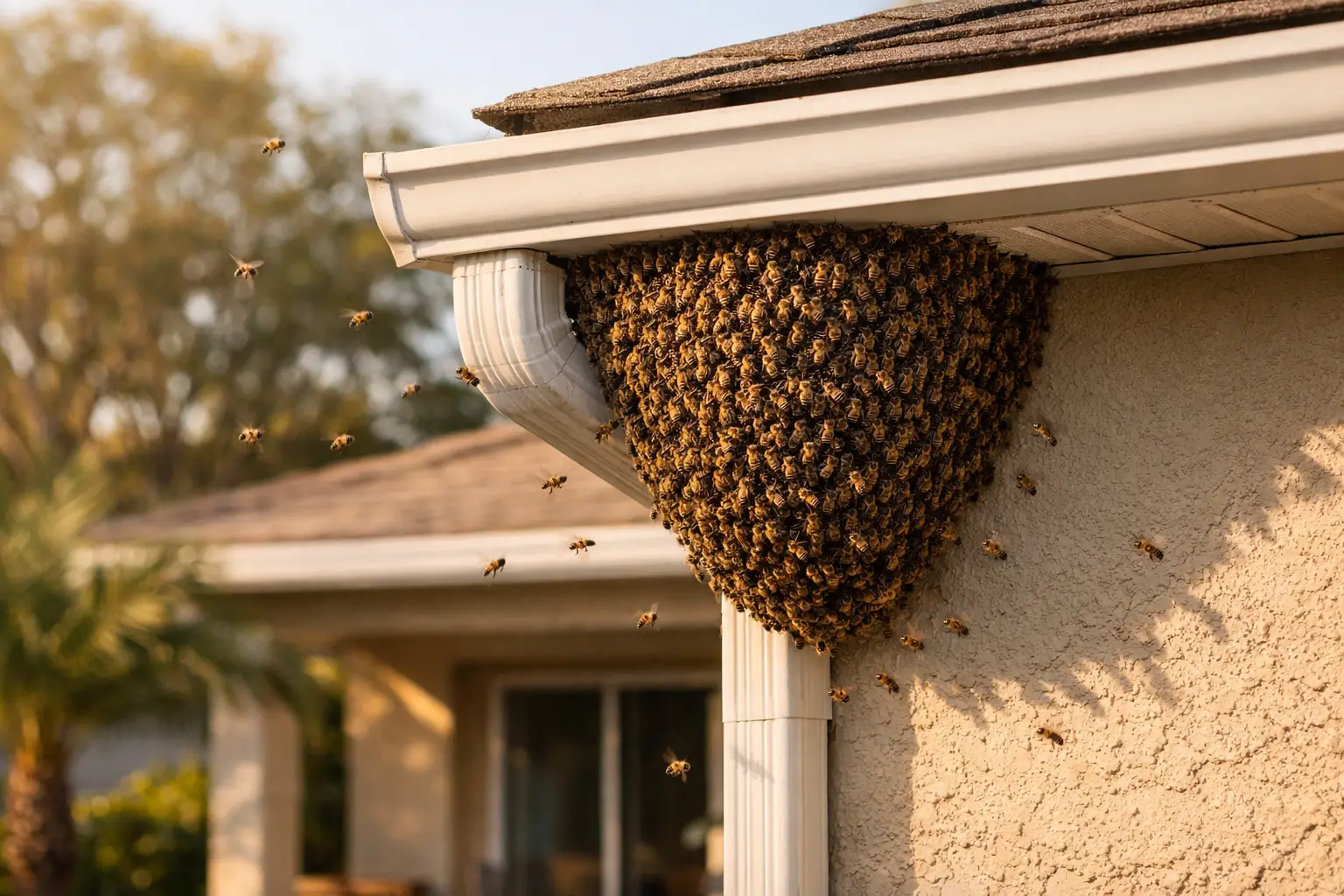

A colony in a soffit usually announces itself late. At first, you notice a few bees tracing the roofline. Then traffic builds at one corner vent or gap, and by the time the sound is audible from below, the hive is already established inside the structure. A good soffit hive relocation example helps homeowners understand what is really happening behind the fascia and why the right response is not spraying, sealing, or waiting.
In Southwest Florida, soffits are a common nesting site because they offer shade, dry cover, and small entry points. From the outside, the problem can look minor. Inside, it can involve comb attached to roof decking, insulation contamination, stored honey, brood, and a queen deep in the cavity. That difference between what you see and what is actually there is why humane relocation has to be handled as a structural removal, not a surface treatment.
A real-world soffit hive relocation example
Picture a single-story home where the owners noticed steady bee activity near the front corner of the roof overhang. The bees were entering through a gap where the soffit panel met the trim. There were no bees inside the living room, no dripping honey, and no obvious damage yet. That often leads people to think the colony is new. Sometimes it is. Sometimes it has been building quietly for weeks.
The first step is inspection, and inspection is more than confirming that bees are present. The removal team needs to read flight patterns, identify access points, estimate colony size, and determine how far the hive may run inside the cavity. Thermal tools, listening, and experience with building layouts all matter here. A soffit can connect to fascia channels, roof returns, or adjacent voids, so a small entrance does not always mean a small hive.
Once the colony is mapped, the access plan is built around two goals – protect people and preserve the bees. That means setting up the work zone, controlling bee flight during the opening, and choosing the section of soffit to remove so the colony can be reached cleanly. Guesswork creates more damage, while accurate access keeps the opening as limited as possible.
Why a soffit hive cannot be solved from the outside
This is the part many property owners do not hear until after a failed treatment. Spraying the entrance may kill some bees returning and leaving, but it does not remove wax, brood, honey, or the queen if the application does not reach the core of the nest. Even if the colony collapses, the structure is still left with comb and stored honey inside it.
That leftover material causes the next round of problems. Honey can melt and stain ceilings or walls. Wax and brood attract ants, roaches, beetles, moths, and rodents. Residual odor can also attract a new swarm looking for a cavity that already smells like a suitable nest site. In other words, a quick kill often turns one bee problem into a building problem.
With soffit colonies, sealing the entrance without removing the hive is just as risky. Foragers can end up searching for another way out and appear inside the house. If the colony remains trapped, heat and decay inside the cavity can create a sanitation issue fast. Full removal is the standard because the goal is not only to stop bee traffic today, but to leave the structure clean enough that the same location does not become a repeat site.
How live relocation usually works
After the work area is secured, the soffit section is opened carefully to expose the hive. At that stage, the difference between a handyman approach and a bee removal specialist becomes obvious. Comb is fragile, often heavy with honey, and usually attached in layers. It has to be cut out methodically so brood comb can be preserved and the queen can be recovered or retained with the cluster.
Adult bees are collected using methods designed for live relocation rather than extermination. The brood comb that is still viable is placed into frames so the colony has continuity after transport. Honey comb that cannot be saved is removed from the structure and separated from salvageable brood. Every piece of attached comb has to come out. Leaving behind even a section can still attract pests and future bees.
Then comes the part homeowners rarely see discussed online – cleaning the cavity. Residual wax, honey, propolis, and bee scent should be scraped and cleaned from the nesting area as thoroughly as the structure allows. If this step is skipped, the job is incomplete. Once the cavity is clean, repairs can begin or the opening can be made ready for repair, depending on who is handling finish work.
When relocation is done properly, the rescued colony is transferred to a managed apiary or safe bee yard where it can stabilize and continue functioning. That is a major difference from standard pest control. The bees are treated as livestock worth preserving, not disposable insects.
What affects the difficulty of a soffit hive relocation example
Not every soffit job is equal. A small colony in an easily accessible overhang is very different from a mature hive that has spread along a second-story eave above landscaping, pool cages, or power lines. Height changes access needs. Heat changes bee behavior. Roof pitch and trim style affect how cleanly the structure can be opened.
Colony age matters too. A newer colony may have less comb and honey stored. An older one can contain significant weight, more defensive behavior, and more contamination inside the cavity. If there has already been an attempted spray treatment, the removal may be more complicated because comb can break down, bees may be agitated, and dead material may already be decomposing inside the soffit.
This is also where public safety enters the picture. In Florida, defensive honey bee behavior cannot be treated casually. If a colony is near a front door, walkway, school route, restaurant patio, or shared HOA space, the urgency goes up because foot traffic raises sting risk. The right plan depends on location, colony temperament, and structural conditions, not just the number of bees visible at the entrance.
What homeowners should expect after the hive is removed
A complete removal should reduce active bee traffic quickly, but a few returning foragers may circle the area for a short time. That is normal. They are orienting to the old entrance and will fade once the colony and scent source are gone. What should not happen is a steady stream of new traffic days later. That can signal missed comb, a secondary access point, or an incomplete removal.
Owners should also expect honest conversation about repairs and prevention. If the gap that allowed entry is not corrected, another swarm can move into the same zone later. Bee-proofing is not complicated in theory, but it has to be precise in practice. Small construction gaps around soffits, fascia lines, vents, and roof returns can all become entry points.
A professional should explain whether the cavity was fully cleaned, whether all comb was removed, and what follow-up signs to watch for. This is also where warranty terms matter. A same-place removal warranty has value because it reflects confidence that the structure was not just emptied, but properly cleared and addressed.
The lesson behind any good soffit hive relocation example
The real lesson is simple: once bees move into a soffit, the job is no longer just about insects. It becomes a structure, sanitation, and safety issue at the same time. Humane relocation works because it addresses the whole system – the bees, the comb, the honey, the cavity, and the entry point.
That is why waiting usually increases cost and complexity. A colony does not pause because the exterior looks quiet for a day or two. It keeps building. If you are seeing regular bee traffic at a roof overhang, especially near one corner or seam, treat that as a structural nest until proven otherwise.
For homeowners, managers, and HOA boards, the best next step is not panic and not DIY spray. It is getting the hive evaluated by a live removal specialist who understands both bee biology and building cavities. When the colony is removed correctly, the property becomes safer and the bees still get a future somewhere they belong.

No responses yet