
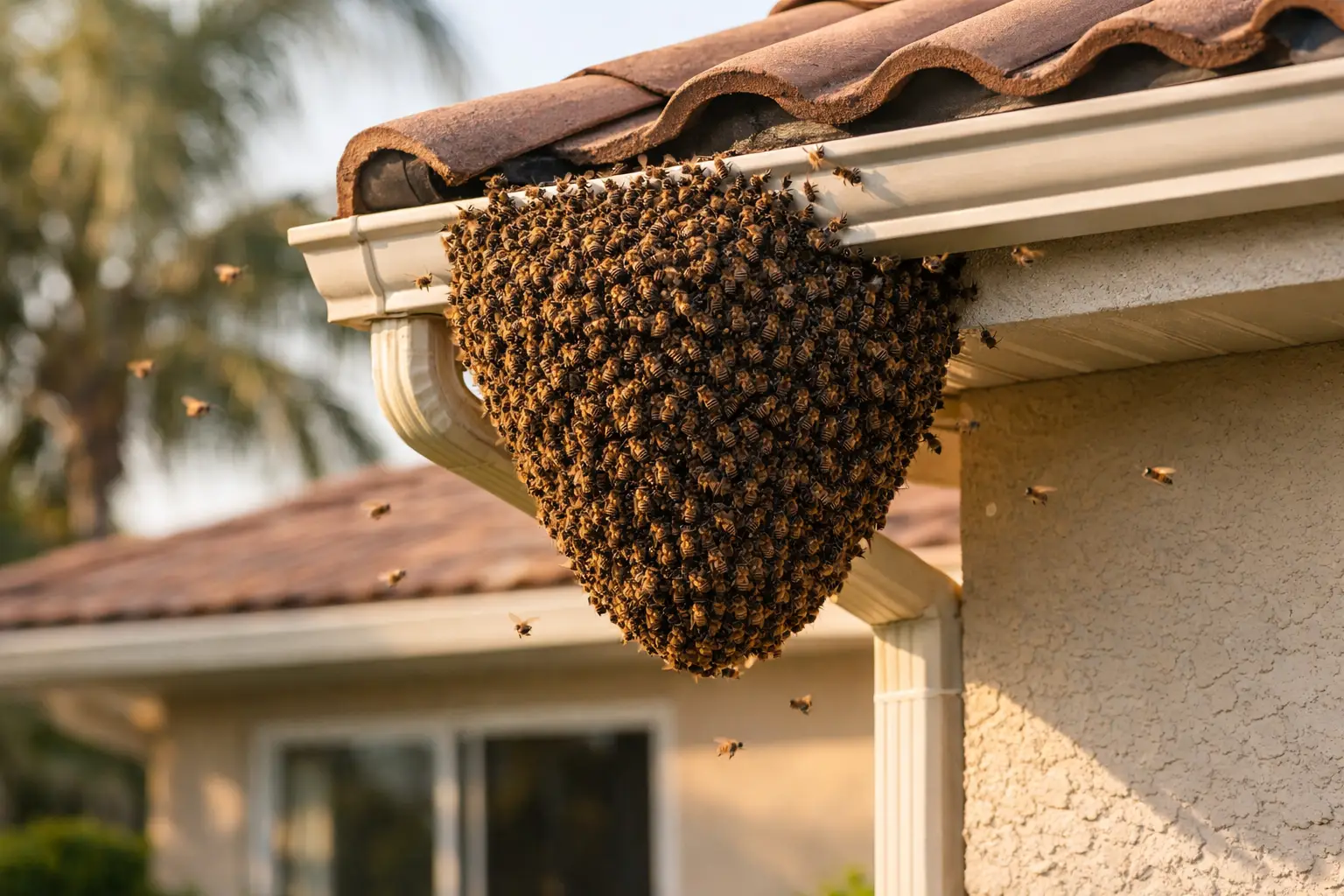

A dark, buzzing cluster in a tree can make any homeowner stop in their tracks. Knowing how to identify a bee swarm helps you respond calmly, protect your family and pets, and avoid destroying honey bees that may only be resting briefly before moving on.
A swarm is not the same thing as an established hive inside a wall, soffit, or roofline. The distinction matters. A temporary swarm often needs space and time, while an established colony needs professional removal before wax, honey, and bees cause structural problems.
What a Bee Swarm Looks Like
A honey bee swarm is a large group of bees gathered tightly around their queen. From a distance, it often resembles a brown or black mass shaped like a football, teardrop, or oversized pinecone. It may hang from a tree branch, shrub, fence, mailbox, outdoor furniture, or the edge of a structure.
The cluster can range from the size of a grapefruit to the size of a basketball or larger. Thousands of bees may be present, but most will be concentrated in one visible clump. Individual bees fly in and out of the cluster, creating a noticeable hum and a small cloud of activity around it.
A swarm typically appears suddenly. One day the branch is bare; the next, it holds a living mass of bees. This happens when a mature honey bee colony divides. The old queen leaves with part of the worker population while a new queen develops in the original colony.
How to Identify a Bee Swarm Instead of a Colony
The clearest sign is whether the bees are clustered outside in the open or entering a protected space.
A swarm is usually exposed and temporary. Bees gather around the queen while scout bees search for a permanent nesting site. They may remain in one spot for several hours, a few days, or occasionally longer if weather conditions interfere with their move.
An established colony has a consistent entrance. You may see bees repeatedly flying into and out of a gap in a wall, roof, attic vent, chimney, tree cavity, utility box, or soffit. Their flight path is often direct and purposeful, especially during warm daylight hours. A colony may be difficult to see because most of the bees, brood, comb, and honey stores are concealed inside the structure.
Listen as well as look. A colony inside a wall can create a low buzzing sound, particularly near an active entrance. You may also notice wax staining, honey seepage, or a sweet odor around the affected area. Those signs call for live structural bee removal, not a wait-and-see approach.
A swarm has no visible comb
A newly formed swarm is bees hanging together. It does not have exposed honeycomb, stored honey, or a permanent entrance. If you can see comb attached beneath a roof edge, inside a shed, or in a tree cavity, the bees have likely been there long enough to establish a colony.
That difference is more than cosmetic. Removing visible bees without removing the comb, brood, and honey from an established colony can leave behind material that attracts pests, causes odors, and invites another bee colony to move into the same void.
How to Tell Honey Bees From Wasps, Hornets, and Yellow Jackets
Not every buzzing insect cluster is a honey bee swarm. Honey bees are typically fuzzy, oval-bodied insects with golden brown and black banding. Their bodies look softer and less shiny than those of wasps.
Wasps, hornets, and yellow jackets usually have smoother, narrower bodies with a defined waist. Their coloring is often bright yellow and black, although some species appear reddish or brown. They build papery nests rather than wax comb, and they do not form the classic hanging cluster associated with a honey bee swarm.
A few clues can help from a safe distance:
- Honey bees often gather in a dense, calm-looking cluster around a branch or object.
- Yellow jackets commonly fly into a hole in the ground, a wall opening, or a small void.
- Paper wasps build open, umbrella-shaped paper combs under eaves and porch ceilings.
- Hornets and some wasps build enclosed gray or tan paper nests that resemble large paper balls.
Do not get close enough to inspect insects by hand. A clear photo taken from a safe distance can help a qualified bee professional identify what you are seeing.
Why a Bee Swarm Is Often Less Aggressive Than It Looks
A swarm can look alarming because of its size and sound, but swarming honey bees are often focused on protecting their queen and locating a new home. Unlike an established colony, they have no honey stores, brood nest, or permanent comb to defend.
That does not mean a swarm is harmless. Bees can sting if they are squeezed, swatted, sprayed, disturbed, or if someone gets too close to the cluster. Children, pets, and people with known sting allergies should stay well away. In Southwest Florida, where Africanized honey bee genetics can be a concern, behavior cannot be judged reliably by appearance alone. Treat every unidentified bee cluster with respect and give it plenty of space.
Avoid the common impulse to knock down the cluster with a broom, blast it with a hose, or spray it with insecticide. These actions can scatter bees, increase defensive behavior, and kill valuable pollinators. They can also turn a temporary outdoor swarm into a problem inside a wall or attic if bees seek nearby shelter.
What to Do When You Find a Bee Swarm
Start by creating distance. Keep people and pets away from the immediate area, and avoid mowing, trimming, pressure washing, or using loud equipment near the bees. If the swarm is low to the ground, close to a doorway, near a pool, or in another high-traffic location, treat it as a prompt safety concern.
Next, observe without disturbing it. Note where the bees are clustered, whether they are entering a crack or opening, and whether you see comb. This information helps determine whether it is a temporary swarm or an established colony.
If the bees are on a branch far from activity, a short period of observation may be reasonable. Some swarms leave on their own once scouts find a suitable site. But waiting has limits. A swarm near a house may choose a wall cavity, roof void, or soffit as its next home. Once that happens, removal becomes more involved because the colony can begin building comb and storing honey.
For swarms near homes, businesses, schools, shared HOA property, or public areas, contact a live bee removal professional. A trained beekeeper can assess the insects, safely collect a honey bee swarm when possible, and relocate it to an appropriate apiary environment.
When It Is an Urgent Removal Situation
Call for professional help promptly if bees are clustered near an entrance, playground, outdoor dining area, pool, walkway, or pet enclosure. The same applies when bees are entering a building, gathering around an electrical box, or appearing in large numbers around a wall or roofline.
Take extra care if anyone nearby has a severe bee-sting allergy. Do not attempt a do-it-yourself removal to save money or time. Even a small mistake can cause bees to spread into inaccessible areas of the property.
Commercial property managers and HOA boards should document the location, restrict access if needed, and arrange an inspection. A visible cluster may be a swarm, but repeated traffic into the same building opening points to a colony that needs complete removal and proper repair or exclusion afterward.
The Best Outcome for Bees and Your Property
Honey bees are valuable agricultural pollinators, but they do not belong in structural voids or heavily used outdoor spaces. The goal is not simply to make bees disappear. It is to identify what is present, protect people from unnecessary risk, and prevent damage caused by an established colony.
If you are in Cape Coral or the surrounding Southwest Florida area, Beeswild can assess whether you have a temporary swarm, a honey bee colony, or another stinging insect issue and pursue a humane relocation when appropriate. A calm response and an early inspection give both your property and the bees the best chance of a safe outcome.

No responses yet