
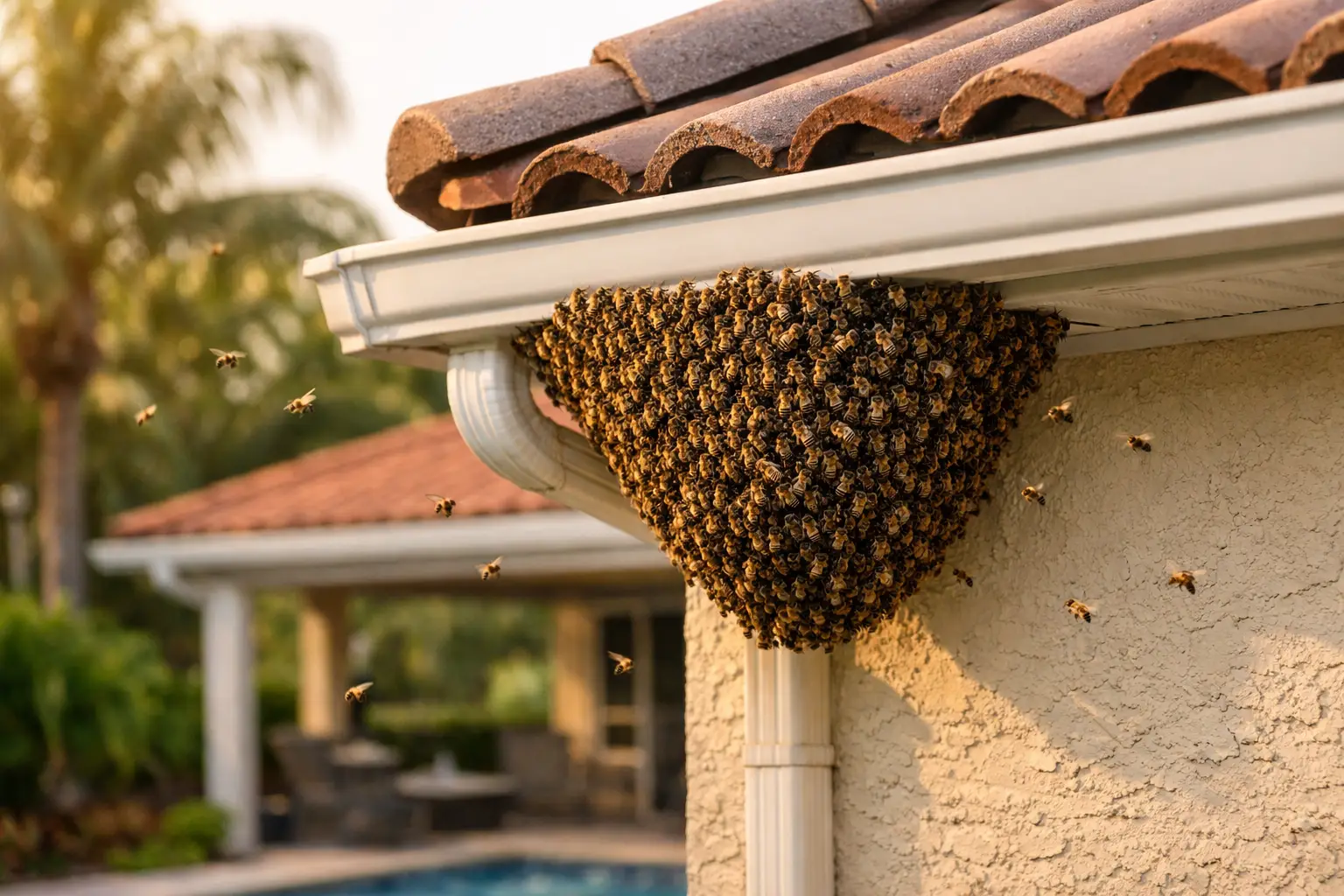

A colony in a clubhouse soffit is not simply a landscaping complaint. For an HOA board, it can become a resident-safety concern, a building-maintenance issue, and a liability question at the same time. Effective bee removal for HOA communities addresses all three without treating a living colony as disposable.
The distinction matters in Southwest Florida, where warm weather allows bees to establish colonies in wall cavities, rooflines, utility boxes, pool equipment enclosures, and community common areas. A few bees around flowering plants may be normal and beneficial. A steady flight path into a structure, bees entering through a crack, visible comb, or honey staining is different. Those signs call for a prompt professional evaluation.
Why HOA Bee Issues Need a Different Response
An individual homeowner may only be responsible for one exterior wall or a detached shed. An HOA often manages shared roofs, gates, mail kiosks, recreational buildings, perimeter features, and landscaping used by hundreds of people. That broader responsibility changes how a removal should be planned and documented.
Boards need a clear record of the reported location, the professional assessment, the work authorized, and the outcome. They also need a vendor who understands that removing bees from a building is not the same as spraying insects from a bush. If a colony is living inside a wall, the bees, comb, honey, and entry point all need attention.
The urgency depends on the location and behavior of the colony. Bees established high on an unused structure may allow for scheduled work with appropriate safety controls. Bees near a pool entrance, playground, pedestrian walkway, or outdoor dining area require faster action. A colony that becomes defensive when people pass nearby should be treated as a safety priority, especially where children, pets, maintenance staff, or residents with sting allergies may be present.
Bee Removal for HOA Communities Starts With Identification
Not every flying insect reported as a bee is a honey bee. Wasps, hornets, and yellow jackets have different nesting habits and require a different control approach. Honey bees are typically fuzzy, brown-and-gold insects that travel in a deliberate line between their colony and a food or water source. A swarm may cluster temporarily on a tree branch, fence, or sign while scout bees search for a permanent home.
A swarm is often less complicated than an established colony because it may not yet contain comb, honey, or brood. It still should not be disturbed by residents or staff. Spraying a swarm can provoke the bees, scatter them, and eliminate a colony that could otherwise be safely collected and relocated.
An established colony is more involved. Bees that repeatedly enter the same small opening in a soffit, stucco wall, chimney chase, or roof intersection are likely living inside. The longer a colony remains in a structural void, the more comb and honey it can build. That increases the chance of staining, melting honey, wax moth activity, ants, roaches, rodents, and secondary bee infestations after the original bees are gone.
Why Poison Alone Often Creates a Building Problem
Chemical treatment may kill bees, but it does not remove the material they leave behind. Dead bees, brood, wax comb, and stored honey remain inside the cavity. In Florida heat, honey can soften and leak into insulation, drywall, or exterior finishes. The scent can attract other pests, and a future swarm may be drawn to the same unsealed cavity.
This is why a live structural removal is often the more complete solution. A qualified bee removal professional opens the necessary access area, removes the colony and comb, cleans the cavity as practical, and closes the bee entry point. The objective is not merely to stop visible activity for a few days. It is to correct the conditions that make repeat occupation likely.
A Practical HOA Response Plan
The best HOA response begins before an emergency call. Property managers and maintenance teams should know who receives bee reports and what information to collect. A resident should never be expected to investigate a colony, take a close-up photo, block an entrance hole, or attempt a home remedy.
When a report comes in, gather the exact address or common-area location, nearby landmarks, when activity was first noticed, and whether anyone has been stung. Ask whether bees are entering a building opening or simply clustered outside. Photos taken from a safe distance can help with initial assessment, but they should not delay a site inspection where risk is apparent.
For active colonies in shared areas, restrict access around the location when feasible. This may mean temporarily moving outdoor seating, rerouting pedestrians, closing a small portion of a pool deck, or keeping maintenance crews away from the area. The goal is to reduce accidental disturbance, not create alarm throughout the community.
The HOA should then authorize a professional assessment that identifies the species, colony location, access method, anticipated repair needs, and safety measures. For structural work, the proposal should explain whether siding, soffit, stucco, roofing material, or interior finishes may need to be opened. Boards should be wary of vague promises to make bees disappear without discussing what will happen to comb and honey inside the structure.
What a Complete Live Removal Looks Like
The exact method depends on the building, colony size, weather, height, and access. No two removals are identical. A colony behind a removable soffit panel may be straightforward, while bees inside a masonry wall or a second-story roofline can require more time and coordinated repair work.
A responsible live removal generally includes locating the colony, safely accessing the cavity, removing bees and comb, collecting the queen when possible, and transporting the colony for relocation to an appropriate apiary setting. The removed comb is not left inside the structure. The cavity is then cleaned to reduce residual odor and attractants before the original entry route is sealed or repaired.
For an HOA, communication during this process is as valuable as the field work. Managers should receive clear expectations about duration, temporary access restrictions, visible construction work, and any follow-up required. If exterior repairs fall under a separate contractor, that division of responsibility should be documented before work starts.
Beeswild combines live removal with beekeeping and rehoming, so rescued colonies can continue in managed farm environments rather than being treated as waste. That approach supports pollinators while still recognizing the HOA’s duty to maintain safe, sound buildings.
Vendor Standards That Protect the Association
Price matters, but the lowest quote can become expensive if it only addresses the bees visible outside. HOA boards should evaluate a removal provider based on scope, safety, and accountability. A capable vendor should be able to explain how the colony will be accessed, whether comb removal is included, and how recurrence will be handled.
Before approving work, ask about insurance, experience with structural removals, and whether the provider performs live relocation when conditions allow. Confirm who is responsible for patching and finishing the access area. A removal company may make an opening necessary for safe colony extraction, while an HOA maintenance vendor or roofer handles final cosmetic restoration. Neither arrangement is automatically wrong, but the board should know the plan in advance.
A same-place removal warranty can also be meaningful when it is clearly defined. Beeswild offers a three-month same-place-removal warranty, which gives property managers reassurance that a colony returning to the same treated area will not be ignored. Warranties do not eliminate the need to repair new gaps, storm damage, or unrelated building defects, so the property should still be monitored after work is complete.
Prevention Is Mostly About Exclusion and Maintenance
HOAs cannot and should not remove all bees from their communities. Pollinators belong in healthy landscapes. Prevention is about keeping them out of structures and high-traffic spaces, not eliminating them from the environment.
Routine inspections should focus on gaps around rooflines, damaged soffits, unsealed utility penetrations, loose siding, openings around pipes, and cracks where building materials meet. Small gaps can provide enough access for a swarm looking for a protected cavity. Repairs are most effective after confirming no active colony is inside.
Landscape choices matter, too. Flowering plants can support pollinators without creating a problem when they are placed thoughtfully. Avoid concentrating highly attractive flowering plants directly beside playground gates, primary building entrances, pool seating, or narrow walkways. Keep irrigation leaks under control, because bees may gather at persistent water sources during dry periods.
A Clear Process Builds Resident Trust
Residents do not expect board members to be beekeepers. They do expect the association to respond responsibly when a potential hazard appears. A short, calm notice can explain that the area is being assessed, that residents should keep their distance, and that a professional is handling the colony.
Avoid language that suggests every bee sighting is dangerous. Overstating risk can create panic and encourage residents to spray or interfere with bees on their own. At the same time, do not minimize a structural colony near people. Clear information gives residents a practical role: report activity, avoid the area, and let trained professionals perform the removal.
When an HOA treats bee activity as both a safety issue and a building-maintenance issue, it can protect residents without sacrificing the colony. The right response leaves the structure cleaner, the entry points secured, and the bees with a safer place to live.

No responses yet