
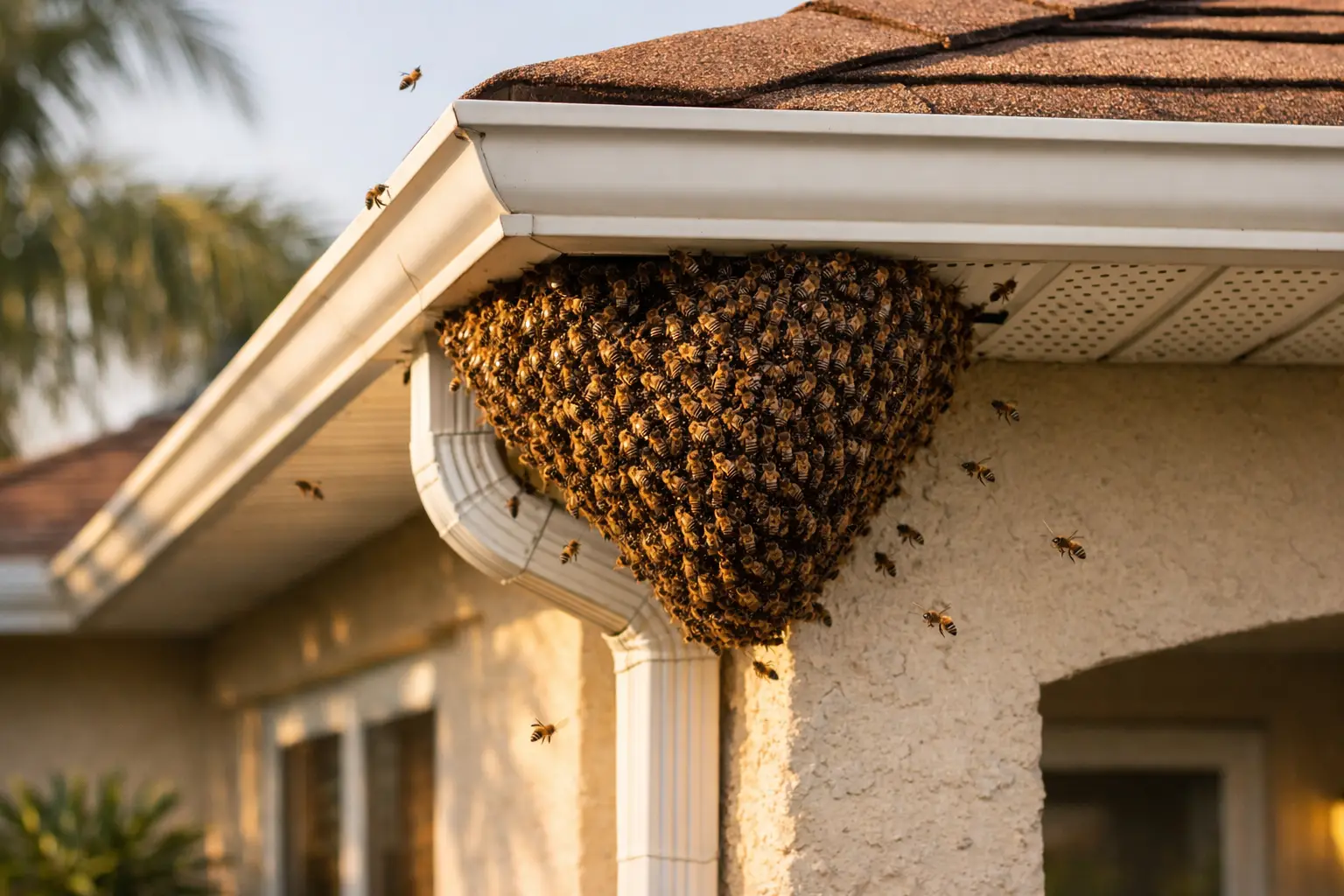

You usually notice it from the ground first – a steady line of bees disappearing into a small gap under the roof edge. That is the classic start of a bees in soffit removal call. It looks minor from outside, but a soffit colony can spread between cavities, build heavy comb, and store pounds of honey where heat, moisture, and gravity all work against the structure.
Soffits are one of the trickier places for live bee removal because they sit at the intersection of roofing, ventilation, fascia, and attic access. The bees may be visible at one opening while the main nest sits several feet away. For a homeowner, that means guesswork is expensive. For a property manager, it means liability, repeat activity, and repair concerns if the job is done halfway.
Why bees choose soffits
A soffit gives a colony what it wants – shelter from rain, shade from direct sun, and a narrow entrance that is easier to defend. In Florida and other warm regions, these spaces stay attractive for much of the year. If there is a construction gap, warped panel, rotten wood edge, or unsealed utility penetration nearby, scout bees can find it fast.
Once a swarm moves in, the colony begins building comb inside the cavity. That comb is not just a cluster near the opening. It can attach to framing, sheathing, and the back side of soffit material. Over time, the weight increases. So does the amount of brood, pollen, and honey packed into the space.
This matters because the visible bee traffic is only part of the problem. The real issue is what is hidden behind the material. A proper removal is not about making the entrance quiet for a few days. It is about removing the living colony and the organic material it leaves behind.
What makes bees in soffit removal different
Not every bee job is structural, but soffit work usually is. The technician often has to confirm the exact nest location, open the correct section, remove comb carefully, vacuum or hand-collect the bees, recover the queen when possible, and then clean the area so it does not invite future swarms.
That is why bees in soffit removal is different from catching a hanging swarm on a tree branch. A swarm can sometimes be boxed with minimal disturbance. A soffit colony is established inside the building envelope. If the comb stays in place, the job is incomplete.
There is also the access issue. Soffits are overhead. That raises the difficulty level right away. Ladders, roof lines, second-story elevations, electrical lines, brittle materials, and wasp look-alikes all add risk. An amateur trying to spray a can upward from a ladder can create a dangerous situation in seconds.
Why poison usually makes the problem worse
Homeowners are often told that killing the bees will solve everything. Structurally, it rarely does. Even if a pesticide kills much of the colony, the comb, brood, honey, and dead bees remain inside the soffit. In warm weather, that material can melt, ferment, leak, stain, and attract ants, roaches, rodents, and wax moths.
There is another issue. Poisoned colonies do not always die cleanly or all at once. Some bees may abscond, some may return, and some may become defensive during treatment. If the queen survives or another swarm later finds the residual odor of wax and honey, the same cavity can be reused.
From a livestock and pollinator perspective, poisoning a workable honey bee colony is also a waste. Healthy colonies can often be relocated to managed apiaries, where they continue pollinating and producing honey instead of rotting in a building cavity.
How a proper live removal works
A good soffit removal starts with locating the colony, not just the entrance. Bee traffic patterns, thermal clues, sound, and construction layout all help identify where the comb actually sits. Opening the wrong panel creates more repair work and still may not reach the nest.
Once the correct section is accessed, the comb is removed piece by piece. Brood comb and food comb are separated carefully, and the bees are collected with equipment designed for live removals. The goal is to save as much of the colony as possible and transfer it into a hive setup where it can stabilize.
After extraction, cleanup is just as important as removal. Residual wax and honey can trigger future problems if they are left in place. The cavity should be cleaned, and the entry points should be sealed after confirming no bees remain trapped inside. If sealing happens too early, surviving bees may move deeper into the structure or find another way into the property.
That sequence matters. Remove first, clean second, seal last.
When the job gets more complicated
Some soffit colonies are straightforward. Others extend beyond the soffit into fascia, roof decking, wall voids, or attic transitions. The outside entrance may be small while the interior colony is large and well established. If the hive has been there for months, there may be extensive comb and a substantial honey load.
Aggression level also varies. Honey bees are not automatically aggressive, but colony temperament changes with weather, disturbance, genetics, and how long they have been established. In parts of the South, defensive behavior has to be assessed seriously, especially in public-facing properties, schools, retail centers, and shared residential buildings.
Then there is the repair question. A removal company can extract the colony, but the surrounding structure may still need carpentry attention if wood is soft, panels are damaged, or moisture intrusion helped create the opening in the first place. The best outcome comes from treating the bee issue and the building issue as connected problems.
What homeowners should do right away
If you see bees entering a soffit, keep people and pets back from the area and avoid blocking the entrance. Do not spray foam, caulk, water, or pesticide into the gap. Those quick fixes tend to force the bees deeper into the cavity or create a defensive response without solving the nest itself.
Try to observe from a distance. Are the bees coming and going steadily through one point? Is activity strongest during warm daylight hours? Has the traffic continued for more than a day or two? That information helps distinguish an established colony from a temporary swarm cluster nearby.
If the colony is attached to a home, condo building, clubhouse, restaurant, or office property, treat it like a structural problem with a biological component. The right response is a live removal specialist who understands both honey bee behavior and the way soffit systems are built.
Why warranties and follow-through matter
Soffit jobs are not just about the day of removal. They are about what happens after the bees are gone. If the cavity is not cleaned properly or the entry points are not secured, the same location can attract new scout bees later. That is one reason same-place warranties matter. They show the company understands recurrence risk, not just extraction.
For homeowners and HOAs, follow-through is part of risk control. A quiet soffit does not always mean a clean cavity. A real solution accounts for leftover attractants, trapped bees, and weak spots in the exterior that made the site available in the first place.
In Southwest Florida, where warm weather extends bee activity and structures take constant sun and moisture stress, those details matter more than they might in cooler climates. Beeswild.com approaches these jobs as live colony rescue combined with structural common sense, which is exactly what soffit removals require.
The real goal of bees in soffit removal
The goal is not to win a fight with bees. It is to solve a structural infestation safely, protect the people using the property, and preserve a valuable colony whenever conditions allow. That takes more than a spray can and more than good intentions.
A soffit colony can be removed cleanly, but only when the work matches the biology of the bees and the reality of the structure. If you are seeing steady bee traffic at the roof edge, the smartest move is to act early – before comb gets bigger, honey gets heavier, and repair costs start climbing. A small opening under the eaves can turn into a much larger job if you wait.

No responses yet