
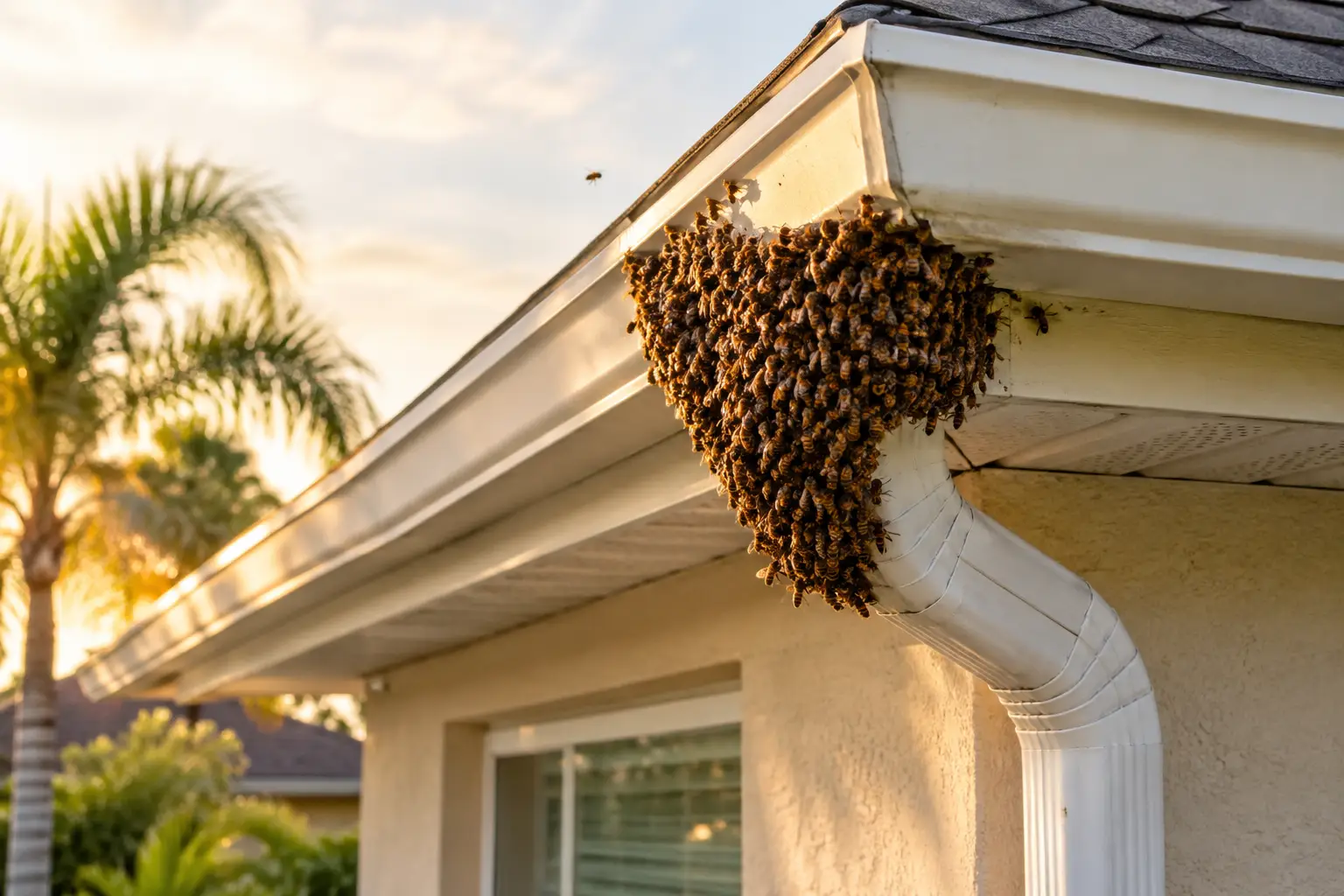

A few bees entering the same gap beneath your roofline may look harmless from the ground. But searches for bees nesting in soffit signs often start when that occasional traffic becomes a steady flight path – and that is when a small opening can lead to a large structural colony.
Soffits are protected, shaded, and often connected to voids in the roof or wall. To honey bees, they can resemble a secure tree cavity. To a homeowner, a colony in that space can mean stored honey, melting wax, moisture, and a difficult repair if it is not handled correctly. The right response protects people and preserves the colony without leaving the home vulnerable.
Why Bees Choose a Soffit
A soffit is the finished underside of a roof overhang. It may be vented, wood-paneled, vinyl, aluminum, or stucco-finished. Small gaps around vents, fascia boards, utility lines, or damaged panels can give bees access to the hollow area behind it.
Honey bees do not build an exposed paper nest. They build wax comb inside sheltered cavities, where a queen can lay eggs and workers can store pollen and honey. Southwest Florida’s warmth can make these spaces especially attractive because colonies may remain active for much of the year rather than experiencing a long winter slowdown.
A swarm may first gather outside the home temporarily, often as a dense cluster on a branch, eave, or fence. If it finds a suitable entry point, however, it can move into the soffit and begin building comb. Once comb is established, the problem is no longer simply a swarm removal. It is a structural bee removal that requires access, careful extraction, and cleanup.
Signs Bees Are Nesting in a Soffit
The clearest sign is consistent bee traffic. Watch from a safe distance during warm daylight hours. If bees repeatedly enter and exit one crack, vent, or seam, particularly with visible pollen on their hind legs, there may be an active colony inside.
Other signs can develop gradually. You may hear a low buzzing through a ceiling or exterior wall near the roofline. A dark stain, sticky spot, or discoloration on the soffit can indicate honey or wax is leaking. In more advanced cases, heat from the colony softens wax and allows honey to seep into insulation, drywall, or the wall cavity below.
Bee activity can also attract other animals. Ants, cockroaches, beetles, rodents, and even birds may be drawn to honey, larvae, or the scent of an established hive. A sweet or fermented odor indoors can be another warning that honey has accumulated behind a finished surface.
Not every flying insect at a soffit is a honey bee. Yellow jackets, hornets, and paper wasps also use rooflines, and they need a different removal approach. Honey bees are typically fuzzy, brown-and-gold insects with flatter bodies than wasps. Still, identification from the ground is not always reliable. Avoid blocking the entrance or spraying the insects while trying to determine what they are.
Why Spraying or Sealing the Opening Can Make Things Worse
It is understandable to want the bee activity to stop immediately, especially near children, pets, doors, patios, or outdoor seating. But poisoning a colony inside a soffit usually addresses only the visible insects, not the material they leave behind.
Dead bees, honey-filled comb, brood, wax, and pollen remain in the cavity. In Florida heat, honey can melt and travel through insulation or along framing. The resulting stains and odors may persist, and the food source can draw pests into areas of the structure that were previously unaffected.
Sealing the entrance while bees are still inside creates another risk. Trapped bees may look for an alternate exit and can enter a wall, attic, or living space. If some foragers are locked outside while the colony remains inside, those displaced workers may cluster around nearby openings.
There is also a repeat-infestation issue. Honey bee scent and residual comb can make the cavity attractive to a new swarm. A patch over the original entrance may look like a finished fix, but if the interior has not been cleared and the surrounding access points have not been addressed, bees may return through another gap.
What Live Soffit Removal Should Accomplish
A proper live removal is more than taking bees away from an opening. Its purpose is to remove the colony as completely as practical while limiting damage to the building and giving the bees a viable future.
The process begins with assessing bee activity, the probable size of the colony, access to the cavity, and the construction material involved. A technician may need to carefully open a limited section of soffit or adjacent material to reach the comb. The bees are collected, the queen is located when possible, and the comb is removed rather than abandoned inside the structure.
Removing comb matters because it eliminates the honey and brood that attract pests and future colonies. The cavity can then be cleaned and prepared for repair. Exclusion – sealing gaps only after the bees and comb are out – is the step that helps prevent a repeat problem.
There is a trade-off: structural removal can require opening building materials, which may involve a visible repair afterward. That is usually far less costly than allowing honey damage, pest activity, and recurring colonies to spread unseen. A transparent removal professional should explain where access is needed, what can be restored, and which repair work belongs to the homeowner or a contractor.
At Beeswild, live removal focuses on relocating viable honey bee colonies to safe apiary environments rather than treating them as disposable pests. For properties in Southwest Florida, that approach addresses the immediate safety concern while supporting the bees that pollinate crops, gardens, and native plants.
What to Do While You Wait for Help
Keep people and pets away from the active entrance, especially if bees are concentrated near a doorway, pool area, or play space. Do not climb a ladder to inspect the soffit. Falls are a serious risk, and disturbing a colony at close range can trigger defensive behavior.
If you can do so safely from the ground, note the exact location of the entry point, how long activity has been present, and whether you have noticed interior stains, buzzing, or odors. Photos or short videos taken at a safe distance can help a removal professional plan the visit.
Avoid using store-bought insecticide, foam, expanding sealant, water, or smoke. These tactics can make a humane removal more difficult and can increase the chance of honey and comb being left in the structure. If anyone is being stung repeatedly, has a known severe sting allergy, or the bees are blocking safe access to the home, treat it as an urgent safety situation and keep clear of the area.
After the Colony Is Removed
The exterior should be checked for the conditions that allowed entry in the first place. Cracked soffit panels, loose vents, rotted fascia, unsealed pipe penetrations, and gaps at roof transitions are common access points. Repairs should allow necessary attic ventilation to continue while closing openings large enough for bees to enter.
Watch the area for several days after removal. A small number of returning foragers may investigate the old location temporarily, but sustained in-and-out traffic should not continue. If it does, the cavity may have another access point or part of the colony may remain.
A soffit colony is not a homeowner failure, and it is not a reason to destroy bees by default. It is a building issue with a living colony inside it. Acting early gives you the best chance to protect the structure, reduce risk around your family or customers, and move the bees to a place where they can keep doing the work they were made to do.

No responses yet