
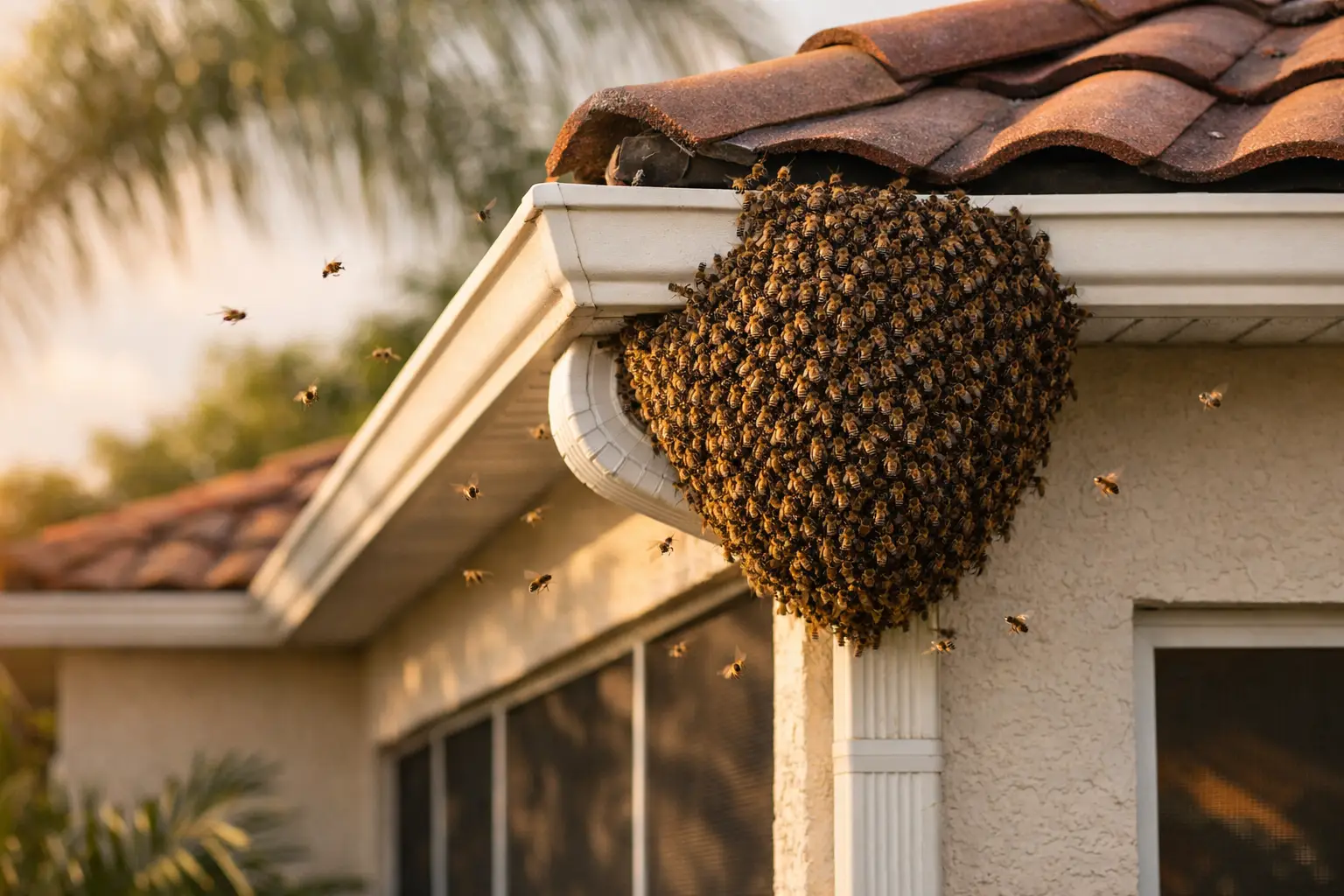

A cluster of bees hanging from a palm tree can look alarming. A colony hidden inside a wall is a different problem entirely. When people search for bee removal Cape Coral services, they are usually dealing with one of two realities – a temporary swarm that may move on, or an established hive that will keep growing, storing honey, and putting the structure at risk.
That distinction matters because the right response is not always the fastest-looking fix. Spraying chemicals may kill visible bees, but it does not remove comb, brood, or honey from the structure. In Florida heat, that leftover material can melt, ferment, stain drywall, attract ants and roaches, and sometimes draw in new bees. Proper bee work starts with identifying what is actually happening on the property.
What bee removal in Cape Coral usually involves
Cape Coral homes and commercial buildings offer bees plenty of attractive nesting spaces. Soffits, block walls, sheds, rooflines, meter boxes, and cavities near warm exterior surfaces can all become shelter. During swarm season, bees may also pause on tree limbs, fences, mailboxes, or pool enclosures while scouts search for a permanent home.
A swarm is generally a resting cluster. These bees are in transition, often less defensive than a colony protecting brood and stored honey. A structural colony is more serious. Once bees have moved inside a wall or roof area and started building comb, the issue becomes both a safety concern and a building concern.
Good removal work is based on access, colony size, and how long the bees have been there. Sometimes the job is straightforward. Sometimes it requires opening part of a soffit, wall, or roof section to fully remove comb and bees. That is why pricing and timing can vary. Anyone promising the same answer for every bee call is usually oversimplifying the problem.
Why live bee removal matters
Honey bees are not disposable pests. They are pollinators, managed livestock, and a working part of agriculture. In a region with flowering landscapes, backyard gardens, and farm activity across Southwest Florida, preserving healthy colonies has real ecological value.
Live removal gives those bees a chance to keep doing their job. Instead of being poisoned in place, the colony can be taken out, secured, and relocated to a managed apiary or safe bee yard. That approach protects the property owner while also keeping viable bees in service.
There is also a practical reason this method matters. Removal that includes the bees, comb, and honey addresses the source of the issue. Killing bees without cleaning out the cavity often creates the next problem. Homeowners then end up paying twice – once for the spray, and again for repairs, odor, stains, pests, or another infestation.
When bees are dangerous and when they are not
Not every bee sighting is an emergency, but some absolutely are. If bees are entering and exiting the same crack or opening all day, especially near a doorway, utility area, or children’s play space, assume an established colony is present. If a colony is in a wall shared with a bedroom, garage, attic, or business entrance, the risk increases.
Aggression is another factor, but it is not the only one. People often ask whether the bees are “good bees” or “Africanized bees.” In the field, behavior matters more than labels in the first moments of response. A colony that chases people, reacts strongly to vibration, or defends a large perimeter needs urgent professional handling.
On the other hand, a quiet swarm resting on a branch may not require panic. It does require judgment. Disturbing it with water, smoke, rocks, or a store-bought aerosol can turn a manageable situation into a dangerous one fast.
Bee removal Cape Coral property owners should expect
A professional bee removal process should begin with inspection, not guessing. The technician needs to identify whether the bees are swarming, nesting in a structure, or entering from a secondary point that hides a larger colony elsewhere. They should also evaluate access, bee traffic, building materials, and whether comb removal will be necessary.
For a swarm, the work may involve safely collecting the clustered bees and transporting them to a relocation site. For a structural colony, the process is more technical. The affected area often has to be opened carefully so the colony can be removed intact. Comb, brood, and honey should come out with the bees whenever possible. After that, the cavity should be cleaned and treated in a way that helps reduce scent trails that attract future swarms.
Repairs are part of the conversation too. Even when a removal company is not the one completing final carpentry, homeowners should be told what was opened, why it was necessary, and what needs to be sealed afterward. Transparency matters because the real goal is not just getting bees out today. It is preventing another colony from moving into the same void next month.
Why poison-only treatments often fail
Poison sounds simple, which is why many stressed property owners are tempted by it. The problem is that bee colonies inside structures are biological systems, not surface-level infestations. If pesticide reaches some bees but not the queen, brood nest, and comb mass effectively, the colony may survive or scatter unpredictably deeper into the structure.
Even if the colony collapses, the aftermath stays behind. Honey comb can soften in attic heat. Wax and honey can seep through ceilings and walls. Dead bees can attract scavengers. Roaches and ants often follow. In some cases, the smell alone becomes the next complaint.
There are situations where chemical intervention may be discussed for severe public safety reasons, especially with highly defensive colonies in difficult locations. But as a default approach, poison-first treatment is often a shortcut with long-term costs. Humane structural removal is more work up front and usually the better building decision.
What homeowners and managers should do first
If you discover bees on your property, keep your distance and reduce activity around the area. Keep children and pets away. Do not plug the entry hole if bees are going into a wall. That can force them into another interior space or trap honey and brood inside.
Avoid spraying foam, water, or household insect products. Those products rarely solve a structural colony and can make removal harder. If the bees are near a front entrance, pool equipment, or a busy commercial walkway, restrict access until a trained bee removal specialist can inspect the site.
Photos and short videos from a safe distance can help with initial assessment. The pattern of flight, the location of entry, and the size of the cluster often reveal whether the issue is a transient swarm or an established colony.
Cape Coral conditions make timing important
Warm weather gives bees a long working season in Southwest Florida. Colonies can build quickly, and cavities that seem small from the outside may contain far more comb than expected. Waiting a week or two can mean more bees, more honey, and more structural impact.
This is especially true in block construction, soffits, and roof transitions where bee traffic may be easy to miss at first. Commercial properties and HOAs face an added challenge because one unmanaged colony can become a liability issue if residents, customers, or maintenance staff are exposed.
That is why response time matters. Fast inspection does not mean rushed work. It means identifying the problem early enough that the removal can be planned safely and completely.
Choosing a bee removal company
The right company should understand both bee biology and structural realities. That means knowing how colonies behave, how to remove and relocate them alive when possible, and how to deal with comb and honey inside buildings. It also means communicating clearly about what can and cannot be seen before opening a wall.
For Cape Coral property owners, local experience matters. Building types, weather, and common nesting points are not minor details. A company working in this region should know where bees typically establish themselves and how Florida heat changes the urgency of full removal.
A humane bee specialist should also be honest about trade-offs. Some removals are clean and simple. Others require more invasive access to do the job correctly. The easy answer is not always the right one.
Beeswild.com LLC operates from Cape Coral with a model built around live removal and relocation, which is the standard many eco-conscious homeowners and property managers are looking for when they want the bees gone without wasting the colony.
If bees have shown up at your home or building, the goal is not to react bigger than necessary. It is to react correctly, before a manageable bee issue turns into a structural one.

No responses yet