
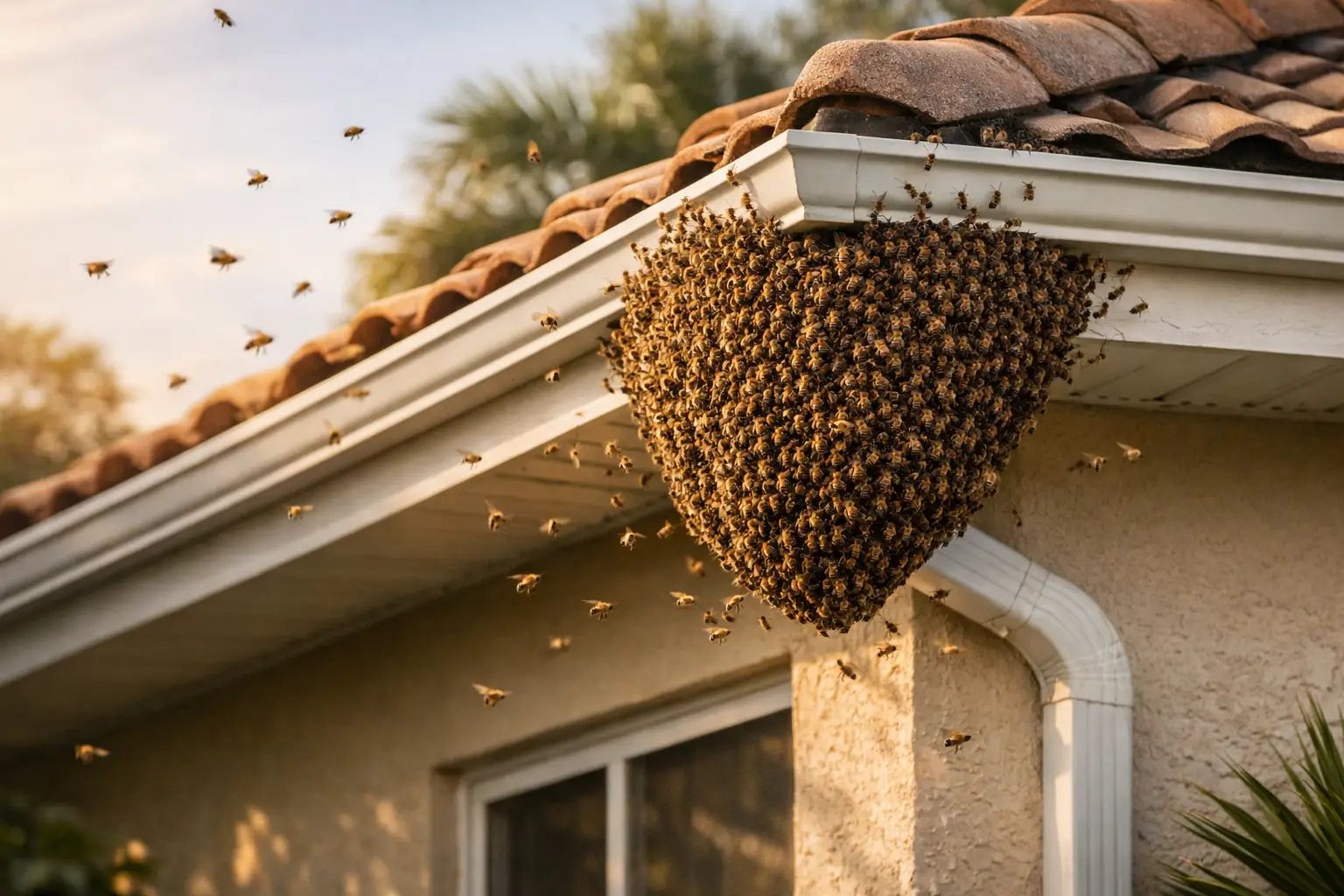

A colony in your wall does not come with a label. To most homeowners, all bees look the same right up until the moment they start circling the dog bowl, the front door, or the soffit over the patio. That is why the question of feral bees versus africanized bees matters. It is not just a biology lesson. It affects safety, removal strategy, and how urgently a colony should be handled.
In Southwest Florida, that distinction also gets muddied by fear. People hear “wild bees” and assume “aggressive bees.” Sometimes that is true. Sometimes it is not. A feral colony can be surprisingly manageable. An africanized colony can react fast, defend a larger area, and turn a routine removal into a true public safety issue. The challenge is that you usually cannot confirm which is which by standing ten feet away and guessing.
Feral bees versus africanized bees: what is the difference?
Feral bees are simply honey bees living in the wild, without a beekeeper managing them. They may be nesting in a tree cavity, block wall, chimney void, or house wall. In many cases, these colonies descended from escaped managed bees. Over time, they adapted to surviving on their own.
Africanized bees are also honey bees. They are not a separate species buzzing around with a different body shape that the average person can reliably spot. They are a strain of honey bee with genetics linked to African honey bees, and they are known for stronger defensive behavior. In the United States, especially in warmer regions like Florida, africanized genetics can show up in feral populations.
That is the first key point: a colony can be both feral and africanized. Feral describes where and how it lives. Africanized describes its genetics and behavior tendencies. Those terms are not opposites.
Why people confuse the two
The confusion makes sense. Both types may show up in the same places – soffits, sheds, meter boxes, palm trees, and masonry voids. Both can swarm. Both produce honeycomb. Both may look nearly identical to the eye.
What people usually mean when they ask about feral bees versus africanized bees is this: Are these bees likely to stay relatively calm, or are they more likely to overreact and become dangerous?
That is the practical question, and it is the right one. For a homeowner, property manager, or HOA, behavior matters more than labels.
Behavior is the biggest difference
A typical feral honey bee colony may defend its nest if disturbed, but the response is often proportionate. If you stay back, avoid vibrations, and do not interfere with the entrance, the colony may remain fairly predictable until removal.
Africanized colonies tend to escalate faster. They can respond to smaller disturbances, send out more guard bees, and pursue perceived threats farther from the nest. Lawn equipment, trimmers, pressure washers, barking dogs, and even repeated foot traffic near the entrance can trigger a more intense defensive event.
That does not mean every africanized colony is constantly attacking, and it does not mean every non-africanized feral colony is gentle. Bee behavior exists on a range. Weather, season, nectar flow, colony size, queen condition, and previous disturbance all matter. Still, when professionals talk about africanized bees, they are talking about a higher-risk defensive profile.
Can you identify africanized bees by appearance?
Not reliably in the field.
This is where a lot of misinformation starts. People may claim a colony is africanized because the bees look “small” or “dark” or “angry.” That is not enough. Physical differences are subtle and not dependable for on-site identification by the public. Lab testing or professional evaluation of behavior and context is far more meaningful.
For property owners, the safer approach is simple: if a colony is established on your structure or behaving defensively, treat it as a professional removal situation regardless of what you think it is.
Nesting habits and survival patterns
Feral colonies are resourceful. They choose protected voids that offer shelter from weather and predators. In developed neighborhoods, that often means buildings. Once bees move into a wall or roofline, the problem is not only the insects themselves. It is also the comb, brood, honey, and heat they create inside the structure.
Africanized colonies often show a stronger tendency to use smaller or more exposed cavities than some managed European honey bee lines. They may also swarm more readily, which can help them spread and re-establish quickly. In real-world terms, that can mean more colony turnover and more surprise nest sites around homes, utility boxes, fences, and landscape features.
This is one reason poison is such a poor answer. Even if a pesticide kills visible bees, it does not remove wax, honey, brood, or scent from the cavity. That leftover material can melt, ferment, stain drywall, attract ants and roaches, and invite a new swarm to move in later. Live removal paired with proper cut-out and cleanup addresses the whole structure, not just the moving part.
Risk to homeowners, businesses, and public spaces
For a single homeowner, the biggest concern is usually family safety. Kids play near eaves. Dogs investigate entrances. Lawn crews hit walls with blowers and mowers. A hidden colony can stay unnoticed until one disturbance turns into dozens or hundreds of defensive bees in the air.
For commercial properties and HOAs, the concern expands into liability. Outdoor dining, mail kiosks, pool equipment rooms, monument signs, and clubhouse roofs all create nesting opportunities. If a colony has africanized traits, the defensive radius may be larger, which makes foot traffic and routine maintenance more hazardous.
Public spaces add another layer. Sidewalks, parks, schools, and municipal structures require a faster risk assessment because there is less control over who might wander too close. In those settings, the question is not whether the bees are “good” or “bad.” The question is whether the colony can stay where it is without creating a preventable emergency. Often, it cannot.
What to do if you suspect africanized behavior
Distance matters. Keep people and pets away from the flight path and nest area. Avoid vibrations, loud equipment, and attempts to spray or seal the entrance. Do not plug the hole. That can force bees deeper into the structure or cause them to find a new exit indoors.
If the colony has already shown defensive behavior, treat it as urgent. A professional can assess entry points, nesting depth, bee traffic, and removal access. Humane live removal is still possible in many cases, but the planning has to match the risk.
In Southwest Florida, where warm weather allows colonies to remain active much of the year, waiting rarely improves the situation. Colonies grow. Comb expands. Honey accumulates. The structural cleanup gets bigger, not smaller.
Feral bees are not automatically a problem
This part deserves care. Not every feral colony needs to be feared. Honey bees are valuable pollinators and agricultural livestock. A swarm resting briefly on a branch may simply need monitoring or relocation before it moves on. A feral colony in a remote tree cavity away from people may pose little immediate risk.
But a colony in a wall, soffit, roof, or utility area is different. Once bees choose a structure, the issue becomes both biological and structural. The right response is not panic. It is informed action.
That is where an experienced live removal team matters. The goal is not just to stop bee activity at the surface. It is to remove the colony, recover the comb, prevent rot and re-infestation, and relocate viable bees whenever possible. That approach protects people, respects the bees, and protects the building.
Feral bees versus africanized bees in real life
Here is the practical takeaway. Feral bees are unmanaged honey bees living on their own. Africanized bees are honey bees with genetics and behavior that can make them more defensive. One term describes condition. The other describes lineage and risk profile. They can overlap.
For the average property owner, the safest assumption is not to self-diagnose. If bees are settled on or inside a structure, or if the colony reacts strongly to normal activity, the distinction should be handled by professionals who understand both bee behavior and structural removal.
At Beeswild, that means looking beyond the swarm at the entrance and asking the more useful questions: Where is the colony actually built? How defensive is it under normal conditions? What will be left behind if someone takes shortcuts? Those answers matter far more than internet myths about what an “angry bee” looks like.
When bees choose your property, fast and careful action gives you the best outcome – safer removal, less damage, and a better chance to preserve the colony instead of turning the problem into a bigger one.

No responses yet