
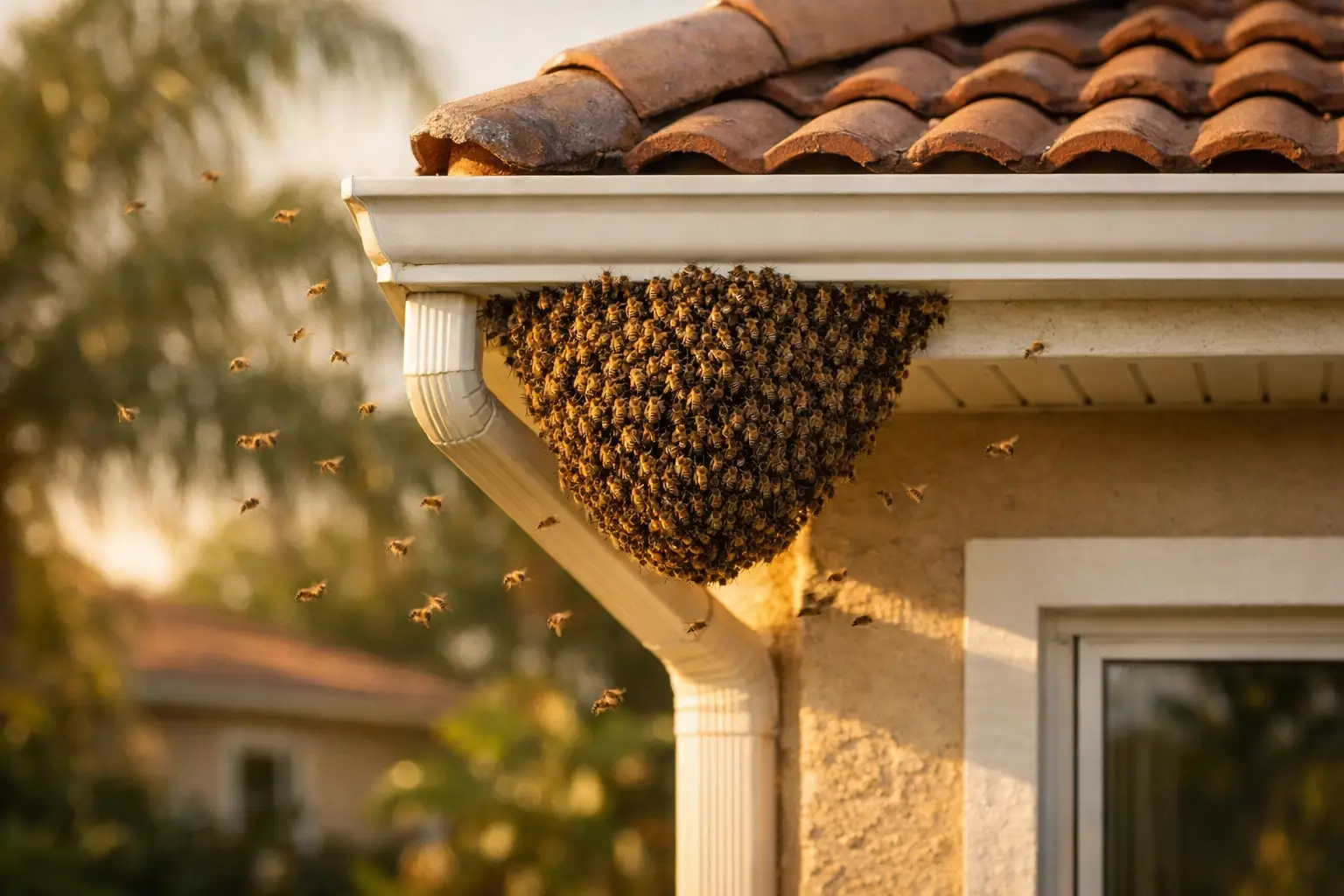

You usually do not see the real problem first. You hear it. A faint buzzing behind drywall, a steady stream of bees near a soffit, or a few insects showing up indoors around a window for no clear reason. Those are often the first signs bees are inside walls, and waiting too long can turn a manageable removal into a much bigger structural mess.
When honey bees move into a wall cavity, they are not just resting there for a day. If they settle and build comb, the colony can expand quickly. That means more bees, more wax, more honey, and more pressure on the structure around them. For homeowners, property managers, and HOAs, the key is recognizing the warning signs early and understanding why a live removal is usually the safest long-term fix.
Why bees choose wall cavities
From a bee’s perspective, a wall can look like excellent real estate. It is dark, sheltered, dry, and protected from wind and predators. Gaps around soffits, fascia boards, rooflines, utility penetrations, and block walls can give a swarm just enough access to move in.
In Southwest Florida, warm weather extends bee activity for much of the year, so colonies can establish themselves fast. What starts as a swarm resting nearby can become a functioning hive inside a structure before a homeowner realizes what happened.
A wall colony is different from bees visiting flowers near your property. Foraging bees come and go. A colony inside a wall creates a repeated pattern, usually from one specific entry point, and that pattern becomes more obvious over time.
7 signs bees are inside walls
1. A steady line of bees entering and leaving one spot
This is one of the clearest signs. If bees are using the same crack, vent gap, or seam in the siding over and over, they are likely not just exploring. They are commuting.
Watch the traffic for a few minutes from a safe distance. If some bees are arriving while others are leaving, especially during warm daylight hours, that usually points to an established colony. A random swarm clustered on a branch behaves differently. A wall hive has a doorway.
2. Buzzing or vibrating sounds behind drywall or stucco
People often describe it as a low electrical hum, a soft vibrating noise, or a faint buzzing that gets louder during the day. You may notice it in a bedroom wall, near a chimney chase, around a fireplace surround, or above a garage ceiling.
The sound can vary based on colony size, wall thickness, and time of day. A small colony may be hard to hear. A larger one can produce a noticeable hum, especially if the room is quiet. If the sound seems to come from the wall itself rather than from outside the window, take that seriously.
3. Bees appearing indoors near windows or light fixtures
When bees establish comb inside a wall, a few may drift into the living space through tiny openings around outlets, recessed lights, baseboards, attic access points, or window trim. Homeowners often notice a handful of bees at a sunny window and assume one flew in through an open door.
If it happens more than once, the issue may be inside the structure. Bees drawn to indoor light often end up at windows because they are trying to find a way out. Repeated indoor sightings in the same area are a strong clue that the colony is in the wall, attic, or ceiling nearby.
4. Dark stains on walls or ceilings
As a colony grows, the comb stores brood, pollen, and honey. In some cases, heat and humidity can soften wax or cause honey to seep. Over time, you may see yellowish or brownish staining on drywall, paint, or ceiling material.
This is not an early sign. It usually means the colony has been there long enough to build substantial comb. At that stage, the risk of secondary problems goes up – sticky leaks, fermenting honey, ants, roaches, and damage to surrounding materials.
5. A sweet odor coming from the wall
Fresh honey and wax have a distinct smell. Some people notice a warm, sweet scent near an interior wall, in a closet, or around an exterior entry point. Others do not smell anything until the colony is larger or the comb starts leaking.
Odor alone is not proof, since other issues can create unusual smells inside walls. But when a sweet scent appears together with buzzing, bee traffic, or indoor bees, it fits the pattern.
6. Increased bee activity during warm parts of the day
A true colony has rhythms. On warm, sunny days, foragers leave the hive to collect nectar, pollen, water, and plant resins. That means activity at the entry point often rises in the late morning and afternoon.
If you only notice one or two bees now and then, it may not be a wall colony. If you see regular movement at the same opening day after day, especially in fair weather, that is different. Patterns matter more than a single sighting.
7. Bees suddenly become defensive near one section of the building
You do not have to disturb a hive directly for bees to react. Lawn equipment, vibrations, pressure washing, pruning, pets, or even people walking too close to the entry area can trigger defensive behavior.
If bees seem unusually focused on one corner of the home, garage wall, mailbox structure, or soffit, there may be a nest nearby. This is especially important around children, delivery paths, pool equipment, and shared community spaces.
What people often mistake for a wall colony
Not every bee sighting means bees are living in your structure. During swarm season, honey bees may cluster temporarily on a branch, fence, or exterior wall while scout bees look for a permanent home. A swarm can stay for a few hours or a couple of days and then move on.
Wasps are also commonly misidentified as bees. The response should be different because the biology and nest structure are different. Honey bees build wax comb and can leave behind honey that keeps causing trouble even after the insects are gone. That is one reason poison-only approaches often fail in structural bee cases. Killing the bees without removing the comb can leave the property owner with melting honey, odors, and a cavity that attracts new swarms later.
Why fast action matters
A small colony is easier to remove than a large one. That is the simple version. The longer bees remain in a wall, the more comb they build and the more honey they store. Removal becomes more involved, and repairs can become more expensive.
There is also a safety angle. Most honey bees are not looking to sting people, but any established colony will defend itself if it feels threatened. In Florida, where defensive genetics can be part of the picture, guessing is not a safe strategy.
Acting early also protects the bees. A proper live removal gives the colony a chance to be relocated rather than destroyed. That matters environmentally, but it also matters practically. Removing the bees, comb, and attractants together is what reduces the chance of a repeat infestation in the same spot.
What to do if you suspect bees are inside a wall
Start by keeping your distance and limiting activity near the suspected entry point. Do not seal the hole, spray foam into it, use store-bought insecticide, or try to smoke the bees out. Those moves often make the situation worse. Sealing the entrance can trap bees inside the wall, drive them into living spaces, or leave comb and honey hidden in place.
Instead, observe from a safe distance. Note where the bees are entering, when activity is heaviest, and whether you hear buzzing indoors. That information helps a professional assess whether it is a swarm, an established colony, or another insect problem entirely.
If the bees are in a home, commercial property, HOA structure, or public-use area, contact a professional experienced in live structural bee removal. This is not just about taking insects away. It is about opening the cavity when needed, removing comb and bees, and reducing the chance of the same location being used again. In Southwest Florida, that approach is especially important because active colonies can develop quickly in our climate.
A good removal plan should be clear about what is being removed, what repairs are and are not included, and how re-entry risk is handled. Beeswild, for example, offers a 3-month same-place removal warranty because repeat activity at the original site is a real concern if the cavity is not addressed correctly.
If your wall sounds alive, trust that instinct and get it checked before the honey starts doing damage you cannot see yet. Early attention protects your home, the people around it, and the bees that ended up in the wrong place.

No responses yet