
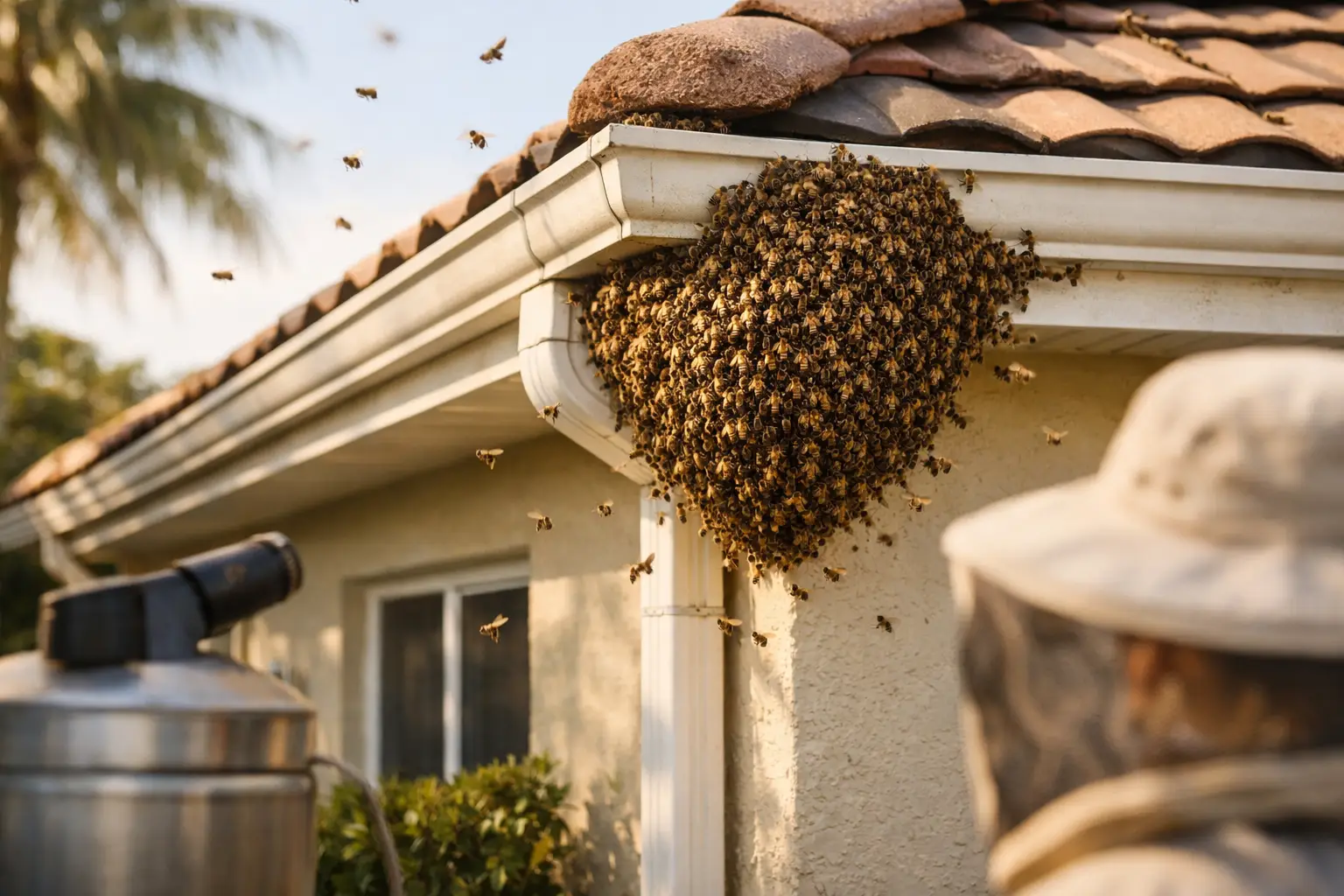

You hear buzzing in a wall, see bees moving in and out of a soffit, and suddenly the question gets very real: bee extermination vs relocation. For most property owners, this is not an abstract environmental debate. It is a safety issue, a structural issue, and sometimes an emergency. The right choice depends on what kind of bee you have, where the colony is located, and whether the problem can be solved without creating a bigger one inside the building.
For honey bees, relocation is usually the better answer when it is done correctly. For some other stinging insects, extermination may be the standard route. That distinction matters because people often call everything with a sting a “bee,” and that is where expensive mistakes start.
Bee extermination vs relocation: what is the real difference?
Extermination means killing the colony where it is or after limited access is created. In many pest-control situations, that may sound faster. The problem is that dead bees do not remove comb, honey, brood, or residue from the structure. If a colony has been living in a wall or roofline for any length of time, those materials remain behind unless someone opens the area and removes them.
Relocation is different. In a proper live removal, the colony is physically removed, including the queen when possible, along with comb and hive material. The goal is not just to stop bee activity at the entry point. The goal is to eliminate the source of the problem and move viable bees into a managed setting where they can keep pollinating and producing.
That is why the conversation should never be reduced to “kill or don’t kill.” The better question is what solves the property issue completely and responsibly.
Why extermination often creates a second problem
When honey bees are poisoned inside a structure, the visible activity may stop, but the structural risk can continue. Honey can melt and seep into drywall, insulation, or ceiling cavities. Wax and brood can attract ants, roaches, rodents, and other scavengers. Odors can develop. New swarms may even be drawn back to the same spot if the cavity still smells like a former hive.
This is one of the least understood parts of the job. A homeowner may think the danger is gone because the flying bees are gone. Meanwhile, the colony material is still in the wall, and the cleanup bill gets larger over time.
There is also a practical issue with certainty. If the queen is not eliminated or if parts of the colony survive treatment, bee activity can continue in ways that confuse the property owner. They may pay once for extermination, then again for repairs, then again for cleanup or secondary pest issues.
When relocation is the better choice
Relocation is generally the best fit when the insects are honey bees and the colony is accessible enough to remove with proper tools and structural care. That includes many situations in walls, roofs, soffits, sheds, utility boxes, and hollow trees near homes or shared-use spaces.
For homeowners, the value is simple. A thorough live removal addresses the bees and the hive contents, which reduces the chance of lingering damage. For HOAs, restaurants, retail centers, and public facilities, relocation can also reduce liability while aligning with environmental expectations. People notice the difference between a provider who treats bees like disposable pests and one who understands they are managed livestock with ecological value.
That does not mean relocation is always easy. Structural removals can take time. Openings may need to be made to reach comb safely. Aggressive colonies, poor access, weather, or height can complicate the job. But difficult is not the same as impossible.
Bee extermination vs relocation in structural removals
Structural removals are where experience matters most. A swarm hanging from a branch is one thing. A mature colony buried behind stucco or fascia is another.
In a structural removal, the technician has to locate the colony accurately, gain access with minimal unnecessary damage, remove bees and comb, clean the cavity, and help prevent re-entry. If that sequence is skipped, the result is often incomplete. This is why the cheapest option on day one can become the most expensive option after repairs.
Relocation works best when the provider understands both bee biology and building conditions. Honey bees do not choose cavities at random. They seek protected, insulated voids. Once established, they build comb according to the space available. Removing them safely requires more than spraying an entry hole.
A professional live removal team also evaluates what happened before the bees arrived. Gaps, construction joints, damaged vents, loose trim, and utility penetrations often create ideal entrances. If those conditions are left unchanged, the property remains attractive to future swarms.
When extermination may still be necessary
There are cases where extermination is considered, but they are narrower than many people assume. If the insects are not honey bees but yellowjackets, hornets, or wasps, relocation is usually not the service being discussed. Those species behave differently, nest differently, and are handled under a different risk model.
Even with honey bees, there can be situations where live relocation is limited by extreme structural inaccessibility, severe safety hazards, or conditions that make rescue nonviable. A colony that cannot be reached safely without major demolition may force a hard decision. Public safety comes first, especially in high-traffic commercial areas or sensitive sites where delays are not acceptable.
This is where honest assessment matters. The right provider should tell you when relocation is realistic, when it is not, and what each option leaves behind.
How to decide what your property needs
Start with identification. Are they actually honey bees? Honey bees are fuzzy, generally amber-brown, and fly in a more purposeful pattern than many wasps. But visual guesses from the ground are not always reliable, especially when people are stressed.
Next, look at location and behavior. A temporary swarm clustered on a tree limb may be a straightforward rescue. Bees entering and exiting the same hole in a wall every few seconds usually indicate an established colony. The longer that colony has been there, the more likely it has built significant comb and stored honey.
Then consider occupancy and risk. If bees are near a front door, school pickup area, restaurant patio, pool equipment enclosure, or HOA mailbox cluster, the timeline changes. What might be manageable in a back corner of a large property can be unacceptable near daily foot traffic.
Finally, ask what happens after the bees are gone. This is one of the best questions a property owner can ask. Will the comb be removed? Will the cavity be cleaned? Will entry points be addressed? Is there a same-place warranty if bees return to that exact area? Those details separate a temporary response from a real solution.
What homeowners and property managers should avoid
The biggest mistake is trying to seal the entrance while bees are still active inside. That can push bees deeper into the structure or force them to find another way out, sometimes into living spaces.
The second mistake is using over-the-counter chemicals without knowing the species or hive location. Besides the safety risk, partial treatment can agitate a colony and make professional removal harder.
The third mistake is waiting too long because the activity seems minor. A small line of bees at a wall gap can represent a large colony behind the surface. Time usually favors the colony, not the building.
For Southwest Florida properties, where warm weather supports long bee activity seasons, delay can allow colonies to expand quickly. That is one reason local knowledge matters. Conditions in Cape Coral and the surrounding area are not the same as colder regions where colonies shut down harder in winter.
The better long-term view
The strongest case for relocation is not just that bees matter. It is that proper relocation often aligns with the best structural outcome too. Removing live honey bees, comb, and residue gives the property a cleaner reset. It also gives the colony a chance to continue in a managed environment rather than being wasted inside a wall.
That balance matters for modern property owners. People want safety. They want the problem solved fully. And many also want to know the solution was responsible.
At Beeswild, that is the standard behind live removal and rehoming work, especially when a colony can be preserved instead of poisoned in place. Saving bees should not mean ignoring risk, and protecting a building should not mean choosing a shortcut that leaves hidden damage behind.
If you are facing the choice between bee extermination and relocation, the most useful next step is not guessing. It is getting a clear inspection from someone who can tell you what species is present, where the colony actually sits, and what removal method solves the whole problem, not just the visible part.

No responses yet