
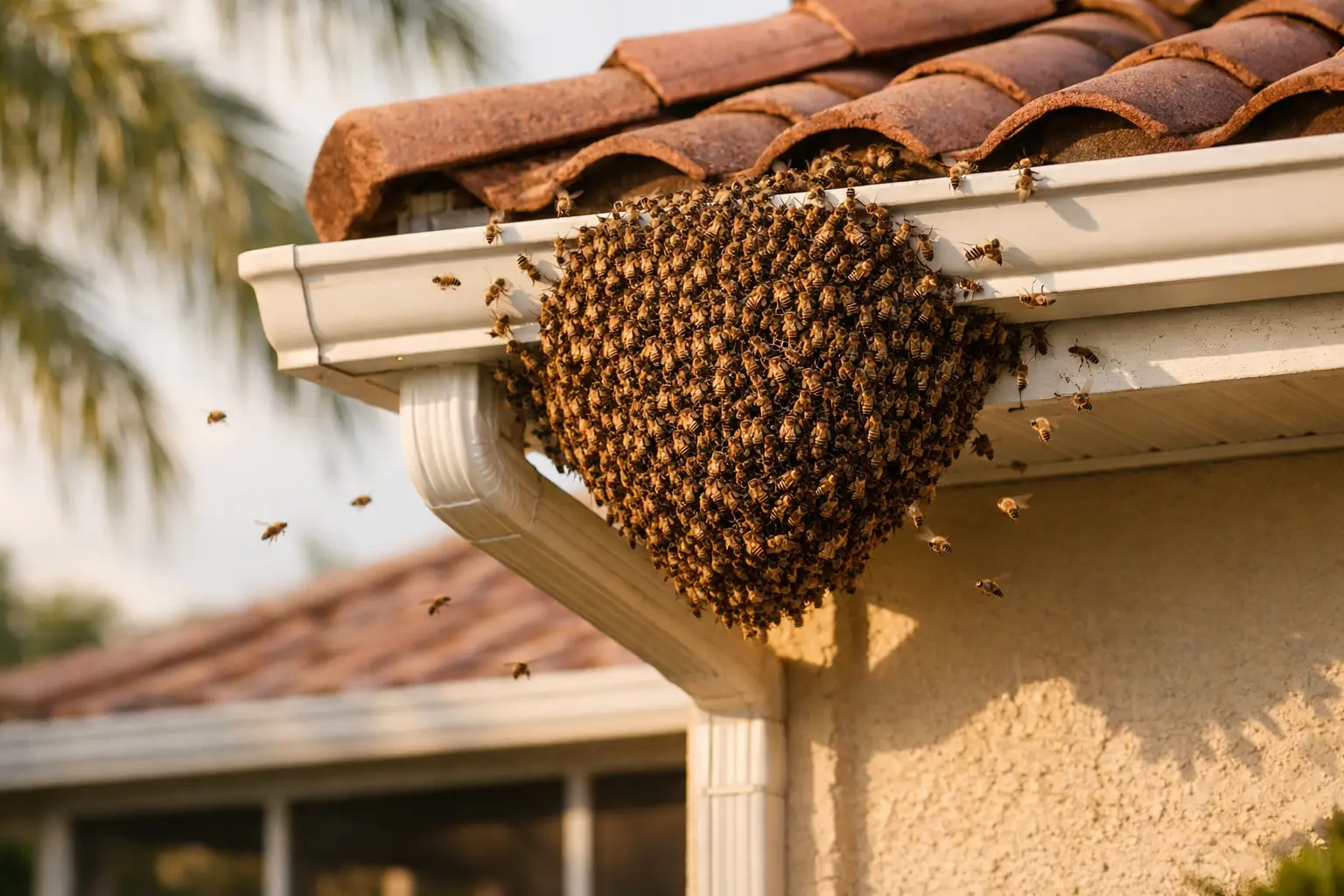

You usually notice bees in roof eaves after the problem has already matured. The flight path gets steady, a low hum starts near the soffit, and suddenly a part of your home that felt harmless now feels off-limits. If you need to remove bees from roof eaves, the first thing to know is simple: a visible cluster is one problem, but a colony established inside the structure is a very different one.
Roof eaves are attractive to bees because they offer shade, dryness, and protection from weather. In Southwest Florida, that shelter matters. Eaves, soffits, and fascia gaps can give a swarm just enough access to move inside and start building comb. Once that happens, this is no longer just about insects outside the house. It becomes a structural issue involving wax, brood, honey, heat, and hidden entry points.
Why bees choose roof eaves
A swarm looking for a permanent home is not random. Scout bees search for enclosed cavities that stay relatively stable in temperature and are protected from rain and predators. Roof eaves check those boxes. Even a small construction gap can lead to a sizable colony if the bees can access a void above a soffit or behind fascia boards.
This is why homeowners are often surprised by how much activity can exist behind a surface that looks intact. Bees do not need a large opening. They need a workable one. And once they move in, the colony begins expanding in the protected space you cannot see.
That hidden growth is what makes eave removals more technical than many people expect. A swarm hanging from a branch may be collected with limited disruption. A colony in roof eaves usually requires locating the nest area, accessing the structure carefully, removing bees and comb, and then addressing why the site was attractive in the first place.
Remove bees from roof eaves – why spraying is a mistake
When people panic, they often reach for wasp spray, foam, or a general pest treatment. That reaction is understandable, but in a roof-eave bee situation, poison often creates a second and more expensive problem.
If the colony dies inside the structure, the comb does not disappear. Honey, wax, pollen, and brood remain in the cavity. In warm weather, that material can melt, ferment, stain ceilings or walls, and attract ants, roaches, rodents, or new swarms. You may stop visible bee traffic for a while, but the underlying issue stays in the house.
There is also a safety problem. Agitated bees can become defensive, especially when a colony is established and brood is present. Spraying near an entry point can push bees deeper into the structure or send them searching for alternate exits. That is how activity sometimes starts showing up around vents, light fixtures, or interior gaps.
For established colonies, live removal and relocation is usually the cleaner long-term answer. It addresses the insects you see and the biological material you do not.
How to tell whether it is a swarm or a colony
This distinction matters because the response is not the same. A swarm is typically temporary. You may see a mass of bees clustered on the exterior of the eaves, often calm, while scout bees search for a permanent home. If they have not moved into the structure yet, removal can be simpler and less invasive.
A colony is different. You will usually notice repeated traffic in and out of the same gap, often strongest during warm daylight hours. The activity may continue for days or weeks. You may hear humming in the soffit area or see small amounts of wax or staining near an entry point. At that stage, bees are not passing through. They are living there.
It depends on timing, of course. A fresh swarm can become a colony fast if the cavity is accessible and conditions are favorable. That is why early action matters. Waiting a week to see what happens can turn a straightforward relocation into a structural removal.
What safe roof-eave bee removal usually involves
The right process starts with inspection, not guessing. A trained live bee removal specialist looks at flight patterns, entry points, construction details, and where comb is most likely located behind the eaves. On some homes, the access path is obvious. On others, bees may enter at one point but nest several feet away.
Once the colony location is confirmed, the goal is to remove the bees, the comb, and the attractants. That may involve opening part of the soffit or eave area with as little damage as practical. The bees are then physically collected and relocated, while brood comb and honeycomb are removed from the cavity.
This is the part many general pest approaches skip, and it is the part that protects the structure. If comb remains, the smell of wax and honey can draw future bee activity even after the original colony is gone.
After removal, cleanup and exclusion are critical. The access area should be cleaned as needed and sealed correctly once the colony material is out. A good removal is not just extraction. It is correction.
When roof-eave bee removal is urgent
Not every bee sighting is an emergency, but some are. If bees are entering near a front door, play area, pool deck, school walkway, mail kiosk, or business entrance, the risk goes up fast. The same is true if anyone on the property has a sting allergy, or if the bees are acting unusually defensive around normal foot traffic.
Urgency also increases when the colony is inside the structure during hot weather. Heat can affect honey and wax, especially in enclosed roof areas. The longer the colony remains, the greater the chance of staining, odor, pest attraction, and repeated infestations.
In commercial and HOA settings, the issue is not only safety but liability. A colony in roof eaves above an entryway or common area can expose property managers to avoidable risk. Fast, professional action is usually less costly than waiting for a complaint, a sting incident, or interior damage.
What you should do while waiting for help
Keep people and pets away from the flight path. Do not block the bees’ entrance, and do not tap, hose, or seal the area. Those actions can trigger defensive behavior or force bees into another part of the building envelope.
If you can do so from a safe distance, note where the bees are entering and whether traffic is steady or clustered. That information helps the removal team assess whether they are dealing with a transient swarm or an established colony. Photos can help too, but only if you can take them without getting close.
Most important, avoid trying to handle an elevated removal on a ladder. Roof eaves combine insect risk and fall risk, which is a bad trade in a stressful moment.
Why live relocation makes sense
Honey bees are valuable pollinators and managed agricultural livestock, not just nuisance insects. When possible, relocating them preserves that value while solving the property problem the right way. For a company built around bee rescue and beekeeping, the point is not simply to get bees off a structure. It is to move viable colonies into safer, managed environments where they can continue to contribute.
That approach also tends to be more transparent for property owners. Instead of treating the symptom and leaving residue behind, live removal addresses the full nest. You know what was removed, where it was found, and why sealing and repair matter afterward.
In Southwest Florida, where bee activity can stay high for much of the year, that matters. A home or commercial building with one successful nesting event can attract another if the underlying access issue is ignored.
Choosing the right help to remove bees from roof eaves
Not every pest company performs structural live bee removals, and that distinction matters. Ask whether they remove comb from inside the cavity, whether they handle soffit or eave access work, and whether they seal the entry point after removal. If the answer is only about spraying, that is a warning sign.
You also want clarity about what happens if bees return to the same spot. For example, Beeswild.com LLC offers a 3-month same-place-removal warranty, which reflects an understanding that bee work is about both removal and recurrence control.
The best outcome is calm, methodical, and complete. The bees are removed alive when possible, the colony material comes out, the structure is protected, and the entry route is corrected so you are not dealing with the same surprise again next season.
If bees are gathering at your roof eaves, treat it like a building issue with living occupants, not a quick spray job. The faster you respond with the right method, the better your chances of protecting both the colony and the home beneath it.

No responses yet