
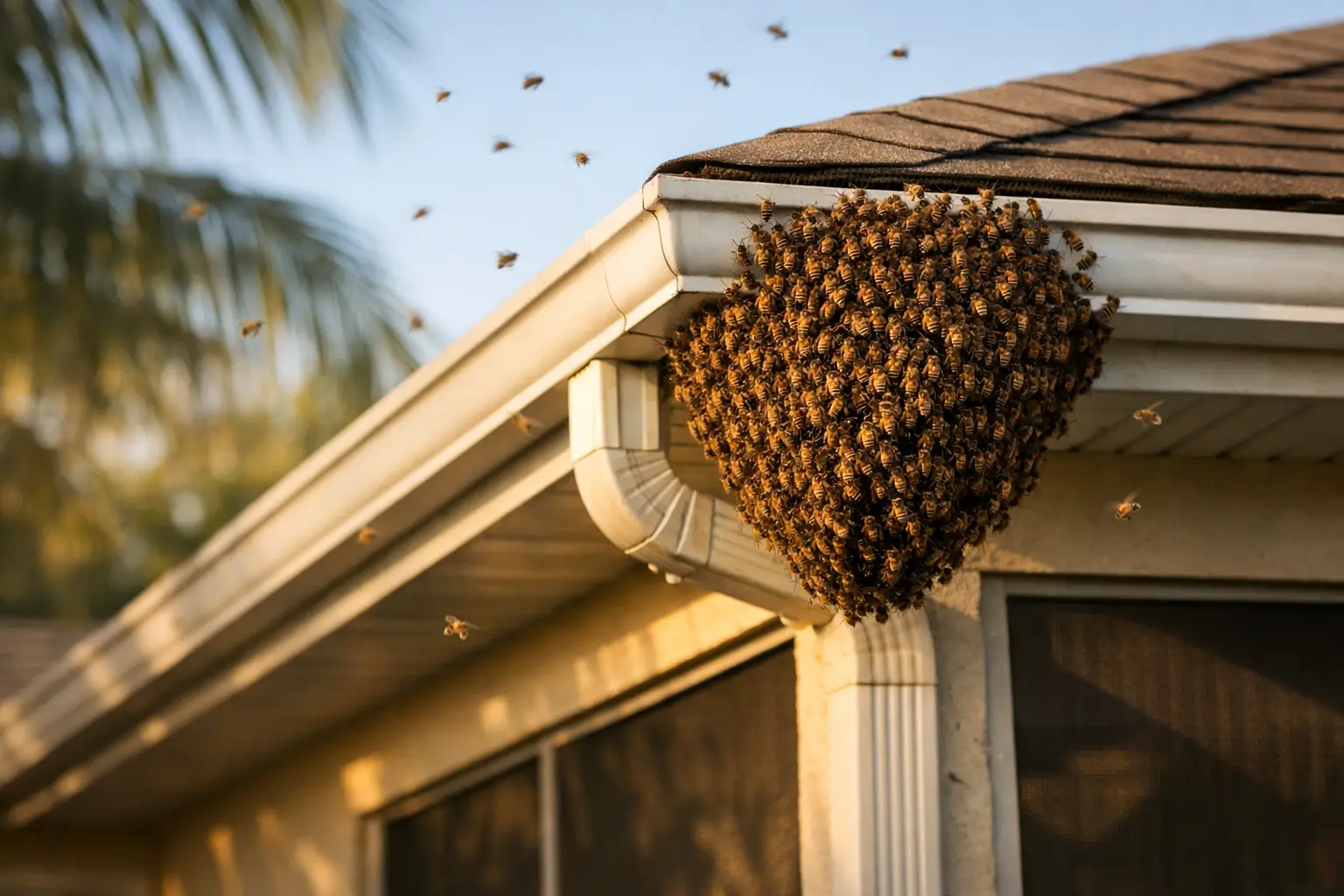

A calm response matters most when bees turn defensive fast. If you are looking for a guide to africanized bee response, start with this: distance saves lives, panic makes things worse, and amateur removal can turn a manageable problem into a medical emergency.
In Southwest Florida, aggressive bee incidents are not abstract. They can happen around soffits, sheds, utility boxes, irrigation covers, palms, and wall voids where a colony has settled out of sight. Many people use the term “Africanized bees” to describe unusually defensive honey bees. That description matters because the immediate risk is not about identifying a bee by sight. It is about recognizing behavior and responding correctly.
What Africanized bee response actually means
A practical Africanized bee response is not a test of bravery. It is a safety procedure. The goal is to get people and animals away from the danger zone, reduce continued stinging, and hand the situation over to trained removal professionals who can secure the colony and the structure.
These bees look very similar to other honey bees. For a homeowner, maintenance worker, HOA manager, or grounds crew member, visual identification is unreliable. Behavior is the real warning sign. If a colony reacts in large numbers, pursues a person for distance, or becomes highly defensive after vibration or disturbance, treat it as a serious incident.
That distinction is important because people often lose time trying to figure out what kind of bee they are seeing. In a defensive event, the right move is response, not diagnosis.
First steps in a guide to africanized bee response
If bees begin attacking, run immediately to an enclosed space such as a vehicle or building. Do not stand still. Do not wave your arms. Do not try to fight the swarm. Put real barriers between yourself and the bees as quickly as possible.
Cover your face while moving, especially your eyes, nose, and mouth. Bees often target the head because carbon dioxide and movement draw them in. If a child or elderly person is nearby, getting them inside takes priority, but do not stop in the open to brush bees away.
Once indoors, remove stingers promptly by scraping them out with a fingernail, card edge, or other firm object. Speed matters more than technique. Do not spend extra time searching for the perfect tool.
Then assess whether emergency medical care is needed. Call 911 right away if the person has trouble breathing, swelling of the throat, dizziness, vomiting, widespread hives, or has sustained many stings. Even without a known allergy, multiple stings can become a medical crisis.
What not to do during an aggressive bee incident
The most common mistakes are also the most dangerous. People hide in bushes, jump into water, try to spray the colony, or attempt to remove a nest after dark. None of those choices solves the immediate risk.
Water is a poor hiding place because bees often wait above the surface. Shrubs and partial cover do not create enough separation. Sprays, foams, and hardware-store pesticides can intensify defensive behavior and scatter bees into other parts of a structure. Poison also creates a second problem inside walls and ceilings – dead bees, melting comb, leaking honey, odor, and secondary pest activity.
There is also a structural issue many property owners miss. If a colony is living inside a building envelope, killing bees without removing comb does not remove the nest. It leaves behind wax, brood, pollen, and honey. In Florida heat, that can quickly turn into staining, fermentation, and damage.
Why colonies become highly defensive
Defensive surges usually have a trigger. Lawn equipment, pressure washing, trimming, roof work, and vibrations from construction can set off a hidden colony. Sometimes children or pets discover the entrance before adults know bees are present. Other times a swarm has recently moved in and the activity is mistaken for something minor until the colony establishes itself.
This is one reason response plans matter for commercial sites and HOAs. Landscapers, maintenance crews, and pool vendors may be the first people exposed. A property manager who gives simple instructions ahead of time can reduce chaos when seconds count.
How homeowners should handle the scene after retreating
After everyone is safely inside, keep them there until bee activity has clearly dropped and professionals advise next steps. Close doors and windows. Bring pets in if it can be done without re-entering the danger area. If animals are trapped outside near the colony, call for help rather than rushing back into the flight path.
From a safe location, note where the bees seem to be entering or gathering. That could be a soffit gap, block wall cavity, meter box, fascia line, tree hollow, or shed roofline. Photos taken from a protected distance can help, but only if doing so does not place anyone back at risk.
If the bees are on a neighboring property or public area, do not assume someone else has already reported it. Notify the property owner or relevant authority promptly. In shared communities, fast communication protects residents, workers, delivery drivers, and children.
A guide to africanized bee response for property managers
For commercial sites and HOAs, the right response is part safety protocol and part liability control. Restrict access to the area immediately. Use cones, temporary barriers, or staff direction to keep people away from the flight path. Suspend landscaping or maintenance work nearby until the colony is professionally assessed.
Then document the location, time, and triggering activity. This is not just paperwork. Patterns matter. If bees become defensive each time hedges are trimmed near a wall void, that points to a concealed colony needing structural removal rather than a quick surface treatment.
The trade-off is speed versus disruption. Managers sometimes want the fastest possible knockdown to reopen an area. But in many cases, the cheapest or quickest chemical approach creates bigger long-term costs if comb remains inside a structure. Humane live removal and relocation can be more involved up front, yet it usually addresses the real source of the issue.
Why professional removal is different from spraying
Professional bee response is not just about taking bees away. It means locating the nest, identifying how the colony is using the structure, removing bees and comb, and closing conditions that invited reentry. If a wall is opened, the cleanup and restoration plan matter just as much as the extraction.
This is where experience matters. A colony in a tree branch is one kind of job. A colony in a cinder block wall, chimney chase, soffit, or roof assembly is another. Structural removals require understanding both bee behavior and building materials.
For that reason, a true response plan should include what happens after removal. Was all comb removed? Was the cavity cleaned? Was the access point sealed? Was the area left vulnerable to another swarm? Those details affect whether the problem is actually solved.
What to expect after stings
Most people with a small number of stings will have pain, redness, heat, and swelling at the sting sites. That is unpleasant but usually manageable. The concern rises when stings are numerous, concentrated around the head and neck, or followed by signs of an allergic reaction.
Children, older adults, and people with limited mobility may have a harder time escaping quickly, which raises exposure risk. Pets are also vulnerable because they investigate with their faces and may not understand how to flee. If an animal has been attacked, contact a veterinarian as soon as possible.
It depends on the person and the number of stings, but no one should minimize a mass-sting event. If there is any doubt, get medical guidance.
Prevention is part of response
The best guide to africanized bee response includes prevention because many serious incidents start with a colony no one realized was there. Watch for steady bee traffic entering one spot in a wall, roof edge, or utility area. Listen for buzzing in voids. Treat repeated bee activity around a structure as a warning, not a curiosity.
Regular inspections help, especially before roofing, painting, tree trimming, or major landscape work. For HOAs and commercial properties, training staff to report bee flight patterns can prevent a dangerous encounter later.
In areas like Southwest Florida, where bees can establish quickly in sheltered spaces, early action makes removal simpler and safer. Companies such as Beeswild.com handle both humane relocation and structural removal, which matters when the goal is to protect people without abandoning the bees to poison or preventable loss.
If you suspect a defensive colony, trust the behavior you are seeing. Back away, secure the area, and bring in qualified help before a hidden nest becomes a public emergency. The smartest move is often the simplest one – give the bees distance, and give the problem to people equipped to solve it.

No responses yet