
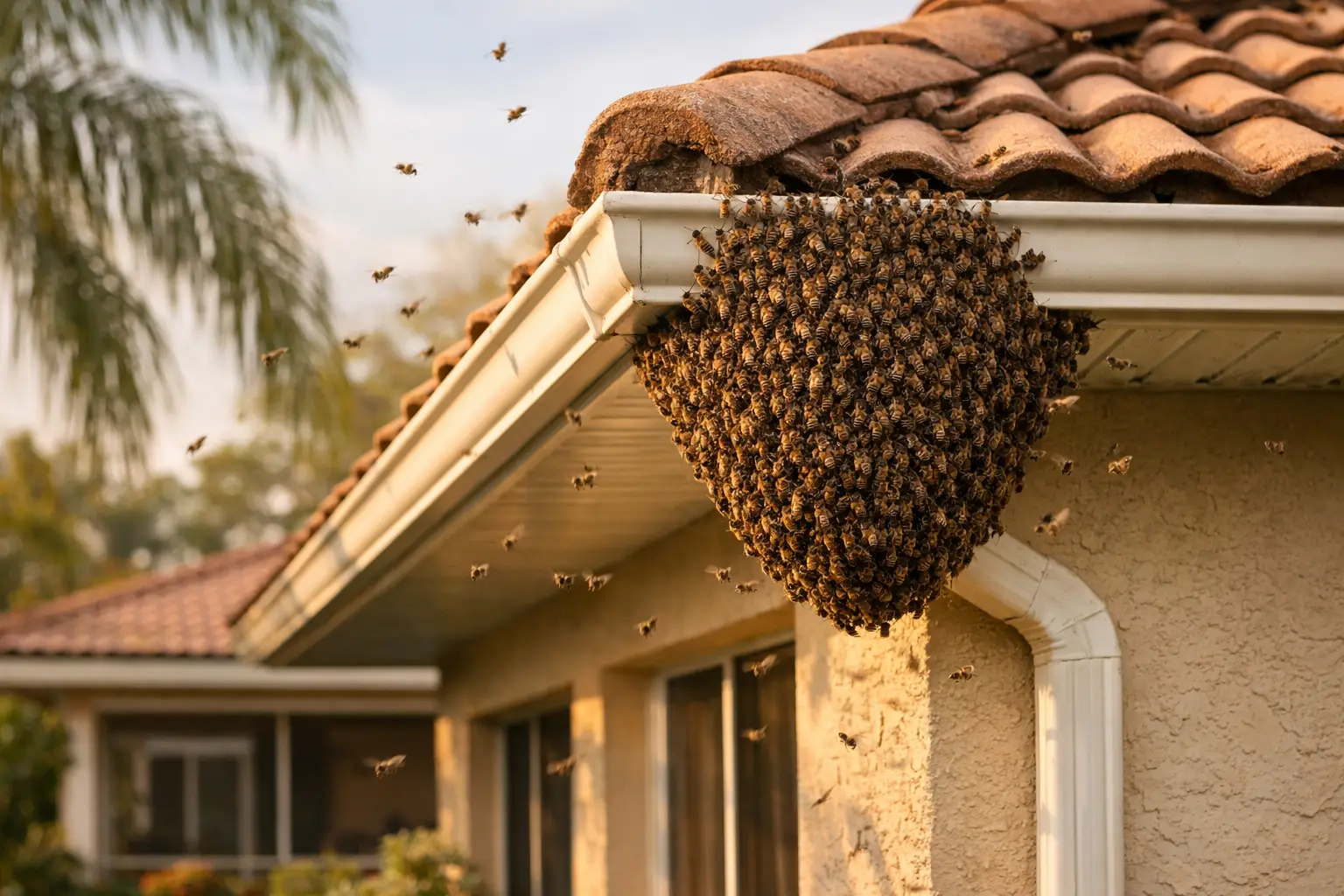

A dark, buzzing cluster on a palm trunk, fence post, or soffit can make any Lee County homeowner stop in their tracks. The good news is that a visible cluster is often a swarm, not an established hive. Lee County swarm removal should begin with distance, calm observation, and a plan to relocate the bees before they choose a wall, roof, or tree cavity as their permanent home.
A swarm is a natural part of honey bee reproduction. When a colony becomes crowded, the old queen leaves with thousands of worker bees to establish a new home. They may gather in a tight ball while scout bees search the area for a suitable cavity. That temporary stop can look alarming, but it is often the best time to arrange live removal.
What to Do When You See a Swarm
Keep children, pets, visitors, and landscaping crews away from the cluster. Do not throw water at it, knock it down, cover it, smoke it, or spray it with household insecticide. A resting swarm is usually focused on protecting its queen and finding shelter, not on defending honey, brood, or a fixed nest. Disturbing it can change that behavior quickly.
Give the bees a wide, clear path. If the swarm is near a doorway, pool area, sidewalk, playground, or business entrance, block off the area rather than trying to move it yourself. Property managers and HOA boards should also notify nearby tenants or residents without creating panic. A brief, factual notice helps prevent someone from taking unsafe action before a professional arrives.
Take a photo only from a safe distance if it can help identify the situation. The location matters as much as the image. Bees clustered on an accessible branch may be collected differently than bees gathering under a second-story eave or entering a gap around a utility box.
A swarm is not always an emergency, but location changes the risk
A swarm in an unused corner of a large lot may remain calm while scouts search for a home. A swarm beside a front door, outdoor dining area, school route, or public walkway deserves faster attention because people are more likely to get too close.
In Southwest Florida, warm weather extends bee activity for much of the year. A swarm can settle into a structural void sooner than a homeowner expects. Once bees begin entering and exiting the same crack in a wall, soffit, roofline, shed, or chimney for several days, the situation may no longer be a simple swarm collection. It may be an established colony that requires a more involved removal.
Lee County Swarm Removal Starts With the Right Identification
Not every flying insect cluster is a honey bee swarm. Honey bees are generally brown and gold, somewhat fuzzy, and gather in a dense, living cluster when they swarm. They may fly in a cloud around the cluster, especially during arrival or departure.
Wasps, hornets, and yellowjackets have different removal needs. They tend to have smoother bodies, narrower waists, and exposed paper nests or ground entrances. Do not assume that every nest should be handled as a bee relocation. Correct identification protects the public and ensures the right service response.
It is also not possible to determine whether honey bees are defensive or potentially Africanized simply by looking at them. In Florida, that is one more reason to avoid do-it-yourself removal. Behavior, location, disturbance, weather, and the presence of an established colony all affect risk. A trained removal professional evaluates the scene before choosing an approach.
The key difference between a swarm and a colony
A swarm is typically temporary and usually has no stored honeycomb at the spot where it is hanging. An established colony has comb, brood, honey, pollen, and a defended home. You may notice a steady line of bees entering a small opening throughout the day. You may also hear buzzing inside a wall or see wax, staining, or sticky material near an entry point.
That distinction matters for your property. Removing visible bees while leaving comb and honey behind can create a larger problem later. Honey can melt or ferment in Florida heat, stain drywall or ceilings, attract ants and roaches, and draw new bee colonies to the same scent-rich cavity. Proper structural removal addresses both the bees and the material that would otherwise remain inside.
Why Spraying a Swarm Often Creates a Bigger Problem
A can of insecticide may seem like the fastest answer, especially when a swarm is close to a home. In practice, spraying can agitate bees, scatter them into nearby voids, and leave injured or dying insects around an area used by children and pets. If bees have already moved into a structure, poison may kill part of the colony while leaving honeycomb, honey, wax, and other attractants behind.
There is also an ecological cost. Honey bees are agricultural livestock and essential pollinators. They support flowering plants, gardens, and food production. A live removal approach recognizes the homeowner’s need for safety without treating a recoverable colony as disposable.
Relocation is not a promise that every bee can be saved in every condition. Severe structural damage, inaccessible locations, and safety hazards can affect the available options. Still, for a reachable swarm or a manageable colony, professional live removal offers a practical path that protects people while preserving bees whenever possible.
What Professional Live Removal Looks Like
For a straightforward swarm, the process may involve carefully collecting the clustered bees and queen into a transport container. The bees are then moved to an apiary or another approved safe location where they can establish themselves away from homes and public spaces.
For colonies inside walls, roofs, soffits, or other structures, the work is more technical. The removal team first identifies the main entrance and estimates where the comb is located. Access is created as carefully as conditions allow, bees and comb are removed, and the cavity is cleaned of honey and wax residue. The opening should then be repaired or sealed so another colony cannot use the same route.
The least invasive option is not always the safest or most durable option. For example, trying to avoid opening a section of soffit may sound preferable, but leaving comb inside can lead to repeated bee activity and property damage. A transparent provider should explain what must be opened, what will be removed, and what follow-up steps are needed before work begins.
Beeswild combines live bee removal with bee farming, meaning rescued colonies can be rehomed in managed apiary locations rather than simply moved from one neighborhood to another. Its three-month same-place-removal warranty also addresses a common concern: whether bees will return to the original entry point after removal.
Preventing the Next Colony From Moving In
After swarm or colony removal, prevention is mostly about closing off attractive cavities. Honey bees seek protected, dry spaces with a small entrance, particularly around rooflines, soffits, wall penetrations, sheds, and utility openings. A pencil-sized gap can be enough for workers to enter and expand their use of a void.
Inspect areas where bees were active, but do so after removal rather than while bees are present. Repair damaged screens, close construction gaps, secure loose fascia, and make sure vents have suitable coverings that maintain airflow. If a structural removal was performed, confirm that remaining openings are sealed only after all bee activity and comb removal have been addressed.
Landscaping can help reduce surprise encounters, though flowering plants should not be treated as the enemy. Keep heavily blooming shrubs away from doorways and play areas when possible, and avoid placing sweet drink stations, open trash, or pet food near known bee activity. These steps will not stop every swarm, but they reduce conflict around high-traffic parts of the property.
A swarm does not mean your home has failed, and it does not require a rushed, harmful response. Give the bees space, keep people away, and act before a temporary cluster becomes a costly structural colony. That measured response protects your household now and gives the bees a real chance to keep doing the work Florida landscapes depend on.

No responses yet