

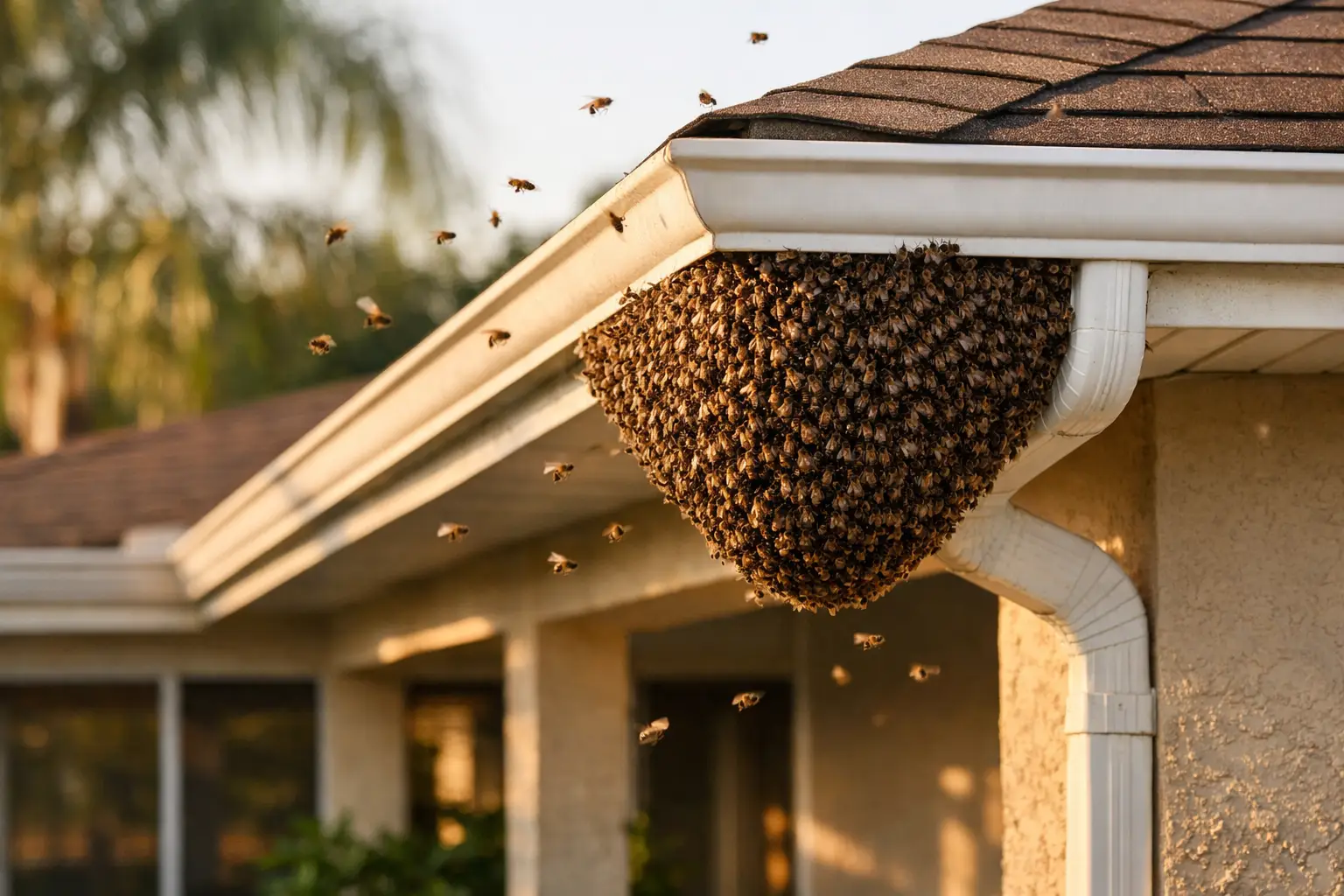

A bee swarm on house siding can stop a normal day fast. One minute you are taking out the trash or letting the dog out, and the next there is a dense cluster of bees hanging from an eave, shutter, or entryway. It looks alarming, but the right response is usually calm, distance, and a quick call to a professional who handles live removal.
For homeowners, the hardest part is not knowing whether the bees are just resting or already moving in. That distinction matters. A swarm is often temporary. A colony inside a wall, roofline, soffit, or chimney is a structural problem that gets worse with time.
What a bee swarm on house usually means
When honey bees swarm, they are not attacking your home. They are reproducing as a colony. Part of an existing hive leaves with a queen and gathers in a temporary cluster while scout bees search for a permanent cavity. Your house can become that temporary stop.
That is why a swarm often appears as a football-shaped mass of bees attached to a branch, gutter, fence, mailbox, or exterior wall. In many cases, the bees have been there only a few hours. Sometimes they move on. Sometimes they decide your structure offers exactly what they need – shade, protection, and a hollow space.
This is where people get into trouble. They assume the bees will leave on their own, wait two or three days, and then discover steady traffic going into a crack in the fascia or soffit. At that point, it may no longer be a simple swarm pickup. It may be a colony establishing comb inside the building.
Bee swarm on house vs bees in the house structure
A cluster on the outside is not the same as a hive in the structure. A swarm usually hangs together in one visible mass. It may look dramatic, but it is often less defensive than an established colony because it has no brood or stored honey to protect.
A structural colony behaves differently. You may see a stream of bees flying in and out of one small opening. The activity tends to increase during warm daylight hours. You might hear buzzing in a wall or ceiling. In more advanced cases, honey starts staining drywall or dripping from soffits.
The trade-off is simple. A visible swarm can often be removed quickly if caught early. Once bees move inside, removal becomes more technical because the comb, brood, honey, and entry points all need to be addressed. Removing only the flying bees is not enough.
Why waiting can make the problem more expensive
Honey bees build fast in Florida conditions. If they enter a wall void or roof cavity, they can produce comb and store honey surprisingly quickly. That creates three separate issues.
First, the colony becomes harder to remove safely. Second, leftover wax and honey attract ants, roaches, beetles, rodents, and even new swarms later. Third, heat inside walls can melt honey and damage finishes.
This is one reason poison is such a poor solution for a home infestation. Even if it kills the bees, it does not remove the comb. Dead bees, fermenting honey, and contaminated wax stay inside the structure unless someone opens the area and cleans it properly.
What to do if you find a bee swarm on house exterior
Start by keeping people and pets away from the area. Do not spray water, throw objects, bang on the wall, or try to smoke the bees out. Vibrations and disturbance can turn a manageable situation into a dangerous one.
If the swarm is near a front door, garage, walkway, pool equipment, or play area, use another entrance if possible. Keep children inside. If anyone in the home has a known sting allergy, treat the situation with extra caution and create a wider buffer zone.
Next, observe from a safe distance. Are the bees tightly clustered in one spot, or are they entering a crack or hole? That detail helps determine whether you are looking at a resting swarm or a colony starting to occupy the structure.
A clear photo can be useful for identification and planning, but only if you can take it without getting close. There is no need to inspect the area with a ladder. Rooflines, soffits, and second-story entries are common places for bees to settle, and those locations add fall risk to an already stressful situation.
What not to do
Home remedies cause more damage than most people expect. Store-bought sprays may kill some bees while driving the rest deeper into the structure. Sealing the entry hole too soon can trap bees inside walls, force them into living spaces, or leave behind a hidden mass of comb and honey.
Calling a general pest company can also be a mixed result if your goal is to preserve the bees and protect the structure. Some companies exterminate but do not perform full removal of comb inside building materials. If bees have entered the house envelope, you need a plan that addresses the whole nest site, not just the surface activity.
When a swarm is an emergency
Not every swarm is aggressive, but location matters. A cluster beside a bedroom window is different from one high in a tree at the back of the lot. A small group near a public sidewalk, school pickup line, restaurant patio, HOA mailbox station, or business entrance can become a liability issue very quickly.
Aggression also changes the urgency. If bees are chasing, stinging unprovoked, or reacting strongly to normal activity from several yards away, do not approach. In Southwest Florida, that can raise concern about defensive genetics, and professional handling matters even more.
For commercial properties and associations, speed matters because foot traffic keeps coming whether the bees are ready or not. Restrict access to the area and bring in a qualified live removal specialist as soon as possible.
How live bee removal works
A proper response depends on where the bees are and whether they are truly swarming or already nesting. For an accessible cluster, a beekeeper or removal specialist may be able to collect the bees and relocate them with minimal disruption.
For a colony inside a wall, roof, soffit, or other cavity, the process is more involved. The technician identifies entry points, confirms the nest location, opens the necessary area, removes the bees and comb, and cleans out honey and wax residue. Then the space can be prepared for repair and sealed correctly so another swarm is less likely to reuse it.
That last step is often overlooked. Bee removal is not just about getting insects out of sight. It is about removing the attractants that make your home vulnerable again.
In Cape Coral and across Southwest Florida, where warmth extends bee activity for much of the year, homes with gaps around rooflines, utility penetrations, and soffits are especially appealing. Humane relocation protects a valuable pollinator while also protecting the building from recurring infestations.
How to lower the chance of another bee swarm on house surfaces
You cannot make a property invisible to scout bees, but you can make it less inviting. Exterior gaps, damaged soffits, loose fascia, unsealed wall penetrations, and uncapped voids are the main problem areas. If a cavity is dry, shaded, and protected, bees may see it as prime real estate.
Routine exterior maintenance matters more than most people realize. A home that looks solid from the ground can still have entry points along roof returns, attic vents, chimney flashing, or trim lines. After a removal, sealing and repairing those areas is part of preventing a repeat situation.
It also helps to stay alert during warm swarm periods. If you notice scout bees checking the same crack repeatedly, that can be an early warning sign before a full colony moves in.
The safest mindset for homeowners
Fear is understandable. So is the urge to fix the problem immediately. But with bees, the fastest-looking solution is often the one that creates the biggest repair bill later.
A bee swarm on house surfaces may be temporary, or it may be the first stage of a structural hive. Either way, the safest move is not force. It is correct identification, safe distance, and professional removal that protects both people and the property.
If you are in Southwest Florida and facing that situation, a company like Beeswild handles the problem with both outcomes in mind – getting the bees off your home and getting them somewhere they can continue doing the work bees are supposed to do.
When bees choose your house, treat it as a time-sensitive building issue, not a weekend experiment.

No responses yet