

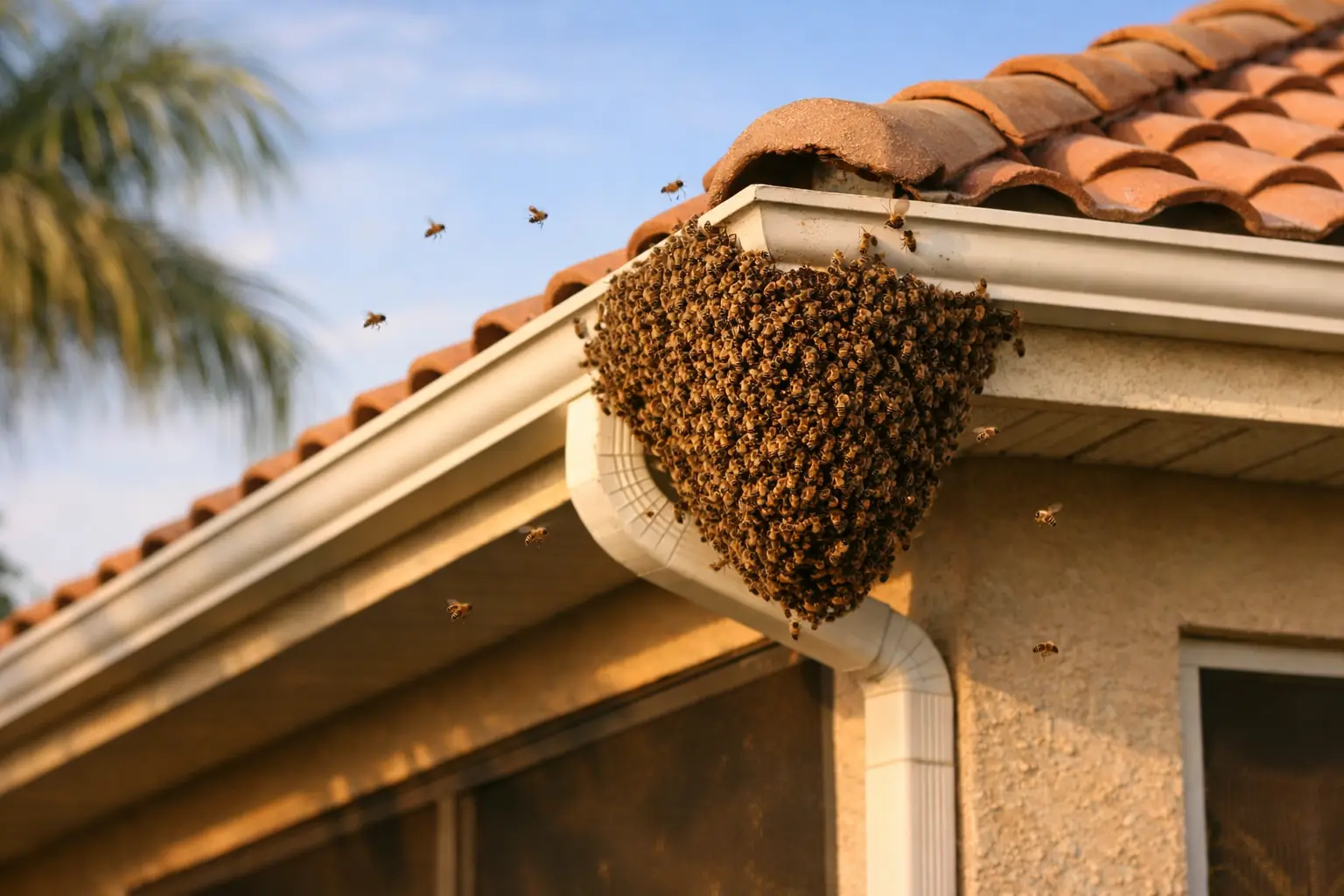

A dark patch under the soffit. A steady line of bees slipping through a gap in the block wall. A sudden swarm hanging from a tree by the driveway. In Collier County, that is usually the moment people realize bee removal Collier County is not a simple pest-control job. The right response has to protect people first, but it also has to deal with what is happening inside the structure, not just the bees you can see outside.
That distinction matters more than most property owners expect. A swarm resting on a branch is very different from an established colony inside a wall, roofline, shed, or meter box. One may be temporary. The other may already contain comb, brood, pollen, and stored honey. If the colony is left in place, or if it is killed without being fully removed, the remaining wax and honey can melt in the Florida heat, stain drywall, attract ants and roaches, and sometimes bring in rodents.
Why bee removal in Collier County needs a structural approach
Southwest Florida gives bees what they need almost year-round – warmth, water, flowering plants, and plenty of protected cavities in homes and commercial buildings. That is why colonies commonly settle in soffits, eaves, masonry voids, roof returns, pool enclosures, and utility areas. By the time you notice regular flight activity, the colony may have been there for weeks or months.
This is where many quick fixes fail. Sprays and foams may kill some or all of the bees, but they do not remove the comb and honey inside the structure. From a property standpoint, that is often the bigger problem. Dead bees can decompose inside the cavity. Honey can ferment or leak. The odor can attract new swarms looking for an established nesting site.
A proper live removal is more than collecting visible bees. It usually means opening the affected area as carefully as possible, cutting out comb, removing the queen if located, vacuuming or hand-collecting the colony, and cleaning the cavity so the site is less attractive for re-entry. If the opening is not repaired or sealed correctly afterward, the problem can repeat.
Bee removal Collier County homeowners often need most
For most homeowners, the real question is not just, “Can someone get rid of these bees?” It is, “Can this be handled safely without making the house problem worse?” That concern is justified.
If bees are entering and exiting one small opening every day, especially in the same pattern, that usually suggests an established colony. If you hear buzzing in a wall or ceiling, see staining near an entry point, or notice increased activity during the warmest part of the day, the colony may be larger than it appears from outside. In those cases, trapping or spraying from the exterior rarely solves the full issue.
A humane removal company focused on relocation will assess where the bees are nesting, how extensive the comb may be, whether the structure needs to be opened, and what safety steps are needed for people and pets nearby. That process is slower than a simple spray, but it is usually the more honest solution.
There is also an ecological reason to choose relocation when possible. Honey bees are not disposable insects. They are managed livestock and major pollinators. When a healthy colony can be rescued and rehomed, that supports agriculture while still resolving the immediate risk at the property.
Swarm versus colony – why the difference matters
A swarm is typically a temporary cluster of bees resting while scout bees search for a permanent home. Swarms often look dramatic, but they are usually less defensive than a colony protecting brood and honey stores. In many cases, a swarm can be collected without opening a structure.
A colony inside a wall, however, is established and invested in that location. That means more defensive behavior is possible, especially if the nest is disturbed. It also means there is something physical left behind if the bees are simply killed. For property owners, this is the difference between a pickup and a structural removal.
What to expect from a professional live removal
A good removal starts with inspection, not assumptions. The technician needs to identify the entry point, estimate nest location, and determine whether the bees are accessible from the exterior or through an interior wall or ceiling area. In Collier County, construction style matters. Stucco homes, block walls, tile roofs, and soffit systems all change how a colony is approached.
Safety comes next. If the bees are near a front door, pool deck, playground area, or business entrance, the area may need to be cleared during active work. Commercial properties and HOAs have an added layer of concern because any sting incident can become a liability issue. That is one reason professional documentation, insurance, and a clear scope of work matter.
Then comes the actual removal. In a live structural removal, the goal is to preserve the colony when feasible while also removing comb and honey from the cavity. This is the part many general pest companies do not handle thoroughly. If the comb remains, the property remains vulnerable.
After the bees and comb are removed, the cavity should be cleaned and, when possible, corrected so future swarms are less likely to move in. Some companies also offer a same-place warranty period, which can be valuable because reinfestation risk depends heavily on whether the original void was properly cleaned and sealed.
Why poison is often the expensive shortcut
People understandably look for the fastest fix when bees are close to family, customers, or employees. But the cheapest immediate option can create the most expensive repair path later.
Poison may stop visible flight activity, which makes it look like the issue is solved. Inside the wall, though, the wax, brood, and honey remain. In Florida heat, that material can slump, leak, and draw pests. If another swarm detects residual odor from old comb, the site may be colonized again. So the cost is not just another bee problem. It can become a drywall, paint, insulation, or cleanup problem too.
That does not mean every situation is simple or ideal for live rescue. Access can be difficult. Weather can interfere. Aggression level matters. In some emergency situations, public safety has to come first. But in general, if a colony is reachable and the work is done by an experienced bee removal specialist, relocation is the more complete and responsible method.
For HOAs, businesses, and public sites, response time matters
A bee issue at a private home is stressful. At a clubhouse, restaurant patio, school area, or municipal structure, it becomes a public-safety event. The pressure is different because managers have to think about foot traffic, signage, access control, and documentation.
That is why bee removal in Collier County often needs more than a casual beekeeper pickup. Structural removals at shared properties require a contractor who understands both bee behavior and building conditions. If aggressive bee activity is reported near walkways or entrances, the response has to be immediate, controlled, and practical.
When to call right away
If bees are entering a structure in a steady pattern, if you see a cluster forming on the building, or if anyone nearby has a sting allergy, do not wait to see if the problem goes away. The same is true if the colony is near a doorway, pool equipment, mail kiosk, playground, or commercial entrance.
You should also move faster if you notice sudden defensive behavior, such as bees reacting strongly when people walk by or when lawn equipment is used nearby. Not every colony behaves the same way. Temperament can vary, and in Florida that is not something to treat casually.
For property owners in Southwest Florida, working with a company that handles live removal and relocation to managed farm areas can make a real difference. Beeswild.com LLC, for example, pairs structural removal with rehoming, which is a more complete approach than simply eliminating visible bees and leaving the nest materials behind.
The best next step is usually the simplest one: treat bee activity as both a safety issue and a building issue. The sooner the colony is identified correctly, the better your chances of avoiding stings, hidden damage, and a second removal later.

No responses yet