
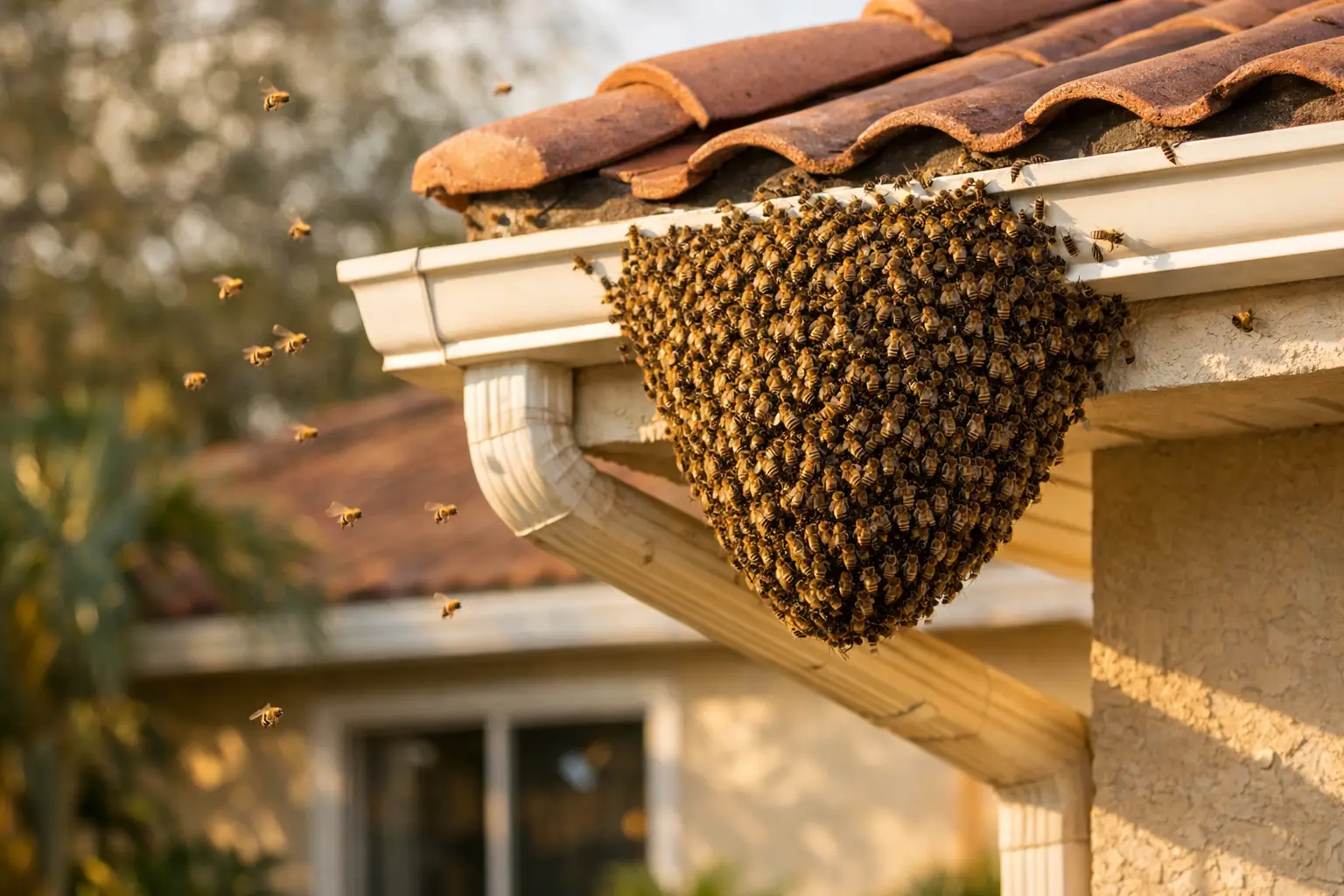

A lot of bee problems start the same way – a few insects near a soffit, a faint buzzing in the wall, or a steady line of bees disappearing into a gap no wider than a pencil. By the time most people search for the top places bees build hives, the colony is often already established. Knowing where bees prefer to move in can help you spot an issue early and respond before honey, wax, brood, and defensive behavior turn a small concern into a structural one.
Bees do not choose hive sites at random. Scout bees look for enclosed, protected spaces that stay relatively dry, hold a stable temperature, and have a defensible entrance. In Florida and other warm climates, that often means human structures are just as attractive as natural cavities. The result is a mix of harmless-looking swarms in the open and fully developed colonies hidden inside buildings.
Why bees choose certain hive locations
Honey bees are trying to solve a simple problem. They need a cavity large enough to support comb, brood, pollen, and honey stores, but small enough to defend from predators and weather. They also prefer an entrance that can be guarded by a few worker bees and a space that does not flood or overheat too quickly.
That is why the best hive sites, from a bee’s perspective, are usually sheltered voids. A colony can survive in the open under some conditions, but long-term success is much more likely inside a hollow tree, wall cavity, roofline, or utility box. If a location smells like wax or old honey from a previous colony, it becomes even more attractive.
Top places bees build hives around homes and buildings
1. Wall voids
Wall cavities are one of the most common places for established colonies. Bees can enter through a crack in siding, a gap around utility lines, a missing vent screen, or a seam near brick or stucco. Once inside, they are protected from rain, predators, and temperature swings.
For homeowners, wall colonies are a serious issue because the visible bee traffic outside can look minor while the internal hive grows fast. If the colony is killed with pesticide instead of removed properly, the remaining honey and brood can melt, ferment, stain drywall, and attract ants, roaches, beetles, rodents, and new swarms.
2. Soffits, eaves, and rooflines
Roof overhangs create exactly the kind of protected entry points scout bees like. Small construction gaps near soffits, fascia boards, and eaves can lead into large hidden spaces. These areas stay dry, are elevated off the ground, and are often left undisturbed for long periods.
This is especially common in residential neighborhoods where repeated building designs create the same weak points from house to house. If you see bees consistently entering the same corner of a roofline, that usually signals more than a temporary swarm.
3. Hollow trees
In nature, hollow trees are classic hive sites. They offer a thick insulating shell, a narrow entrance, and enough room for comb development. When people imagine where bees belong, this is often the picture they have in mind.
That said, a tree colony is not automatically harmless. It depends on the location. A colony in a remote wooded area may be fine left alone, while one in a hollow tree by a playground, sidewalk, pool deck, or front yard creates a different risk profile.
4. Attics and ceiling spaces
Attics are less common than wall voids, but when bees gain access, they can build substantial colonies there. Vents without screens, damaged roof transitions, and gaps around gables can all provide entry. Once inside, bees may attach comb to rafters, decking, or insulation supports.
Attic colonies can become expensive because they are often discovered late. People may first notice a sweet odor, dark staining, or bees appearing inside light fixtures or air vents. In hot regions, attic heat can also soften comb and increase the chance of honey damage if the colony is mishandled.
5. Chimneys
Unused or poorly screened chimneys are another attractive cavity. They are vertical, enclosed, and relatively protected. Bees can build comb hanging downward inside, sometimes for a surprisingly long time before anyone notices.
Chimney colonies come with trade-offs. Removal can be straightforward in some setups and very difficult in others. If a fireplace is used while bees are inside, heat and smoke can stress the colony and push bees into adjoining living spaces.
6. Sheds, barns, and outbuildings
Detached structures are ideal because they usually have gaps, low traffic, and plenty of sheltered corners. Bees may occupy wall cavities, rooflines, old equipment, or exposed framing inside a shed or barn.
These colonies are sometimes tolerated longer because they are not in the main living space. Still, they can become a hazard when someone suddenly disturbs them with lawn equipment, storage cleanup, or repairs. A quiet outbuilding can host a large colony without much outward evidence.
7. Utility boxes and meter boxes
Electrical boxes, irrigation boxes, and meter enclosures can attract bees because they are compact, enclosed, and warm. These are high-priority situations because they mix stinging insects with essential equipment and frequent service access.
Not every box with bee activity contains a full colony, but many do. This is not a do-it-yourself problem. Utilities and bee removal professionals need to manage it carefully due to shock risk, public safety, and the possibility of defensive behavior in a confined space.
8. Ground cavities and abandoned structures
People often assume ground nests belong only to yellowjackets, but honey bees can occasionally occupy cavities near the ground, especially if there is an existing void. Crawl spaces, old drainage structures, retaining wall gaps, and abandoned enclosures can all work.
These sites are less typical for managed honey bee housing but still very possible in the field. The challenge is that bee traffic is easier to miss until someone mowing, digging, or landscaping gets too close.
9. Under decks, porches, and stair voids
Any structure that creates a protected cavity with a small access point can attract bees. The void under a porch roof, behind skirting, or beneath exterior stairs often checks every box. These spots are shaded, dry, and rarely inspected closely.
They are also close to people and pets. A colony under a deck may seem calm most of the time, but routine vibration from footsteps, outdoor furniture movement, or pressure washing can trigger defensive responses.
10. Old hive sites
One of the most overlooked answers to the question of top places bees build hives is simple: where bees have already lived before. Residual wax, propolis, and brood odor make previous colony sites highly attractive to new swarms.
This is why repeat infestations happen. If a colony was removed but the cavity was not cleaned and sealed correctly, scout bees may find it again. A good repair matters almost as much as the removal itself.
What makes a location more likely to attract bees
Bees are opportunistic, but they are not careless. They tend to favor spaces with weather protection, a manageable entrance, and enough interior volume to expand. They also benefit from nearby water and flowering resources, which is one reason developed neighborhoods can support colonies so easily.
In Southwest Florida, warm weather extends bee activity and swarming opportunities across much of the year. That does not mean every cluster of bees is a permanent hive. A swarm hanging on a branch may just be resting while scout bees search. But if bees are entering a structure steadily over several days, that usually points to an active nesting site.
When a hive location becomes a property problem
A bee colony does not have to be aggressive to be a problem. The real issue is often where it is located and what happens if it is ignored. Colonies in walls, roofs, and chimneys can cause staining, odors, insect secondary infestations, and expensive repairs. Colonies near entryways, playgrounds, pool equipment, or commercial walkways also create a safety concern.
It depends on the setting. A hive in a distant tree cavity may be monitored. A hive in a school sign, HOA clubhouse wall, or family home’s soffit usually needs fast action. Humane live removal is often the best path because it addresses both the immediate risk and the long-term structural consequences of leaving comb behind.
A smarter way to respond when you find bee activity
If you notice steady bee traffic into a wall, roofline, box, or cavity, avoid sealing the entrance or spraying it yourself. That can drive bees deeper into the structure or leave dead bees and melting honey inside. The better first step is to identify whether you are looking at a temporary swarm or an established colony, then have the site evaluated for safe removal and repair.
For property owners in Southwest Florida, that usually means acting sooner rather than later. Beeswild handles live bee removal with the goal of preserving the colony while protecting the structure, which is the right balance when bees are valuable livestock but the hive is in the wrong place.
The helpful habit is simple: if bees are moving in and out of the same spot like they own it, believe them early.

No responses yet