

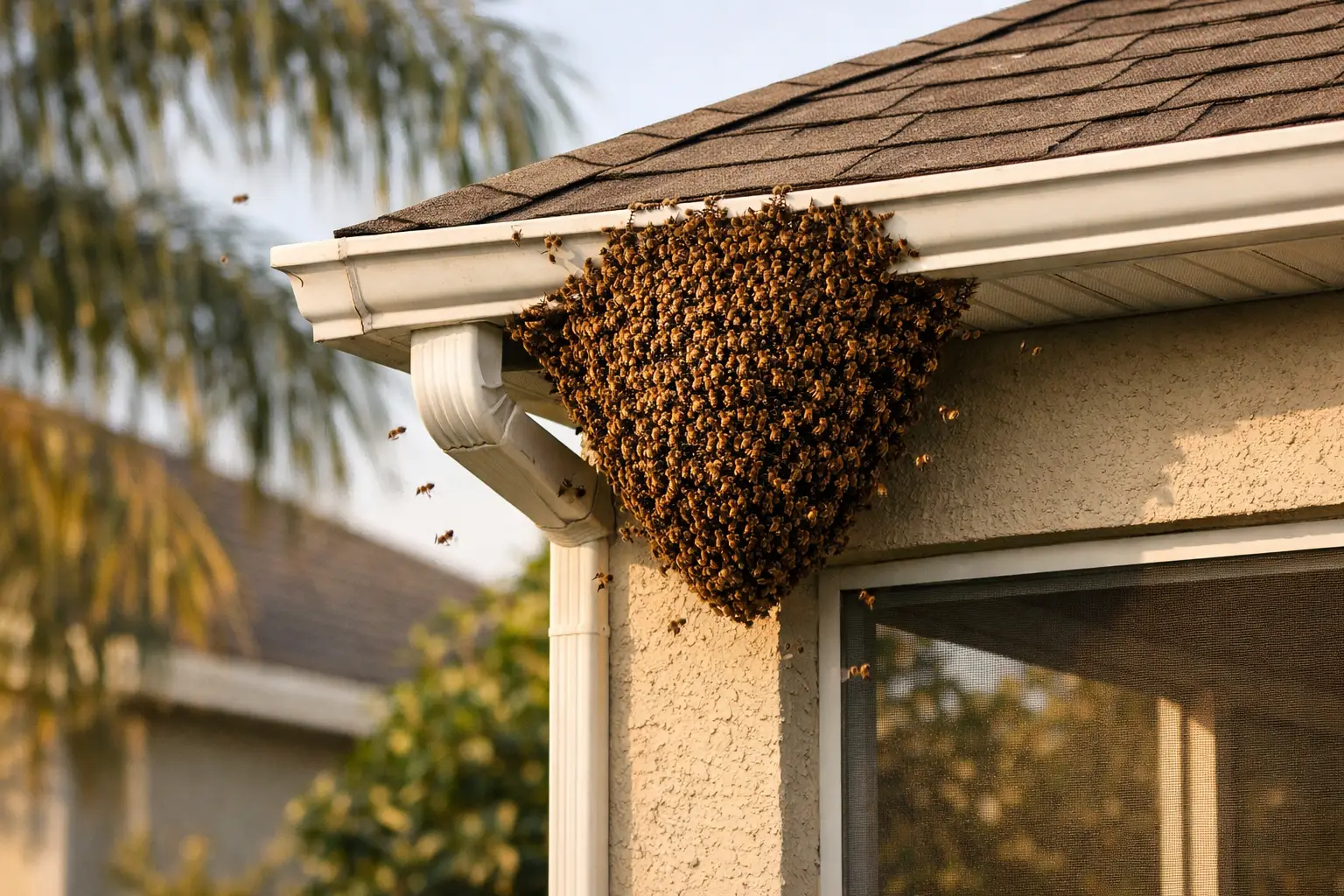

If you have bees going in and out of a wall, soffit, roofline, or block column, the first question is usually simple and urgent: how much does bee cutout cost? The honest answer is that bee cutout pricing varies widely because you are not just paying to remove insects. You are paying for skilled structural access, live colony removal, comb and honey cleanup, safety planning, and the work required to keep the same space from becoming a problem again.
A true cutout is different from catching a swarm on a branch. A swarm is usually exposed and temporary. A cutout means the bees have already moved into a structure and built comb. That changes the labor, the risk, and the cost.
How much does bee cutout cost in real life?
For most structural removals, bee cutout cost commonly falls somewhere between a few hundred dollars and a few thousand dollars. Small, accessible jobs may start in the lower range. Large colonies inside stucco walls, tile roofs, chimneys, sheds, soffits, or second-story areas can cost much more.
That range sounds broad because the work itself is broad. Some removals take under an hour with minimal opening. Others require partial demolition, ladder work, protective setup, careful comb extraction, bee vacuuming, cleanup, and sealing recommendations. If the colony has been there for months or years, there may be gallons of honey and a lot more comb than the homeowner expects.
As a rule, the price rises when the bees are harder to reach, the colony is bigger, or the structure is more delicate to open and restore.
What drives bee cutout cost?
1. Where the bees are living
Location is one of the biggest price factors. Bees inside an easy-to-access shed wall are usually less expensive to remove than bees buried behind interior drywall, under a flat roof, or inside a block structure.
Soffits, eaves, and exterior walls can sometimes be opened with less disruption. Interior walls may require extra protection for flooring and furniture, more cleanup, and more coordination with repair work. Roof cutouts can be especially expensive because roof systems are harder to open correctly and harder to put back together without creating future water issues.
2. Colony size and age
A newer colony is often simpler than an established one. Once bees have been in place for a while, they build more comb, store more honey, and spread farther through the cavity. That means more time to remove material completely.
This matters because leaving comb and honey behind is not a small detail. Residual honey can melt into walls, stain finishes, attract ants and roaches, and invite new bee colonies into the same void. Proper cutout cost reflects proper removal, not just knocking the bees down for the day.
3. Height and access difficulty
Ground-level removals are different from second-story gables, rooftops, or awkward overhangs. The moment a job requires tall ladders, lift equipment, more technicians, or additional safety controls, the cost goes up.
Access also includes whether the crew can work directly at the entry point or whether landscaping, fencing, pool cages, solar panels, or attached structures slow the process down.
4. Aggression and safety conditions
Not every colony behaves the same way. Some are relatively calm. Others are highly defensive, especially in hot weather, after storms, or when the colony is disturbed by lawn equipment, vibration, or previous failed treatment attempts.
If there are children, pets, neighboring homes, foot traffic, or a business entrance nearby, the removal plan may need more containment and more labor. Safety affects cost because experienced bee removal is not random pest spraying. It is controlled fieldwork around live livestock.
5. Whether repairs are included
This is where many quotes get confusing. Some companies price removal only. Others include opening and closing the area. Others remove the bees and comb but leave restoration to a contractor.
So when comparing estimates, ask a precise question: does this price include structural opening, comb removal, honey cleanup, and closure of the access area? If not, what part is separate?
A lower quote may not be lower once you add drywall, stucco, siding, fascia, roofing, paint, or insulation repair.
Why cheap bee removal often gets expensive later
Homeowners under stress understandably look for the fastest low number. The problem is that cheap bee work often means incomplete bee work.
If someone kills the bees but leaves the comb, honey, brood, and scent behind, the structure can continue to suffer. Honey can ferment or leak. Wax and brood attract pests. New scout bees can move into the same cavity later. That is one reason a proper same-place-removal warranty has value. It shows the company understands recurrence risk and stands behind the work.
Poison-only treatments also create a false sense of closure. Dead bees do not remove the cause. The comb is still there. The cavity still smells like a bee home. In structural colonies, that is where the hidden cost lives.
What a professional cutout usually includes
A real cutout generally involves locating the colony, opening the structure as needed, removing the bees alive when possible, extracting comb and honey, cleaning the cavity, and addressing the conditions that made the space attractive.
It may also include relocating the colony to an apiary or other managed bee yard rather than destroying it. For an eco-conscious homeowner or property manager, that matters. Honey bees are valuable agricultural livestock, and humane relocation protects both public safety and pollination resources.
In Southwest Florida, where warmth supports year-round bee activity, speed matters too. A small colony can become a much larger structural problem surprisingly fast.
How to compare estimates without getting misled
When you ask how much does bee cutout cost, the better question is often what exactly am I getting for that price?
Ask whether the estimate includes live removal, full comb removal, honey cleanup, disposal of contaminated materials if needed, and closing the opening. Ask whether there is a warranty for same-place reinfestation. Ask what happens if the colony is larger than expected once the wall or soffit is opened.
It is also fair to ask how the company handles bee relocation. A specialist in live removal and rehoming is solving a different problem than a general pest company using chemical control. If your goal is to protect your property without wasting a healthy colony, the method matters just as much as the quote.
Residential vs commercial bee cutout cost
For homeowners, the price usually depends on structure type, urgency, and damage risk. For commercial properties, HOAs, restaurants, retail centers, and municipal sites, cost often includes another layer: liability management.
A colony near an entryway, playground, pool area, or public walkway may need after-hours scheduling, site control, or rapid-response handling. Commercial clients also tend to need documentation, insurance verification, and coordination with maintenance teams. That does not always make the job dramatically more expensive, but it can change the scope.
When the higher quote is actually the better value
A higher estimate can make sense if it reflects better access planning, more complete removal, or stronger post-removal protection. That is especially true with established colonies inside walls and roofs.
If one company plans to remove all comb and clean the cavity while another only treats visible bees, those are not equal services. One is solving the structure problem. The other may just delay it.
This is where experience matters. A company that understands both bee behavior and building cavities is less likely to miss hidden comb, secondary entrances, or moisture-related damage.
A realistic way to budget for a cutout
If you suspect a structural colony, plan for two categories of cost: the bee removal itself and any finish repairs that may follow. Sometimes they are bundled. Sometimes they are not. The safest approach is to ask for that breakdown before authorizing work.
Photos help, but they do not always tell the full story. Once the cavity is opened, the colony may be smaller than feared or much larger. Good operators will explain that uncertainty upfront rather than promising a flat number that ignores what is behind the wall.
For property owners in Southwest Florida, it is smart to act early. Waiting usually does not make a cutout cheaper. It gives the colony more time to build, store honey, and spread into more of the structure.
If you are weighing a quote right now, focus on completeness, safety, and what gets left behind. The cheapest bee removal is rarely the least expensive outcome. The best value is the job that protects people, preserves the bees when possible, and leaves your structure truly cleaned out and less likely to host another colony next month.

No responses yet