
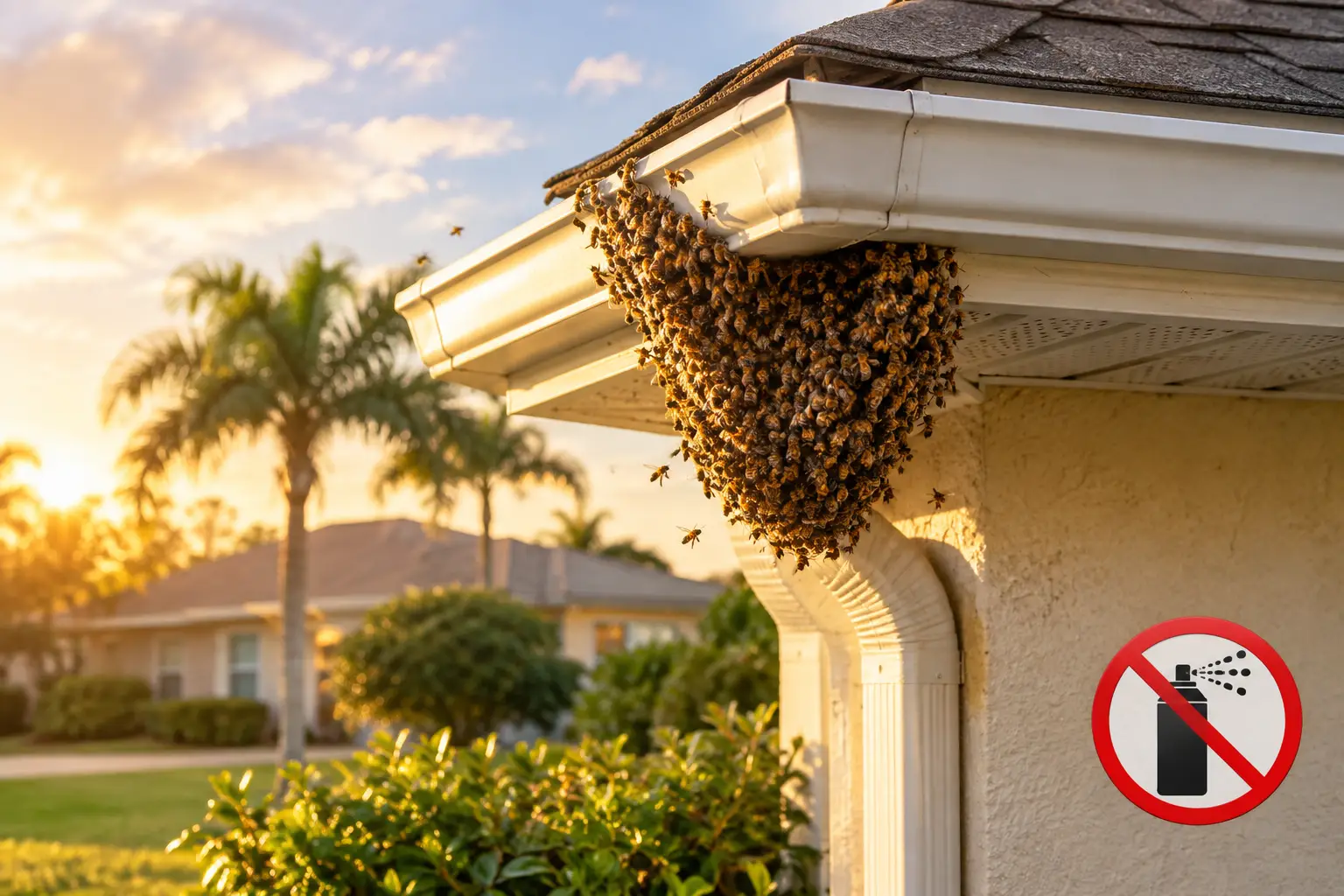

A buzzing insect colony on a soffit, in a wall, or above a doorway can feel like one urgent problem. It is not. Honeybee removal versus wasp control involves two very different jobs, because honeybees and wasps build differently, behave differently, and leave behind different risks for a property.
The first priority is always safety. Keep children, pets, and guests away from the area, avoid spraying or sealing an active entrance, and do not strike or disturb the nest. From there, proper identification determines the right solution.
Honeybee Removal Versus Wasp Control: The Core Difference
Honeybees are managed colonies. A swarm may be temporarily clustered on a branch, fence, or vehicle, while an established colony may be living inside a wall, roofline, chimney, soffit, or utility structure. Their nest is made of wax comb, and that comb stores honey, pollen, brood, and thousands of developing bees.
Wasps, including yellowjackets, paper wasps, and hornets, are predatory insects. They build paper-like nests from chewed wood fibers rather than wax. Their nests do not contain stored honeycomb that can melt, ferment, stain walls, or attract other pests after the insects are gone.
That construction difference changes everything. A successful honeybee removal usually means physically locating the colony, removing bees and comb, cleaning the cavity, and closing the entry point. Wasp control generally focuses on safely treating or removing the nest and confirming that activity has stopped. Both require care, but they are not interchangeable services.
Why Honeybee Colonies Need Physical Removal
When honeybees establish themselves inside a structure, simply killing or blocking them rarely solves the underlying problem. The colony may die, but the wax comb and honey remain. In Southwest Florida heat, honey can soften or leak through ceilings and walls. The odor may draw ants, roaches, wax moths, rodents, and other scavengers.
An abandoned cavity can also attract a new swarm. Honeybees are drawn to locations that smell like a former colony, especially where comb residue remains and an entrance is still available. Sealing the exterior before bees and comb are removed can trap bees inside the structure, driving them into living spaces or causing them to search for another exit.
Live removal addresses the full colony. A trained bee removal specialist identifies the bees’ access point and estimates where the comb is located. When structural access is necessary, the goal is to open only the area needed, carefully remove the comb and bees, clean residual wax and honey, and then seal the space against future occupation.
This work is not just about preserving bees, although that matters. Honeybees are valuable pollinators and managed agricultural livestock. It is also about protecting the building from the long-term damage that an incomplete removal can create. A properly relocated colony can continue its work in an apiary rather than becoming waste inside a wall.
Swarms and established colonies are not the same
A swarm is a temporary cluster of honeybees that has left an existing hive to establish a new home. It often looks alarming, but it may have no comb, honey, or permanent nest yet. Swarms are frequently more straightforward to collect and relocate when handled promptly.
An established colony has already built comb and may have occupied a cavity for weeks, months, or longer. Bee traffic entering a small gap near a roof, wall, or soffit is a strong sign of an established colony. This situation calls for more than swarm collection because the interior material must be addressed.
What Wasp Control Usually Involves
Wasp control begins with species and nest-location assessment. Paper wasps commonly build exposed, umbrella-shaped nests under eaves, porch ceilings, and outdoor fixtures. Yellowjackets may nest in the ground, wall voids, landscaping, or structural gaps. Hornets can construct large enclosed paper nests in trees or protected exterior areas.
The location matters because wasps can become defensive when their nest is disturbed. Yellowjackets, in particular, may respond in numbers if a hidden nest is bumped, mowed over, or treated improperly. Unlike honeybees, many wasps can sting repeatedly. A person with a known insect-sting allergy should not attempt nest work.
For an exposed, small paper-wasp nest far from doors and outdoor living areas, some homeowners may choose to leave it alone until the season ends. That choice depends on the species, accessibility, household risk, and activity level. A nest near a doorway, playground, pool deck, restaurant patio, or public walkway is a different matter because the likelihood of accidental disturbance is much higher.
Professional wasp control may use targeted methods appropriate to the species and setting. The objective is to resolve an immediate safety problem without creating unnecessary exposure for people, pets, or nearby pollinators. After activity ends, accessible nest material can be removed when appropriate, and openings that allowed nesting can be repaired.
Identification Protects People and Pollinators
Color alone is not a reliable way to identify a stinging insect. Honeybees are generally fuzzy-bodied and carry pollen on their hind legs. They fly in and out of a single opening when using a structural cavity. Wasps tend to have smoother bodies, narrower waists, and more visible yellow, black, reddish, or brown patterning, although appearances vary widely.
Bumblebees are another common source of confusion. They are rounder and fuzzier than honeybees and often nest in the ground or sheltered cavities. They are also pollinators and should not be assumed to be wasps simply because they are large.
Photos taken from a safe distance can help a specialist identify the insect. Do not get close enough to photograph the entrance, and do not cover it with tape, foam, or cloth. In areas of Florida where defensive Africanized honeybee genetics may occur, colony temperament cannot be judged safely from a distance. A cautious, professional response is the sensible approach.
The Mistakes That Make Both Problems Worse
The most common mistake is treating every flying insect as a pest that should be sprayed immediately. Broad insecticide applications can kill honeybees without removing comb or honey, contaminate an area unnecessarily, and provoke defensive insects before the homeowner can retreat safely.
Another mistake is sealing an active hole. With honeybees, this can force bees into the home and leave stored material behind. With wasps, it can redirect insects through a wall or toward another opening. The entry point should be addressed only after the colony or nest has been properly handled.
It is also wise to avoid DIY removal from ladders, roofs, attics, or wall cavities. Falls, electrical hazards, hidden nest entrances, and unpredictable defensive behavior turn a small-looking nest into a serious risk. This is especially true for commercial properties and HOA common areas, where a poorly handled nest can expose residents, customers, and staff.
Choosing the Right Response for Your Property
If bees are clustered in the open, ask whether they are a temporary swarm or an established colony. If bees are entering a crack in a structure, assume there may be comb inside and seek live removal rather than extermination. The work should include a clear plan for bee relocation, comb removal when present, cleanup, and exclusion repairs.
If the insects are wasps, consider where the nest is located and how often people pass nearby. A nest well away from activity may be tolerated in some cases. A nest near entrances, playgrounds, outdoor seating, mailboxes, or work areas should be evaluated promptly.
For Cape Coral and the wider Southwest Florida area, the warm climate can support long periods of insect activity. Fast identification helps avoid the two outcomes no property owner wants: an escalating sting hazard or a hidden honeybee colony creating damage behind the walls.
The right answer is not always to remove every flying insect. It is to identify what is present, respect the safety risk, and use the method that protects both the people on the property and the structure they depend on.

No responses yet