
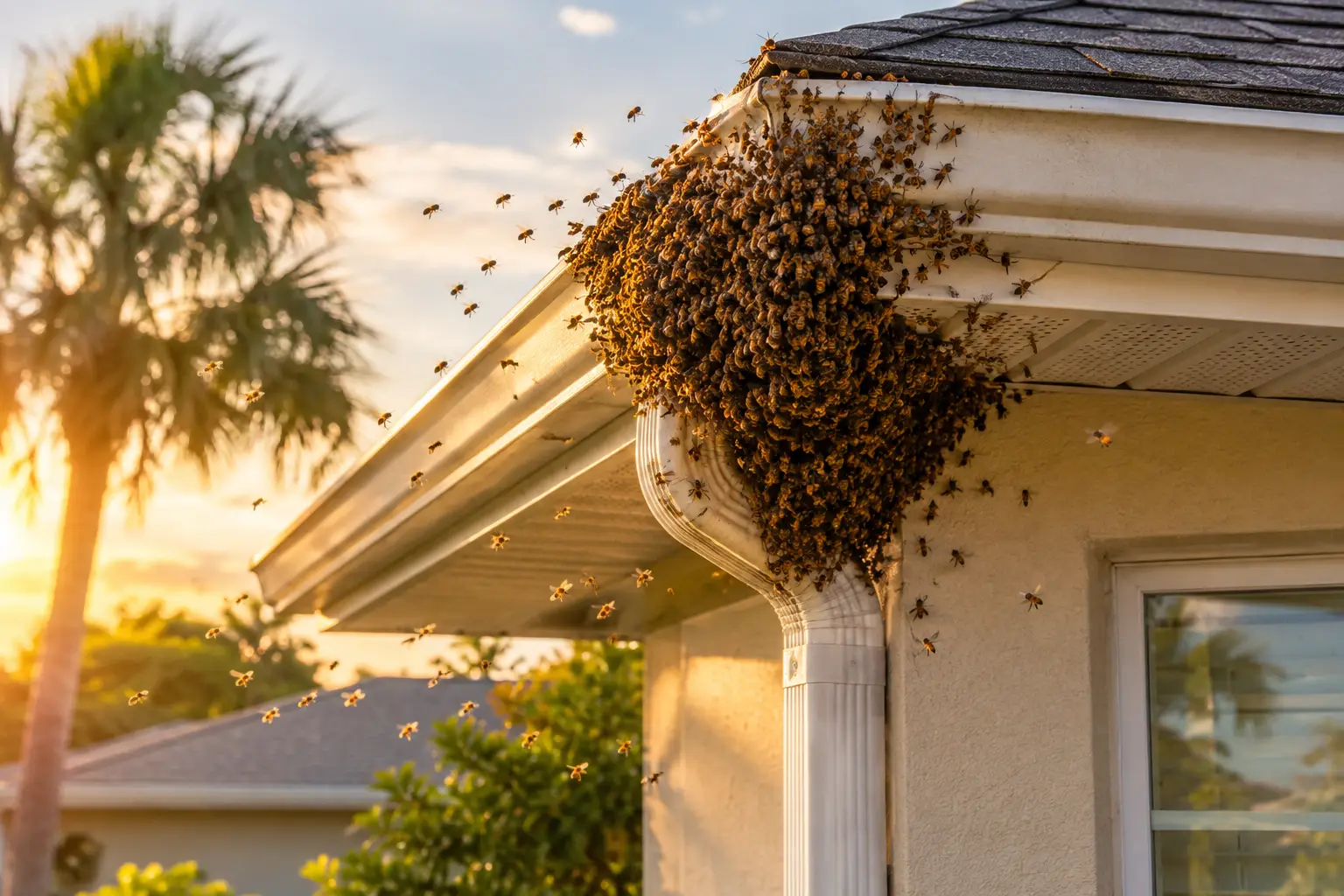

A dark, humming cluster on a palm branch can look alarming, especially near a doorway, pool, playground, or outdoor dining area. But swarm collection versus extermination methods is not simply a choice between doing nothing and using pesticides. The right response depends on whether the bees are temporarily resting, already established inside a structure, behaving aggressively, or creating an immediate public-safety risk.
For Southwest Florida homeowners and property managers, the distinction matters. A visible swarm may leave on its own within hours or days. A colony that has moved into a wall, soffit, roofline, shed, or utility box can produce honey, wax, and a growing population for years. Treating both situations the same can create unnecessary danger, expense, and damage.
First, Know Whether You Have a Swarm or a Colony
A honey bee swarm is a reproductive event. When a healthy colony becomes crowded, the old queen leaves with a large group of worker bees to find a new home. They may gather in a ball-shaped cluster on a tree limb, fence, shrub, mailbox, or exterior wall while scout bees search for a permanent nesting site.
Because a swarm has no established nest to defend, it is often less defensive than a colony in a wall. That does not mean people should approach it. Bees can still sting when handled, sprayed, hit with water, or disturbed by pets and lawn equipment. The safest move is to keep people and animals away and have a trained bee professional assess the situation.
An established colony is different. Bees entering and exiting a small opening in the same location day after day usually indicate a nest inside a cavity. You may see activity around a roof vent, soffit seam, block wall, attic opening, water meter box, or gap around a pipe. Inside, the colony may have built extensive comb filled with honey, pollen, brood, and wax.
That hidden comb is why a simple spray treatment is rarely a complete solution.
Swarm Collection: Removal Without Destroying the Colony
Swarm collection is the process of safely capturing a clustered group of honey bees and transporting them to an apiary or other suitable location. The goal is to collect the queen and as many worker bees as possible, then give the colony a managed home where it can continue pollinating and producing honey.
For a reachable outdoor swarm, collection is usually the most practical and least disruptive option. A trained remover uses protective equipment, controlled handling, and proper transport methods rather than chemicals. The bees are placed in a hive box, secured, and relocated away from homes, businesses, and high-traffic public areas.
The advantages go beyond the bees themselves. No pesticide residue is introduced near landscaping, children’s play areas, pets, pools, or outdoor gathering spaces. There is no dead colony left in a hard-to-reach cavity, because a temporary swarm generally has not built one yet. And, when handled promptly, collection can prevent the swarm from settling into a nearby wall or attic.
Still, swarm collection has limits. A cluster high in a mature tree, behind heavy landscaping, or near power equipment may require specialized access or a different safety plan. Weather, height, and the bees’ location all affect whether removal can happen immediately. If the swarm departs before a technician arrives, that is normal behavior, not a failed collection.
Why a Collected Swarm Needs a Real Home
Collecting bees only solves the immediate location problem if they are relocated responsibly. A swarm released in an unfamiliar neighborhood may simply move into someone else’s structure. A beekeeper or live-removal provider with managed apiary space can establish the colony in a hive, monitor it, and give it a productive future.
That is the difference between moving a problem and actually rehoming a colony.
Extermination Methods and Their Hidden Costs
Extermination methods generally rely on insecticides to kill the bees at or near their entry point. This may seem fast, particularly when bees are entering a wall or ceiling where the nest cannot be seen. Yet killing visible bees does not remove the comb, honey, wax, larvae, or scent left behind.
A dead colony inside a structure can create several costly issues. Honey may melt and seep through drywall or ceilings in Florida heat. Ants, wax moths, beetles, cockroaches, rodents, and new bee colonies may be attracted to the remaining material. The odor and staining can persist. If the original entry point is not sealed after comb removal, another swarm may move into the same void.
Extermination can also produce a short-term spike in defensive behavior. Disturbed bees may exit through unexpected openings, including gaps around light fixtures, vents, or interior walls. For a business, HOA, or occupied home, that can complicate an already stressful situation.
There are circumstances where public safety must lead the decision. Bees that are actively attacking, repeatedly stinging people or animals, or occupying a location where safe live removal is not immediately possible require urgent professional evaluation. In Southwest Florida, honey bee defensiveness can vary, and bees cannot be reliably judged as safe or dangerous simply by appearance. Do not attempt to identify, trap, poison, or remove them yourself.
The practical point is not that every situation is identical. It is that extermination should not be treated as a complete structural-removal plan when live removal, comb extraction, repair, and exclusion are feasible.
Swarm Collection Versus Extermination Methods for Buildings
Once honey bees have established themselves inside a structure, the better comparison is often live structural removal versus kill-only treatment. A proper structural removal addresses both the living bees and the materials they leave behind.
The process usually begins with locating the colony, identifying the most appropriate access point, and protecting the work area. The remover then extracts bees and comb with as little opening of the structure as practical. Honeycomb is removed because leaving it behind invites pests and future nesting. The cavity is cleaned, repair needs are explained, and exterior entry points are sealed or prepared for sealing.
This approach may cost more upfront than a spray service because it involves skilled labor, careful access, and repair-aware work. But it often reduces the chance of paying later for stained ceilings, pest activity, odor, or a replacement colony in the same void. For commercial properties and HOAs, it also provides a clearer path toward resolving a recurring liability issue instead of masking it temporarily.
Beeswild combines live bee removal with managed apiary relocation, so suitable colonies can move from an unsafe structure into a maintained farm environment. For customers, that means the service is designed around both immediate safety and a durable solution for the property.
What to Do When You Find Bees
Your first actions can make the job safer and easier. Keep children, pets, contractors, and curious neighbors away from the area. Avoid mowing, pressure washing, trimming branches, or blocking the bees’ flight path. Do not seal an active entry hole while bees are still inside, since they may find another route into the building.
Take note of where you see activity and when it occurs. A photograph from a safe distance can help a professional determine whether it appears to be a temporary swarm, a colony entrance, or possibly another stinging insect. If anyone has been stung repeatedly, if bees are pursuing people, or if the site is near a school, public walkway, or sensitive individual, treat it as urgent and call for professional assistance.
After removal, ask about the condition of the cavity and how the entry point will be secured. A complete plan should account for bees, comb, cleanup, and prevention. Some providers also offer a same-place removal warranty, which can offer reassurance when a colony has been occupying a complicated section of a building.
The Better Outcome Is Usually the More Complete One
Fear of stings is understandable, and no homeowner should be asked to tolerate bees in a wall, roof, or frequently used outdoor space. But the fastest-looking method is not always the one that protects the building, the people around it, or the bees that can be safely saved.
When a swarm is accessible, collection can turn an alarming discovery into a new beginning for a healthy colony. When bees are established in a structure, thoughtful live removal and comb cleanup can protect both the property and the wider environment. The next time bees appear, give the situation room, keep others clear, and choose a response that solves the full problem rather than leaving it hidden behind the wall.

No responses yet