
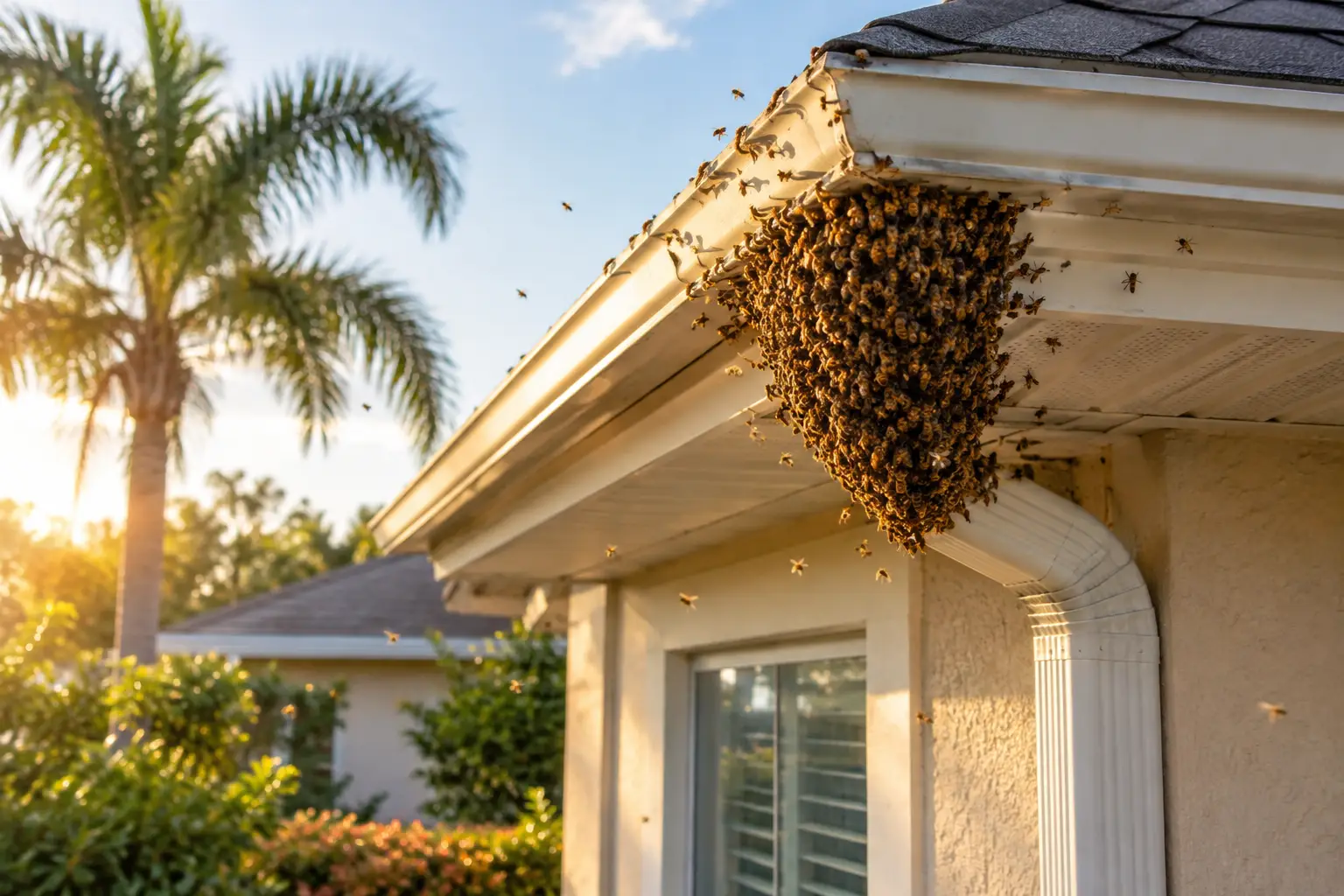

A cluster of bees on a tree branch can look alarming, but a colony entering a soffit, wall, roofline, or utility box creates a different kind of problem. The right bee control alternatives must protect the people using the property while preventing honey, wax, and future bee activity from damaging the structure. For most situations, the goal should not be to simply make bees disappear. It should be to resolve the immediate safety concern and stop the location from becoming a repeat nesting site.
For Southwest Florida homeowners, property managers, and HOA boards, the best option depends on whether they are seeing a temporary swarm, an established colony, or bees attracted to a previous hive location. Those distinctions determine whether monitoring, live removal, structural repair, or professional exclusion is appropriate.
Why conventional bee treatment often creates bigger problems
Chemical treatment may kill bees near an entry point, but an established colony is more than the visible bees. Inside a wall or roof cavity, there may be honeycomb, honey, pollen stores, brood, and thousands of dead insects left behind. In Florida heat, that material can melt, ferment, leak through drywall, and attract ants, beetles, roaches, rodents, and other pests.
Killing a colony without removing the comb also leaves behind a scent trail and a ready-made cavity. New swarms can be drawn back to the same protected space, particularly if openings remain accessible. The homeowner may pay for a quick treatment, then face staining, odor, secondary pests, or another colony later.
This does not mean every bee situation requires the same response. A small, newly arrived swarm outdoors may be handled very differently from a mature colony that has been building comb in a wall for months. The key is matching the response to the biology of the bees and the construction of the building.
Bee control alternatives that solve the source
Live removal and relocation
Live removal is usually the strongest alternative when bees are established inside a structure or in a place where people, pets, customers, or workers are regularly nearby. A trained removal team locates the colony, accesses the cavity as carefully as possible, removes the bees and comb, then relocates the colony to a managed apiary or safe farm setting.
The critical work is the comb removal. Extracting bees while leaving honeycomb behind is not a complete solution. A proper structural removal addresses the materials that attract replacement colonies and cause property damage after the bees are gone.
Live relocation has practical limits. Colony behavior, height, access, weather, the building material, and the presence of electrical or plumbing systems all affect the method. Aggressive bees should never be approached by an untrained property owner. In Southwest Florida, where defensive bee behavior can be a serious public-safety concern, identification and handling should be left to qualified professionals.
Swarm collection
A swarm is a temporary mass of bees clustered around a queen, often on a branch, fence, shrub, vehicle, or exterior surface. Swarming is how honey bee colonies reproduce. At this stage, the bees may be looking for a permanent nesting cavity and may move on within hours or days.
Because a swarm has not necessarily built comb, collecting it can be less invasive than removing a colony from a wall. Still, it should not be ignored near doorways, playgrounds, pool areas, or commercial entrances. Disturbing a swarm with a hose, insecticide, broom, or loud equipment can turn a manageable situation into a stinging hazard.
A professional can assess whether it is truly a honey bee swarm, whether it is accessible for collection, and whether it poses an immediate risk. If the bees have already begun entering a void, prompt action matters. Once comb is established, the job becomes more complex.
Exclusion after removal
Exclusion means closing the gaps that allowed bees into the structure in the first place. It is one of the most effective long-term bee control alternatives, but timing matters. Sealing active bees inside a wall can force them into living areas or trap honey and comb where they cannot be removed. Sealing a main entrance while leaving secondary openings can also cause bees to find a new route indoors.
After the colony and comb are removed, openings should be repaired with materials suited to the building. Common entry points include loose soffits, roofline gaps, vents without proper screening, openings around utility penetrations, damaged fascia, and cracks where exterior finishes meet.
For commercial properties and HOAs, exclusion should be part of routine building maintenance. A small opening can become a costly structural problem when it gives a colony protected space to grow unnoticed.
Habitat adjustments for low-risk outdoor activity
Not every bee sighting requires removal. Bees visiting flowers, fruit trees, or water sources are performing normal pollination activity and are generally best left alone when they are not nesting nearby. If bee traffic is concentrated around a pool, pet bowl, fountain, or dripping irrigation head, reducing accessible water sources can make the area less attractive.
Property owners can also place flowering plants away from high-traffic doors, patios, and play areas. This is not a way to remove an established colony, but it can reduce routine bee encounters without harming pollinators. Avoid broad-spectrum insecticides on flowering plants. Those products can affect beneficial insects well beyond the bees causing concern.
When no-action monitoring makes sense
Observation can be reasonable when bees are simply foraging outdoors and there is no hive, no dense cluster, and no conflict with people. It may also be appropriate for a distant swarm on a large property if a professional confirms it is in a low-risk location and likely to move on.
Monitoring is not the right choice when bees are entering a building, gathering in large numbers around a public access point, repeatedly appearing from the same hole, or behaving defensively. A colony in a wall rarely resolves itself. It usually expands as the season progresses, and the eventual removal can require more access to the structure.
If someone has been stung repeatedly, if a family member has a known severe allergy, or if bees are near a school, business entrance, or shared amenity, treat the situation as a safety issue. Keep people and pets away, avoid vibration near the colony, and arrange an inspection.
What not to do with an active colony
Home remedies often fail because they focus on the bees people can see rather than the colony hidden behind the surface. Spraying an entrance, filling a hole with foam, smoking a wall cavity, or attempting to vacuum bees can create a dangerous response and make later removal more difficult.
Do not knock down a cluster, seal an active entrance, or cut into a wall without knowing where the comb is located. Bees may use multiple exits, and opening the wrong area can spread them into the building. It can also damage wiring, ducts, plumbing, roofing, or finishes.
A better first step is simple: observe from a safe distance. Note where bees are entering, how consistently they are moving, whether the activity is on an exterior surface or inside a structural gap, and whether the location affects people. Photos taken from a distance can help a removal professional evaluate the situation before arrival.
Choosing a bee removal provider
The provider should explain what happens to both the bees and the comb. Ask whether the work includes locating the colony, removing honeycomb and debris when feasible, and identifying entry points that need repair. A clear scope protects the property owner from assuming that a bee treatment includes structural cleanup when it does not.
It is also reasonable to ask about warranty terms, access needs, repair responsibilities, and how the provider manages aggressive colonies. For an HOA or commercial site, request documentation that supports your vendor and liability requirements. The lowest initial price is not always the lowest total cost if it leaves honeycomb in the building or invites a new colony weeks later.
At Beeswild, live removal is paired with relocation to managed bee farm areas, so rescued colonies have a place to continue their role in pollination rather than being treated as disposable pests. For property owners, that approach can address the immediate problem without losing sight of why honey bees matter.
A bee problem does not require a one-size-fits-all response. When safety, building conditions, and bee behavior are considered together, the most effective solution is usually the one that removes the source, protects the structure, and gives the colony a safer place to be.

No responses yet