
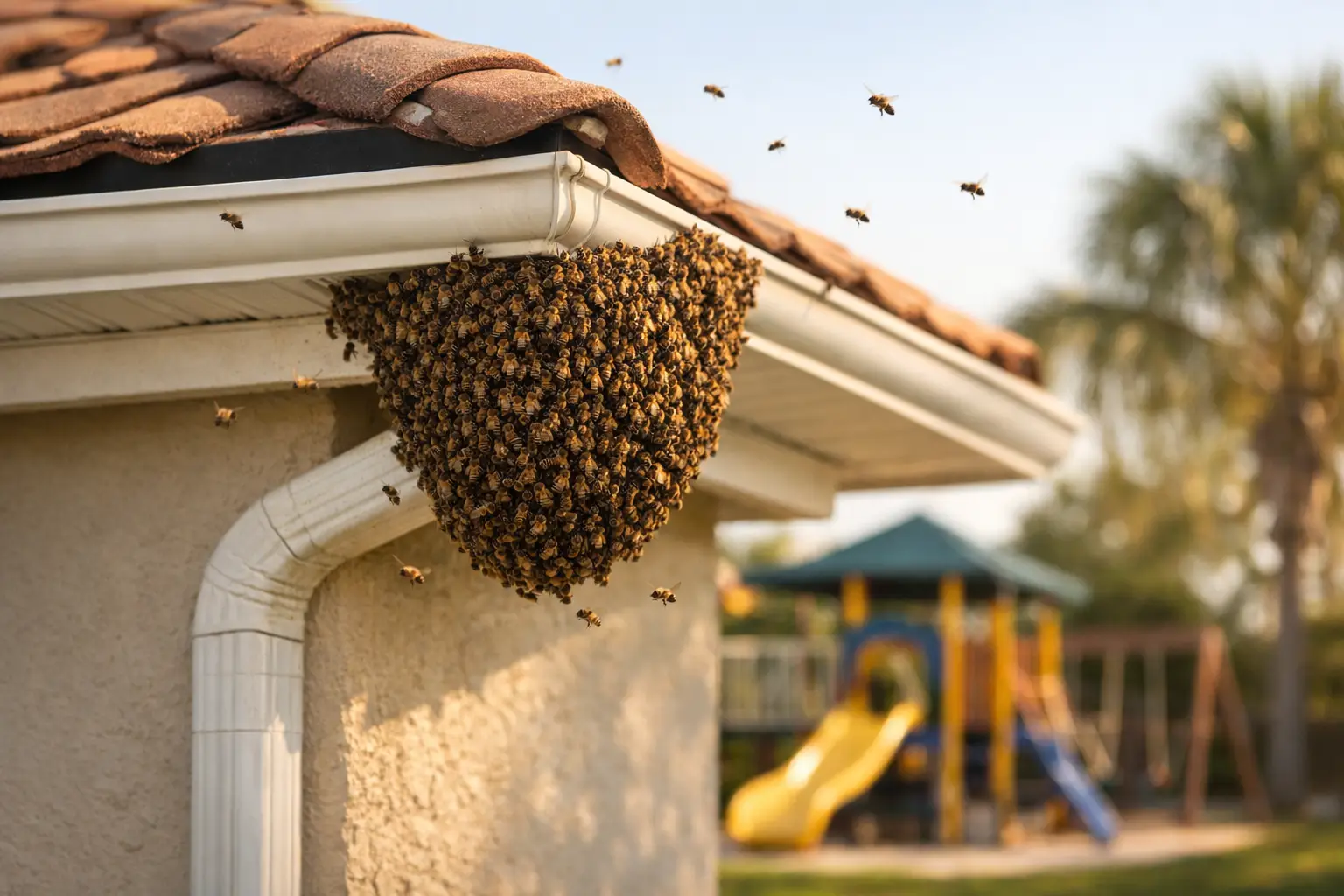

A few bees drifting through a playground usually do not mean danger. But if you are asking, are bees dangerous near playgrounds, the honest answer is that it depends on what kind of bee activity you are seeing, how close it is to children, and whether there is a nest or colony nearby.
That distinction matters. A single honey bee visiting clover in the grass is very different from repeated flight in and out of a wall cavity, a trash area full of yellow jackets, or a defensive colony established near slides, shade structures, or benches. For parents, school staff, HOAs, churches, and park managers, the real question is not whether every bee is a threat. It is whether the activity creates a reasonable risk of stings, panic, or liability in a space built for children.
Are bees dangerous near playgrounds or just passing through?
Most of the time, bees seen around a playground are foraging, not attacking. Honey bees and native pollinators move through landscapes looking for nectar, pollen, and water. If flowering weeds, ornamental plants, or dripping irrigation are nearby, a few insects may appear even when there is no nest in the play area itself.
In that situation, the risk is usually low. Bees are not interested in children unless they are stepped on, grabbed, swatted, or trapped in clothing. That is why stings at parks often happen when a child runs barefoot through flowering ground cover, drinks from an open can with an insect inside, or accidentally disturbs a hidden nest.
The concern rises when bee traffic is concentrated and repetitive. If insects are entering a hole in a wall, fence post, roofline, or playground equipment, that suggests an established colony or nest. Once social insects settle into a structure, they become much more than occasional visitors. They become a site hazard.
What actually makes a playground bee situation risky
Children change the risk equation. Adults can usually notice insect patterns, avoid problem zones, and stay calm. Young children do the opposite. They run, wave, yell, drop snacks, and explore openings and shrubs without realizing what may be inside.
The biggest safety factors are proximity, behavior, and species. A colony 100 feet away in a tree line may pose little practical danger if flight paths do not cross the playground. A colony inside a shade canopy support or retaining wall next to a swing set is a different matter. In a high-traffic area, even normally manageable bees can become a repeated sting risk.
Behavior matters even more than numbers. Calm foraging is one thing. Defensive circling, repeated bumping into people, or sudden agitation after vibration or noise points to a nest that feels threatened. Playgrounds naturally create vibration through running, jumping, balls striking structures, lawn maintenance, and nearby equipment. That can trigger defensive behavior if a colony is too close.
Then there is the issue of who may be exposed. For many children, a sting is painful but limited. For a child with a known venom allergy, one sting can become a medical emergency. Property owners and managers cannot assume every family on site knows how to respond, or that an epinephrine injector will be immediately available.
Honey bees vs. wasps vs. aggressive bee colonies
Not every striped insect near a playground is a honey bee. This is where people often underestimate or misread the threat.
Honey bees are generally defensive only near their colony. Away from the hive, they are usually focused on forage. A swarm hanging temporarily from a branch can look alarming, but swarms are often less aggressive than established colonies because they are protecting no brood or stored honey yet. Even so, a swarm near a playground still needs professional attention because children should not be near it.
Yellow jackets and some wasps are often more likely than honey bees to cause playground problems. They are drawn to juice, food waste, trash cans, and sugary spills. They can nest underground, inside voids, or in landscape edges where children step or sit. Unlike honey bees, they can sting multiple times.
In parts of Florida and the southern US, another layer of caution is necessary. Some honey bee colonies may be unusually defensive due to Africanized genetics. You cannot reliably identify that by sight alone. If a colony near a playground reacts strongly to normal activity, treat it as an urgent public safety issue rather than a wait-and-see situation.
Signs a playground needs professional bee assessment
A lot of bee calls come too late, after someone has already been stung. It is better to act on pattern recognition.
Repeated insect traffic to one opening is a clear warning sign. So is buzzing concentrated around wall voids, utility boxes, soffits, bleachers, or play structures. Bees gathering at a water source, such as a leaking spigot or drainage low spot, may be less urgent, but the source should still be corrected to reduce attraction.
Listen for reports that sound minor at first. Staff may say, “We always see bees near that bench,” or “Kids avoid that side because bugs come out of the wall.” Those are often early structural colony clues. Another red flag is a sudden increase in activity after mowing, trimming, or pressure washing nearby.
If stings happen in the same area more than once, stop treating it as random bad luck. Repeated incidents usually point to a fixed source.
What parents and staff should do right away
If you suspect active nesting near a playground, create distance first. Keep children away from the area and avoid slamming, spraying, poking, or blocking the entry point. DIY actions often make the situation worse.
Sprays are especially risky around structures. Killing visible bees does not remove comb, honey, brood, or the conditions that attract new infestations. In wall or equipment voids, dead colonies can leave behind melting wax, fermenting honey, odor, staining, and secondary pests. More importantly, agitated surviving bees may become more defensive before the problem is actually resolved.
For schools, HOAs, churches, parks, and commercial properties, the safest move is to close off the affected zone and document what staff are seeing. Note time of day, insect behavior, exact location, and whether children were stung. That gives a professional a much clearer starting point.
Are bees dangerous near playgrounds after dark or in cooler weather?
Sometimes people assume the risk is gone if they do not see insects flying. That is not always true. Activity may drop in the evening or during cooler weather, but the colony is still there. A hidden nest can remain fully viable even when foraging traffic slows.
That matters for maintenance crews. Opening a panel, trimming shrubs, blowing debris, or repairing playground components near a colony can trigger a defensive response even outside peak daytime activity. A quiet morning is not proof of a safe structure.
Prevention matters more than panic
The best playground bee safety plan is environmental, not emotional. Reduce what attracts insects and identify structure problems early.
Ground cover with clover or flowering weeds should be managed in active play zones, especially where children run barefoot. Trash and drink spills should not sit near benches or under shade areas. Irrigation leaks and standing water should be corrected. Cavities in posts, walls, roofs, and utility penetrations should be inspected and sealed appropriately once professionals confirm they are not currently occupied.
Routine inspection is especially important in warm climates where colonies can establish quickly and stay active for long periods. In Southwest Florida, for example, bee and wasp pressure does not follow the same narrow seasonal pattern seen in colder regions. That means playgrounds in schools, apartment communities, churches, and public parks need ongoing awareness, not just springtime checks.
When removal is the responsible choice
There is a difference between respecting pollinators and ignoring a hazard. Bees are valuable livestock and essential pollinators, but a colony placed next to a children’s play area is in the wrong location. Relocation by an experienced live removal specialist is often the best outcome when honey bees are involved.
That approach protects people first while preserving the colony whenever possible. It also addresses the structural issue instead of just knocking down surface activity. Humane removal, cleanup, and repair guidance reduce the chance of recurring problems in the same spot.
For property managers, this is also a liability decision. Once a colony is known, delay becomes hard to defend if someone gets hurt. For parents, the standard is simpler. If insect activity near a playground feels organized, repetitive, or tied to a structure, trust that instinct and report it.
A safe playground does not require a bug-free world. It requires knowing the difference between normal pollinator traffic and a colony that has moved too close to where children play. When that line is crossed, quick, informed action protects both families and the bees that belong somewhere else.

No responses yet