
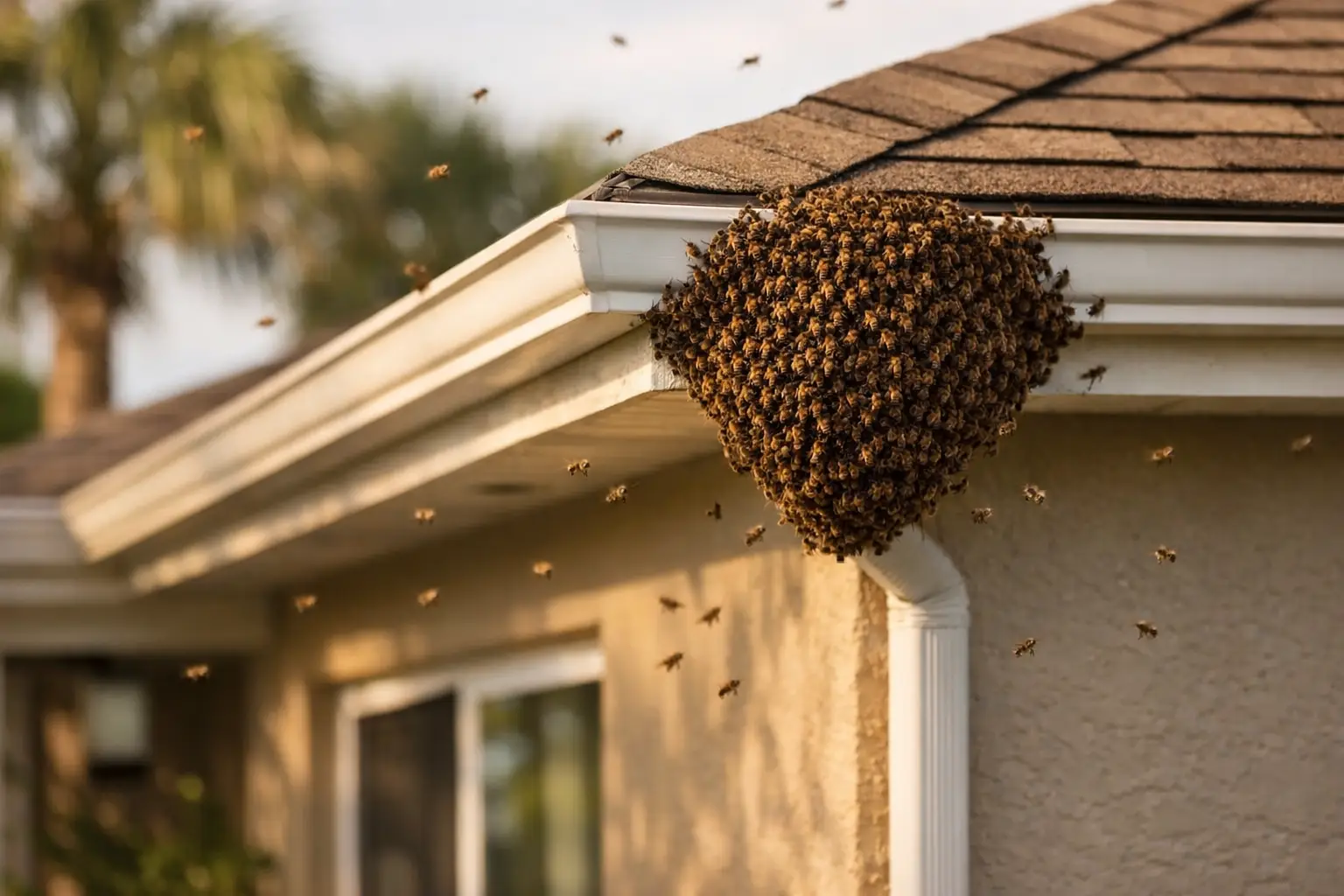

A cloud of bees around a flowering shrub is usually not an emergency. Bees repeatedly striking people, pursuing them away from a nest, or gathering at a school entrance, playground, pool area, or busy walkway is different. Knowing how to report aggressive bees helps protect people and pets without treating every bee encounter as a reason to destroy a valuable pollinator colony.
In Southwest Florida, where bees may nest in soffits, block walls, sheds, utility boxes, and mature trees, the safest response begins with distance. Do not investigate a suspected colony, throw objects at it, block its entrance, or use store-bought sprays. Your goal is to get the right people accurate information while keeping everyone away from the bees.
First, decide whether the situation is an emergency
Call 911 when bees are actively attacking people, a person has been stung many times, someone is showing signs of a serious allergic reaction, or the bees are preventing people from safely leaving a vehicle, building, or public area. Signs of a severe reaction can include trouble breathing, swelling of the face or throat, dizziness, widespread hives, vomiting, or loss of consciousness. Do not wait to see whether symptoms improve.
If bees are attacking, move indoors or into a closed vehicle as quickly as possible. Cover your face with a shirt or jacket if available, but keep moving. Do not jump into a pool. Bees can remain above the water and sting when a person resurfaces. Avoid swatting, because fast movements and crushed bees can increase defensive behavior.
For a non-immediate hazard, keep children, visitors, and pets away from the area and arrange a professional inspection. A colony that is defensive near its entrance may not chase people when left alone, but it can become a serious problem when landscaping, roof work, pressure washing, or repairs disturb it.
How to report aggressive bees to the right place
The correct report depends on where the bees are and what they are doing. A private home, a public sidewalk, and a commercial property do not always follow the same process.
For an active emergency, report the location to 911 and clearly state that bees are attacking or blocking safe access. Give the dispatcher the exact address, the nearest cross street if the site is large, and details about anyone who has been stung or trapped.
For bees nesting on your own property, contact a qualified live bee removal professional. Describe the behavior, but avoid diagnosing the colony yourself. People often use the phrase “Africanized bees” when a colony is defensive. In reality, a colony’s genetics cannot be confirmed by appearance or a brief observation. What matters first is the immediate safety risk and safe removal from the structure or landscape.
For a colony on public property, such as a park, right-of-way, city building, school grounds, or community recreation area, report it to the agency or property manager responsible for that location. Explain whether the bees are simply present, actively stinging, or situated near a high-traffic area. If the location is an HOA common area, notify the property manager or board as well as the removal provider they authorize.
At a restaurant, shopping center, office park, or apartment complex, alert on-site management immediately. Commercial managers need to protect employees, customers, and residents, and they may need to close off the area until a trained removal team can assess the colony.
Give a report that leads to faster action
A useful report is specific, calm, and based on what you observed. Start with the exact location of the bees: for example, “entering a gap under the east soffit above the garage” is more helpful than “bees are by the house.” Mention the closest door, unit number, utility equipment, tree, or landmark.
Then describe the activity. Say whether bees are flying in and out of one opening, clustering in a visible swarm, stinging without close contact, or becoming defensive when people pass at a normal distance. Include when you first noticed them and whether the activity is increasing.
If it can be done from a safe distance, a photo or short video can help a professional identify whether the insects appear to be honey bees, wasps, hornets, or another species. Never get closer for a better image. A photo is helpful, not required.
Also report practical access details. Let the responder know about locked gates, dogs, ladders, roof height, power lines, irrigation equipment, or people who need special access accommodations. For structural colonies, the entrance is not always where the comb and honey are located, so a technician may need time to trace the colony before proposing the removal method.
What not to do while you wait
A defensive colony needs less disturbance, not more. Keep a clear buffer around the entrance and choose a different route into the home or building if possible. Tell neighbors, delivery drivers, contractors, and landscapers not to approach the area.
Do not seal a hole while bees are still using it. Closing an active entrance can force bees into wall cavities, living spaces, or other openings. If a colony is inside a wall, killing or trapping it without removing the comb can leave honey, wax, larvae, and moisture behind. That residue can attract ants, roaches, rodents, and new bee swarms, while also creating staining or odor issues.
Avoid pesticides, foaming products, smoke, and fire. Besides putting people at greater risk when disturbed bees emerge, these methods can make later removal harder. Humane removal and relocation are not always possible in every situation, particularly when a colony has been contaminated or is inaccessible without major construction. But calling a bee specialist before spraying preserves the best chance to remove both the bees and the nesting materials correctly.
Understand the difference between a swarm and a colony
A swarm is a temporary cluster of honey bees, often hanging from a branch, fence, mailbox, or exterior wall. Swarming bees are usually focused on finding a new home and may appear calmer than bees defending an established nest. They still deserve space, especially around children and pets, but a swarm is often a strong candidate for live collection.
A colony is established inside or around a structure. You may see a steady line of bees entering and leaving the same crack, vent, roofline, or cavity throughout the day. Colonies have brood, food stores, and a queen to protect, which is why they can become defensive when their nest is disturbed.
The distinction affects the response. A visible swarm may be collected with minimal disruption. A structural colony often requires careful access, comb removal, cleanup, and repair recommendations so the same location does not attract another colony. Reporting the bees promptly gives the responder more options and can limit property damage.
Protect the site after removal
Removal is only part of the job when bees have lived in a wall, roof, soffit, or other cavity. The comb and honey must be addressed, and the original entry point should be repaired after bee activity has stopped. Otherwise, scout bees may discover the same sheltered space and begin building again.
Ask the removal provider what was found, whether comb was removed, what repairs are needed, and how long you should monitor the area. A reputable company should explain the work in plain language rather than offering a quick spray as the only solution. At Beeswild, live removal focuses on relocating recoverable honey bee colonies to safe farm areas, while addressing the conditions that allowed bees to establish themselves in the first place.
If you manage a commercial property or HOA, document the report, the response time, the treatment or removal plan, and the final repair. That record helps protect residents and visitors, and it makes recurring issues easier to identify.
Bees are essential livestock and pollinators, but a colony defending a nest near people needs professional attention. Create distance, report the exact hazard to the responsible party, and let trained removal specialists determine the safest path for both people and bees.

No responses yet