
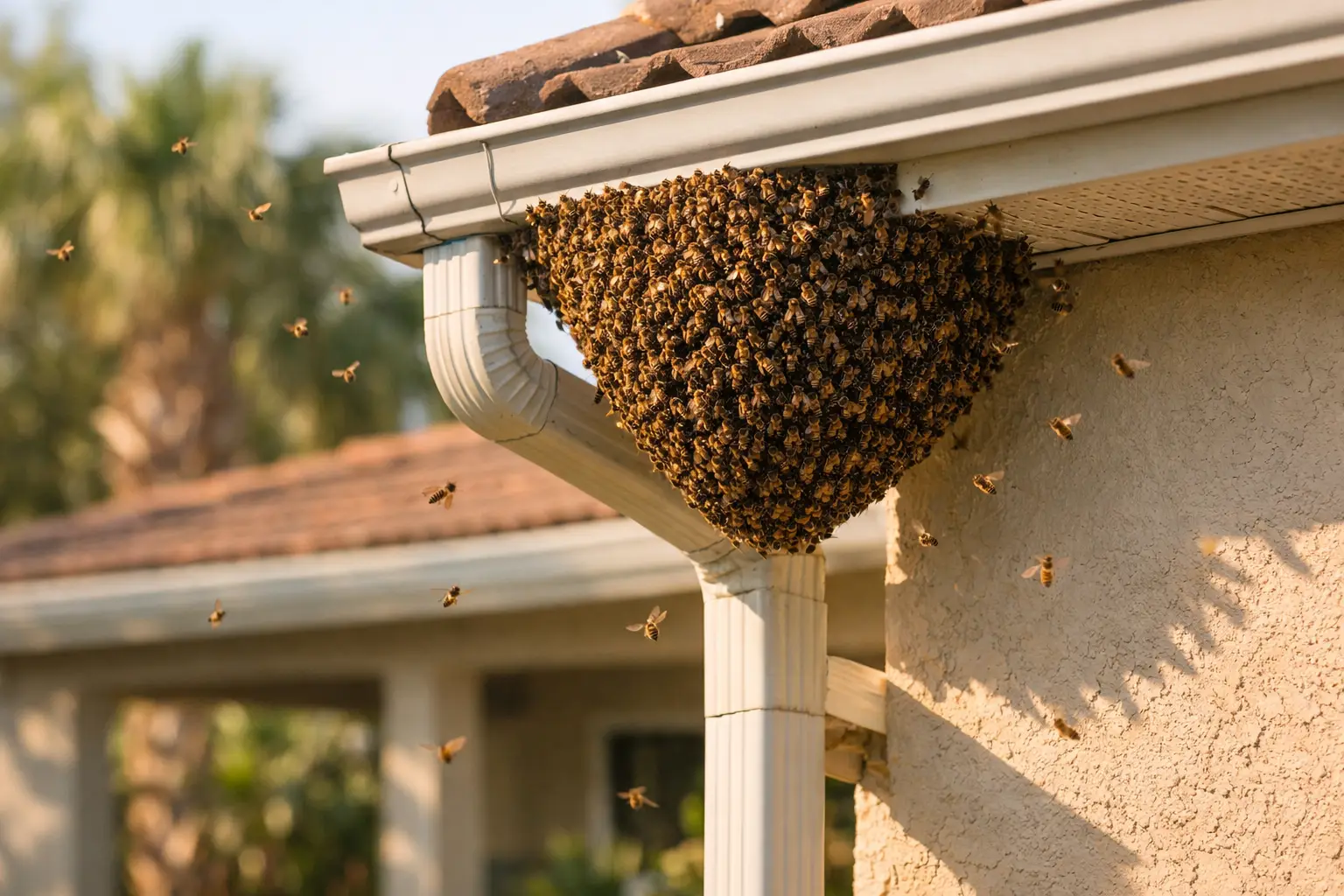

A cluster of bees hanging from your porch rail or light fixture can look alarming fast. If you need to handle bee swarm on porch situations safely, the first thing to know is this: a swarm is often less aggressive than an established hive, but it still needs careful distance, calm decisions, and the right kind of removal.
For homeowners, the biggest mistake is treating every bee problem like an attack. A swarm usually means a colony is in transition. The queen has left with part of the colony, and the bees are temporarily gathering while scout bees search for a permanent home. That temporary stop can be a tree branch, a mailbox, a soffit, or your front porch.
What a bee swarm on a porch usually means
A swarm is not the same as a nest inside your structure. That distinction matters. When bees swarm, they often form a tight ball or hanging mass that may remain in one spot for a few hours or a couple of days. During this phase, they are exposed and usually focused on protecting the queen, not defending honey stores or brood.
That said, lower aggression does not mean no risk. If children, pets, lawn crews, delivery drivers, or neighbors get too close, the situation can escalate. This is especially true if the bees are stressed by vibration, loud equipment, spraying water, or someone trying to knock the cluster down.
On a porch, swarms also create a second concern. If scout bees like the area, they may move from a temporary cluster into a wall void, roofline, soffit, or column. Once bees enter the structure, the job changes from simple swarm pickup to structural removal. That is more invasive, more expensive, and more urgent.
How to handle bee swarm on porch without making it worse
The safest first response is simple: create space. Keep everyone indoors or at a clear distance, and do not try to test whether the bees are calm. Curiosity gets people stung more often than the swarm itself.
Avoid spraying anything on the bees. Water, dish soap, wasp spray, bleach mixtures, and store-bought insecticides can turn a manageable rescue into a dangerous mess. Poison also creates a hidden problem if the bees later move into a cavity or if a colony was already beginning to establish itself. Dead bees, wax, honey, and brood left inside a structure can attract ants, roaches, beetles, rodents, and mold.
You also should not seal entry points while bees are active nearby. Homeowners sometimes caulk a gap quickly, thinking that prevents the problem. In reality, that can trap bees inside a wall or force them deeper into the structure. If the swarm is still outside but scouting your porch, sealing too early can also push them to another crack you have not noticed.
If you need to pass through the area, move slowly and avoid swatting. Bees respond to rapid motion and pressure. Keep pets inside. Turn off porch fans near the swarm if they are blowing directly at the cluster, but do not get close just to make adjustments. If the bees are near a porch light, leave it alone until a professional assesses the situation.
When a porch swarm is an emergency
Not every swarm requires a panic response, but some do require immediate professional help. If anyone in the home has a known sting allergy, if the bees are near a front door that cannot be avoided, or if the swarm shows defensive behavior, treat it as urgent.
Defensive behavior looks different from simple clustering. Bees flying at faces, repeated bumping, chasing people across the yard, or reacting strongly to normal movement can indicate a more dangerous situation. In Southwest Florida and other warm regions, aggressive bee behavior must be taken seriously.
Time of day also matters. A swarm found in the morning may still move on its own, but there is no guarantee. By late afternoon, scout bees may already have chosen a cavity in the porch roof, wall, or trim. Once you see steady bee traffic entering and exiting a crack or hole, you are no longer looking at a loose porch swarm. You may be dealing with a colony beginning to establish in the structure.
Why live removal is usually the best option
A porch swarm is one of the few bee situations where humane relocation is often very achievable. Because the bees are clustered and have not always built comb yet, a trained bee removal specialist can often capture the swarm intact and relocate it to a managed apiary or safe bee yard.
That outcome is better for the bees and often better for the property owner. It reduces the chance of bees being scattered, agitated, or pushed into your home. It also avoids the false finish that comes with spray-only treatments. Poison may kill some bees, but it does not solve structural risk if comb or a partial colony remains behind.
Live removal does depend on timing. A fresh swarm hanging openly on a porch post is a cleaner job than a swarm that has already started moving into a ceiling cavity. This is why early action matters. Waiting to see what happens can work in some outdoor locations, but on a porch attached to a home, delay often increases the chance of a structural colony.
What a professional will look for
When a bee removal specialist arrives, the first question is not just, “How many bees are there?” It is, “Are they truly swarming, or are they entering the building?” That determines the scope of work.
A true swarm pickup focuses on safely collecting the clustered bees and queen. If there is no comb, honey, or brood yet, removal can be relatively straightforward. If bees have started drawing comb inside a porch column, under decking, or behind siding, then the technician has to assess access, construction materials, and whether the area can be opened and repaired properly.
A good inspection also looks at why the porch was attractive in the first place. Gaps, voids, warm overhangs, old hive scent, and protected cavities all make porches appealing. Once removal is complete, prevention becomes part of the real solution.
For that reason, reputable providers explain not only what they are removing but what should happen next. In some cases, that means sealing after removal. In other cases, it means cleaning residual scent or comb from a hidden area so new bees are not drawn back.
Preventing bees from returning to the same porch
If you have had one swarm on your porch, that does not guarantee another. But the odds do go up if the area offers shelter and scent cues. Bees are practical. If a location worked once, scout bees may check it again.
The most effective prevention is exclusion after proper removal. Cracks around soffits, hollow posts, trim gaps, loose fascia, and unsealed utility penetrations should be identified and corrected. This should happen only after bees and any comb are fully removed. Sealing over active bee issues is how small problems become expensive repairs.
It also helps to reduce conditions that make inspection harder. Overgrown shrubs tight against the porch, clutter near entry points, and neglected roofline damage can hide early bee activity. You do not need to make your property sterile. You just want to remove easy structural opportunities.
Homeowners sometimes ask whether repellents keep swarms away. Results are inconsistent at best. Strong smells may annoy some insects, but they do not replace proper exclusion and cleanup. When scout bees are searching for a protected cavity, physical access matters more than porch-side folklore.
A few common mistakes to avoid
The most common mistake is assuming the bees will always leave on their own. Sometimes they do. Sometimes they move six feet into your wall.
The second mistake is treating bees like wasps. Bee swarms require a different response because a live colony may be recoverable, and because leftover comb inside a structure creates long-term issues. The third is hiring someone who only kills visible bees without addressing comb, entry points, or relocation options.
If you are in Southwest Florida, where warm weather extends bee activity, that margin for error gets smaller. Bees can establish quickly, and porch structures often offer exactly the kind of protected void they need. Companies such as Beeswild approach these calls as both a safety issue and a livestock rescue, which is the right mindset when the goal is to protect people without creating a bigger structural problem.
If bees are gathered on your porch today, resist the urge to fix it with speed alone. Calm distance, accurate identification, and timely live removal usually produce the safest outcome for your family, your property, and the bees themselves. The best next step is often the simplest one: keep clear, keep others back, and let the situation be handled correctly before a temporary stop becomes a permanent colony.

No responses yet