
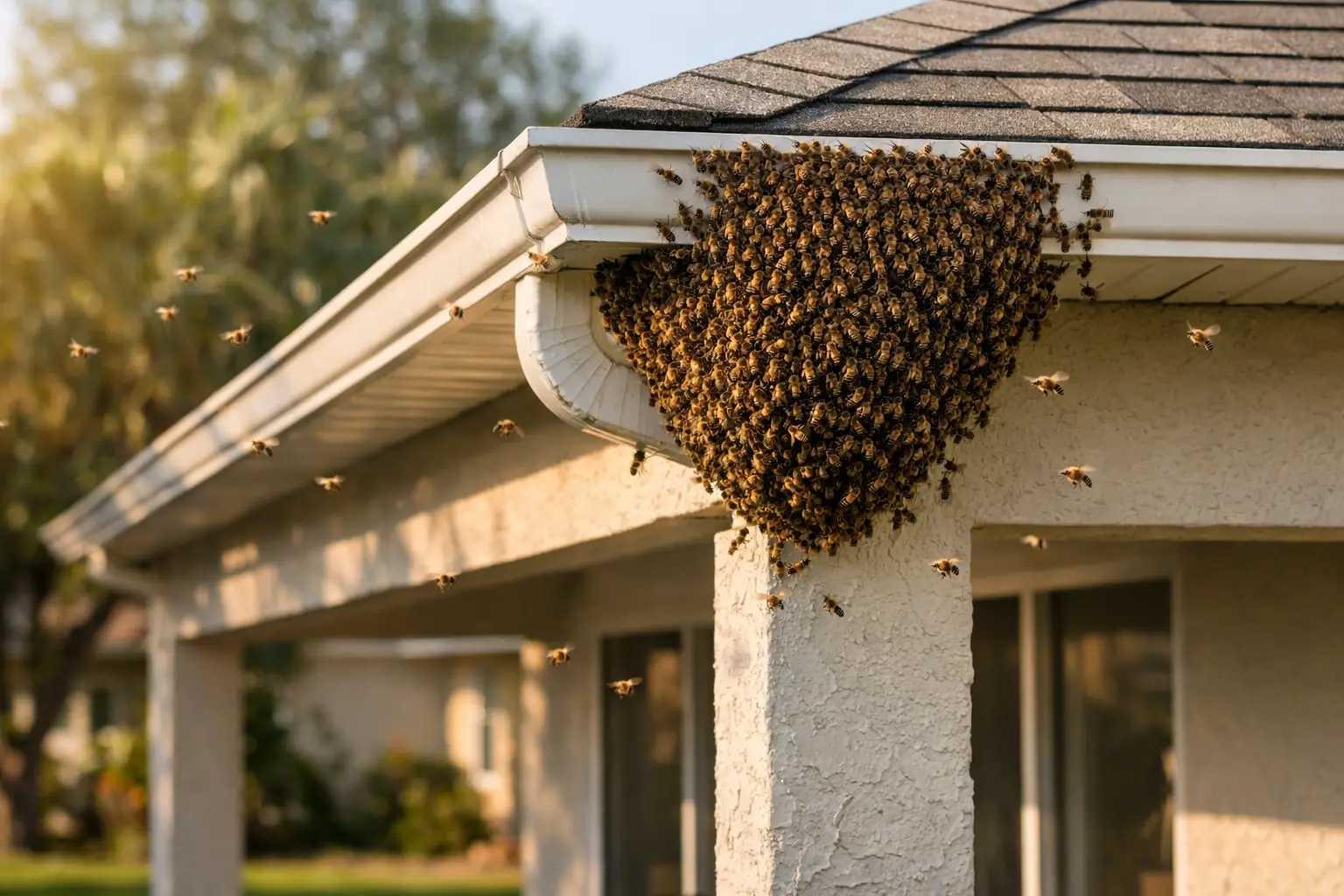

A cloud of bees near a porch can look alarming, but the scene does not always signal danger. The answer to when are bees most aggressive is usually not a particular month or time of day. Bees become defensive when they believe their colony, queen, food stores, or young are under threat.
That distinction matters for homeowners. A temporary swarm hanging from a tree may be comparatively calm, while an established colony hidden in a wall can react quickly if someone mows nearby, taps the siding, or tries to seal its entrance. Knowing the difference helps protect your family, your property, and the bees.
When Are Bees Most Aggressive?
Honey bees are most defensive close to an established nest, especially when the colony is disturbed. Their response can intensify during warm weather, when more bees are active outside the hive, and when the colony has abundant brood and honey to protect.
In Southwest Florida, bee activity can continue through much of the year because temperatures remain favorable. Spring and early summer often bring swarms as colonies reproduce and search for new homes. Late summer and fall can also bring strong defensive behavior around established colonies as they gather and guard food reserves.
Weather and daily conditions matter, too. Bees are generally more likely to react defensively on hot, humid, stormy, or windy days. Dark skies, approaching rain, and vibrations around the nest can put a colony on alert. Activity is often highest during daylight hours, particularly from late morning through afternoon, when foragers are moving in and out. But a colony in a wall, soffit, roofline, shed, or tree cavity must be treated cautiously at any hour.
A Swarm Is Different From a Colony in Your Wall
This is the most useful distinction a homeowner can make. A swarm is a traveling cluster of bees, often gathered around a branch, fence, mailbox, or other temporary resting place. It may contain thousands of bees, but it usually has no honeycomb, eggs, or stored honey to defend. Swarming bees are focused on finding a permanent nesting site, so they are often less defensive than people expect.
An established colony is different. It has built comb and contains brood, honey, pollen, and a queen. The bees have a home worth protecting. If the colony is inside a structure, the entrance may be only a small gap in a soffit or siding, while the comb extends much farther behind the surface.
Do not mistake quiet activity for a minor problem. A steady stream of bees entering and leaving the same opening is a common sign of an established colony. That colony can grow, and honey, wax, and moisture can cause damage long after bees are gone if the comb is not properly removed.
What Actually Triggers Defensive Behavior
Bees do not need a person to touch the hive before reacting. Common triggers include lawn equipment, leaf blowers, hedge trimmers, hammering, pressure washing, and repeated movement directly in front of an entrance. Vibrations and exhaust can disturb a colony, particularly one located low in a wall, landscape feature, or ground-level cavity.
Strong scents can also make encounters less predictable. Perfume, sweat, gasoline, and some scented personal-care products may contribute to defensive responses near a hive. Dark clothing can be more provocative than light-colored, smooth clothing, and rapid arm movements look threatening to bees already on alert.
Most importantly, bees release alarm pheromones when a bee is crushed or feels threatened. Those signals can recruit other guard bees. Swatting at bees often turns a manageable encounter into a more intense one.
Why Some Colonies Respond More Strongly
Every colony has its own temperament. Genetics, queen lineage, colony size, available food, recent disturbance, and local conditions all affect behavior. A small, newly arrived colony may tolerate activity nearby better than a large colony that has occupied a structure for months.
In Florida, homeowners should also avoid assuming that all honey bee colonies will respond the same way. Africanized honey bee genetics occur in parts of the state. Colonies with these traits can be more defensive, may respond in greater numbers, and may pursue a perceived threat farther than gentler colonies. You cannot reliably identify a colony’s temperament just by looking at bees from a distance.
That is why a nest near a doorway, pool area, playground, pet run, or commercial entrance deserves prompt professional attention, even if no one has been stung yet. The risk is not only the number of bees present. It is how close daily human activity is to the colony’s defensive boundary.
What to Do if Bees Become Defensive
If bees begin circling, bumping into you, or stinging, leave the area immediately. Cover your face as you move away, but do not stop to swat. Go indoors, into a vehicle, or another enclosed building. Bees may cluster in hair or clothing, so once safely inside, carefully remove any bees that remain.
Do not jump into a pool or pond. Bees can wait above the water, and you may have to surface repeatedly. Do not hide in shrubs, under a small patio umbrella, or behind a screen enclosure that bees can enter. A solid enclosed space is the safer choice.
If someone receives multiple stings, has trouble breathing, develops swelling of the lips or throat, feels faint, or has a known severe allergy, seek emergency medical care immediately. Even people without a known allergy can have a serious reaction. Remove visible stingers promptly by scraping them sideways with a card or fingernail, then wash the area and use a cold compress for local pain and swelling.
How to Prevent a Home Encounter
Prevention starts with giving bees space. If you see bees consistently using a gap in a wall, roofline, utility box, shed, or hollow tree, keep children and pets away and avoid directing equipment toward the area. Postpone mowing, trimming, or repairs nearby until the situation has been assessed.
Do not spray insecticide into an opening or seal the opening while bees are still active. Poison can cause surviving bees to relocate deeper into the structure, and sealing them inside can force them into living spaces. It also leaves comb, honey, and dead bees behind. That material can melt, ferment, attract ants and other pests, stain drywall, and create a second property problem.
A proper live removal addresses the colony and the comb. The bees are carefully collected and relocated, honeycomb and residue are removed, and entry points can be repaired after the bees are out. This approach is more involved than spraying an entrance, but it addresses the conditions that invite repeat infestations.
Simple Habits That Reduce Risk
Keep exterior gaps maintained, especially around soffits, vents, siding transitions, and utility penetrations. Store sweet drinks and food in covered containers outdoors, and keep trash receptacles closed. These measures will not prevent every bee visit, but they reduce the chance that bees or other stinging insects establish themselves close to people.
If a swarm lands on your property, give it room. Keep pets inside, close nearby windows, and ask neighbors not to approach for photos. A swarm may leave on its own, but professional relocation is the safer option when it is near an entrance, walkway, school, business, or heavily used yard.
The Safest Response Is Calm, Early Action
Fear is understandable when bees appear close to home, especially where children, pets, or allergic family members are present. Still, most bee problems become more manageable when people resist the urge to disturb or poison the colony. Distance, a clear assessment, and humane removal protect people first while preserving valuable pollinators whenever possible.
If bees have chosen a spot on your property, treat the location as active until it has been professionally evaluated. Calm, early action can prevent a frightening encounter from becoming a medical emergency or a costly repair.

No responses yet