

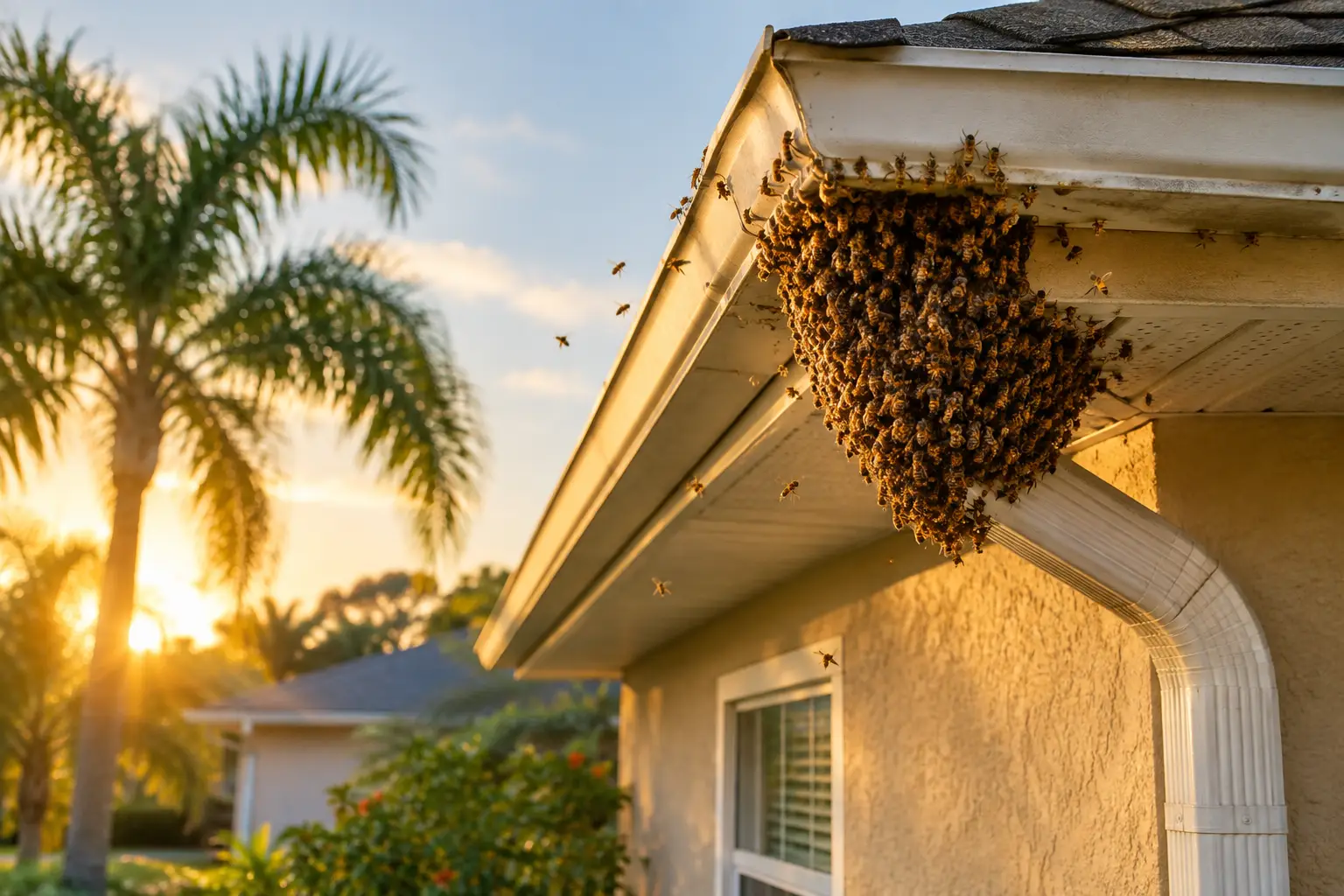

A buzzing colony in a soffit, shed, palm, or block wall can turn an ordinary Southwest Florida afternoon into a real safety concern. This Florida guide Africanized bee risks explains what homeowners, property managers, and community leaders need to know without treating every honey bee as a threat. Honey bees are essential pollinators, but a defensive colony near people requires a careful, professional response.
What Africanized bee risk means in Florida
Africanized honey bees are honey bees with African ancestry that have hybridized with other honey bee populations. They are not a separate insect that can be reliably identified by color, size, or a quick look at a swarm. In fact, Africanized and European honey bees look extremely similar. Definitive identification generally requires laboratory testing.
The practical issue is behavior. Some colonies can respond more intensely to disturbance, send out more guard bees, and pursue a perceived threat farther than a typical managed colony might. A mower, leaf blower, barking dog, construction vibration, or a child throwing an object near the entrance can be enough to trigger defensive behavior.
That does not mean every established colony in Florida is Africanized, nor does it mean every swarm is dangerous. A swarm resting temporarily on a branch is often focused on finding a new home and may be less defensive than a colony that has been established in a wall or utility box for months. Still, people should give any bee cluster or active colony plenty of room. Behavior can change quickly when bees are disturbed.
Why Florida properties need a practical response
Florida’s warm weather creates long foraging and nesting seasons. Colonies can establish themselves in cavities that seem insignificant at first: a meter box, soffit return, barbecue grill, vacant birdhouse, irrigation enclosure, roofline, tree hollow, or the space behind siding. Once bees begin storing honey and raising brood, the colony becomes more invested in defending that location.
The greatest risks are usually tied to location rather than the mere presence of bees. A colony high in a remote tree may pose little immediate concern. A colony beside a front door, pool enclosure, playground, restaurant patio, dog run, or maintenance path presents a different situation. The risk also rises where people cannot easily see the entrance and accidentally work near it.
For commercial properties and HOAs, the concern extends beyond a single sting. Staff, residents, guests, delivery drivers, and contractors may pass the area without knowing a colony is present. A clear response plan protects people while avoiding unnecessary harm to pollinators.
People and pets who need extra caution
Anyone can have a serious reaction after multiple stings. Children, older adults, people with limited mobility, and pets are especially vulnerable because they may not be able to get away quickly. A person with a known bee-sting allergy should treat any nearby active colony as a reason for heightened caution, but severe reactions can also happen in people without a known allergy.
Dogs are commonly stung around the face after investigating a ground-level opening, shrub, shed, or landscape feature. Horses and other livestock can also be at risk if a colony is established near a barn, water source, or feeding area. Do not try to block an entrance while bees are active. Trapped bees may find another route indoors or become more defensive around the opening.
Signs that call for distance, not DIY removal
A few bees visiting flowers are doing normal pollinator work. The concern begins when there is consistent, directional traffic to one hole or cavity. Watch from a safe distance for bees repeatedly entering a soffit gap, wall crack, roof vent, tree cavity, or utility enclosure. You may also hear a low, steady hum inside a wall or see wax and bee activity near a specific opening.
Defensive warning signs can include bees bumping into a person, circling the head, following after someone moves away, or emerging in large numbers when nearby equipment starts. If that happens, calmly leave the area. Do not swat at the bees, spray them, or stand still to investigate. Cover your face as you move to an enclosed building or vehicle.
Avoid common DIY approaches such as insecticide sprays, foam, fire, water, or sealing the entrance. These methods can create several problems at once. Poison may kill part of a colony while leaving honey, wax, brood, and dead bees inside the structure. That residue can attract ants, roaches, beetles, rodents, and other pests. Surviving bees may move deeper into the building or emerge through an interior wall or ceiling.
A sealed entrance is not the same as a removed colony. If bees and comb remain behind, Florida heat can soften wax and cause honey to leak into insulation, drywall, or ceiling cavities. Proper removal addresses the bees, the comb, the honey stores, and the entry points that allowed the colony to establish itself.
What to do if bees become defensive
If bees begin stinging or pursuing someone, the priority is getting to shelter. Run indoors, into a vehicle, or to another enclosed space. Protect your face and eyes with your shirt, hands, or another available covering while moving away. Do not jump into a pool or pond. Bees may remain above the water and continue stinging when the person surfaces.
Once safe, remove stingers promptly by scraping them out with a card edge or fingernail. The goal is speed, not a perfect technique. Wash the area, use a cold compress for swelling, and monitor symptoms. Seek emergency medical help immediately for trouble breathing, swelling of the lips or throat, dizziness, widespread hives, vomiting, confusion, or numerous stings. Multiple stings deserve medical attention even when symptoms initially seem mild.
Keep other people and pets away from the area until it can be assessed. For a public-facing property, restrict access with temporary barriers or clear notices if it can be done without approaching the colony. Let landscapers, pool technicians, roofers, and delivery personnel know about the location. Preventing an accidental disturbance is often the most effective immediate safety measure.
Florida guide: Africanized bee risks and humane removal
Professional live removal is not simply a matter of collecting visible bees. A trained bee removal team first evaluates the colony’s location, access points, structural conditions, and activity level. The method depends on whether the bees are a temporary swarm, an exposed colony, or an established colony inside a wall, roof, soffit, or other structure.
For a structural colony, humane removal typically involves carefully opening only the necessary area, removing the bees and comb, cleaning out honey and wax, and preparing the void so it does not become an attractive nesting site again. The colony can then be relocated to an appropriate apiary setting when conditions allow. This approach protects the structure as well as the bees.
There are trade-offs. Live removal may cost more than a quick spray treatment because it requires skilled labor, safe access, comb removal, cleanup, and repair coordination. But a cheaper kill-only approach can become more expensive when it leaves honey damage, pest activity, stains, odors, or a new colony entering through the same gap. The right solution depends on the colony’s location, the building materials, and the level of public exposure.
In Southwest Florida, Beeswild provides live bee removal and relocation with an emphasis on resolving the full nesting problem rather than simply driving bees away. For homeowners, businesses, and associations, asking how the provider will handle comb and honey is as important as asking how they will remove the bees. A same-place removal warranty can also offer reassurance that the original access area has been properly addressed.
Prevention starts with small repairs
Bee-proofing is most effective before scout bees find a cavity. Inspect exterior gaps around soffits, fascia, vents, siding transitions, utility penetrations, outdoor enclosures, and rooflines. Repair damaged screens and seal openings only when you are certain no active colony is inside. If bees are already using an opening, have the colony removed first and seal the area afterward.
Property managers can reduce surprises by including bee activity in routine maintenance walks, especially before pressure washing, trimming trees, replacing roof materials, or opening utility cabinets. Homeowners should also look at seldom-used structures such as sheds, trailers, playhouses, and outdoor kitchens. These quiet spaces can provide ideal nesting cavities.
Respect for honey bees and respect for safety belong together. Give active colonies distance, respond quickly when bees establish themselves near people, and choose removal that protects both the building and the pollinators that Florida agriculture depends on.

No responses yet