
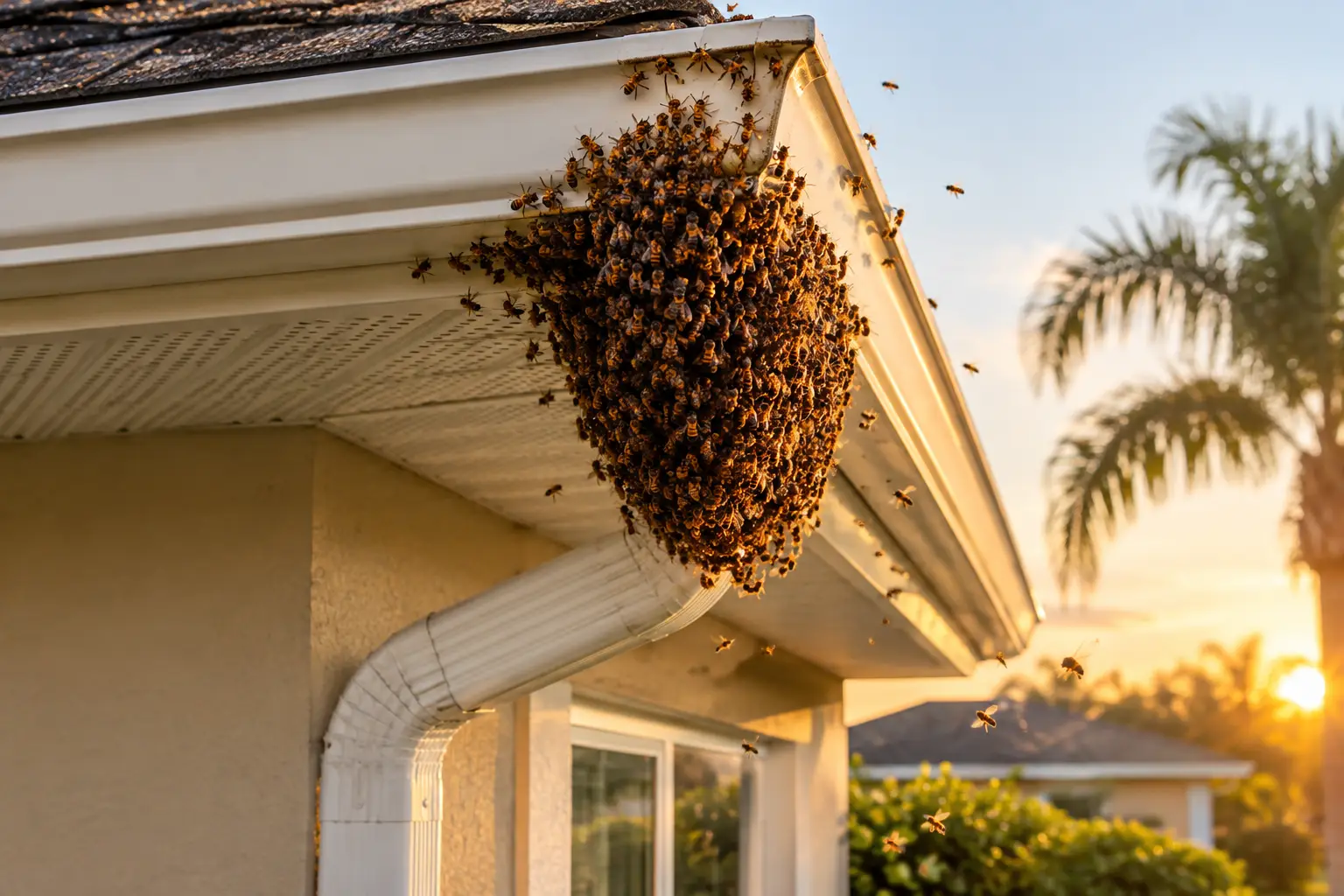

A wall cavity honey cleanup example makes one point very clear: removing live bees is only half of a structural bee removal. A colony can leave pounds of honey, wax comb, pollen, and brood inside a wall. If that material stays behind in Southwest Florida heat and humidity, it can melt, ferment, stain finishes, attract insects, and create odors that are far more difficult to solve later.
The right approach protects people in the home, preserves the colony when possible, and treats the wall cavity as a repairable building system. That means gaining controlled access, removing the entire nest, cleaning the affected surfaces, and closing the structure so another swarm cannot move into the same protected void.
The situation: bees living behind a laundry-room wall
Consider a common scenario. A homeowner notices bee activity at a small gap where a utility line enters an exterior wall. At first, the bees seem manageable because they are outside. Within a few weeks, however, the flight path becomes busy, a warm honey-like odor develops near the laundry room, and a faint brown stain appears at the top of the baseboard.
Inspection confirms that the colony is established inside the exterior wall cavity. The bees have built comb between studs, beginning near the entry point and extending downward. This is no longer a swarm resting temporarily outdoors. It is an active colony with stored honey and developing brood.
A chemical treatment might kill bees at the entrance, but it does not remove the comb or honey. In fact, that choice can leave the homeowner with a wall full of decaying biological material and no easy way to determine where the colony was located. Live removal addresses the source rather than simply stopping visible activity.
What happens during wall cavity honey cleanup
Every building is different, so the exact access point depends on framing, siding, plumbing, electrical lines, and where the comb sits. The goal is to use the smallest practical opening that still allows complete removal. Sometimes that means opening drywall from the interior. In other cases, exterior siding, soffit material, or a trim section provides better access and avoids disruption to finished rooms.
Before opening the wall, the removal team identifies the bees’ entrance and maps the likely extent of the nest. Thermal imaging, listening for colony activity, and careful visual inspection can help, but conditions inside a wall cannot be confirmed fully until the cavity is opened. A responsible estimate should allow for that uncertainty rather than promise that a large colony can be removed through a tiny hole.
Once access is created, the beekeeper carefully removes bees and comb section by section. Viable brood comb may be placed into frames so the colony can be relocated to an apiary. Honey comb is handled separately because it is heavy, fragile, and prone to dripping in warm weather. The queen is located when possible, helping keep the colony together during relocation.
The cavity is not considered clean because the bees are gone. Remaining wax, honey, propolis, dead bees, and loose debris must be removed from the stud bays, sheathing, insulation, and other accessible surfaces. This is the part of the job that prevents a second wave of problems.
Why honey cannot be left in the wall
Honey is stable when sealed in a hive, but an exposed wall cavity is not a hive. Florida temperatures can soften wax and cause honey to run down framing or drywall. Moisture and contaminants can cause it to ferment. The smell may attract ants, roaches, wax moths, beetles, and other scavenging insects. In some cases, rodents are drawn to the food source as well.
Honey stains can also travel farther than homeowners expect. A stain may emerge several feet below the original nest as liquid follows a stud, electrical penetration, or drywall seam. Cleaning only the visible stain is cosmetic. The source inside the wall needs to be removed first.
Cleaning, drying, and treating the exposed cavity
After comb removal, the crew scrapes residue from framing and sheathing, then wipes or washes affected accessible surfaces with an appropriate cleaner. The objective is not to make raw lumber look new. It is to remove the sticky organic residue that can feed pests and hold odors.
Insulation deserves particular attention. Fiberglass insulation touched by a small amount of honey may sometimes be removed locally. Insulation saturated with honey, wax, or bee debris generally needs replacement. Trying to save heavily contaminated insulation can leave odor and insect attractants in the wall even after the comb is gone.
The cavity must then dry before it is closed. If honey has leaked into materials or if cleaning introduced moisture, trapping that dampness behind new drywall creates another avoidable risk. The drying time depends on the size of the colony, the degree of leakage, the materials involved, and indoor humidity. A modest, dry nest may be ready for closure promptly. A large colony with melted honey may require additional cleanup and drying work.
If staining has reached painted drywall, trim, or ceiling surfaces outside the opening, those finishes may need separate restoration. The bee removal work solves the biological source; drywall repair, painting, and insulation replacement may be completed by the removal provider or coordinated with a qualified repair professional, depending on the scope.
Sealing the original entry point matters as much as cleanup
A wall cavity that once housed bees remains attractive to scout bees if the entrance is left open. Odors from residual wax and propolis can signal that the location has sheltered a colony before. That is why exclusion is part of a complete structural removal.
After the cavity is cleaned and the removal is complete, gaps around pipes, vents, siding joints, fascia, and utility penetrations should be sealed with materials appropriate for the building surface. The repair must preserve needed ventilation and drainage. Sealing every visible opening without understanding its purpose can create moisture problems of a different kind.
For a Florida home, it is also wise to inspect nearby soffits, roofline gaps, meter boxes, and wall penetrations. Bees often find one vulnerable area, but the same maintenance issue may exist elsewhere on the structure.
The trade-off: a small repair now versus larger damage later
Homeowners understandably worry about opening a wall. It can feel less destructive to wait, spray the entrance, or hope the colony leaves on its own. Established colonies usually do not simply abandon a productive nest, and a wall opening made deliberately is often much smaller and cleaner than the repair required after honey leaks through finished surfaces.
The least invasive option is not always the smallest opening. It is the option that allows the nest to be removed completely, the cavity to be cleaned, and the access point to be secured. A narrow opening that leaves several pounds of honey behind can become the more expensive choice.
This is particularly relevant for rental properties, HOAs, restaurants, and other commercial spaces. A visible bee flight path creates a safety concern, while hidden honey damage can turn into a maintenance dispute if the underlying nest was never removed. Documentation of the removal area, condition of materials, and needed repairs helps property managers make sound decisions.
When a wall cavity cleanup needs extra care
Some removals are more complex than the example above. Electrical wiring, plumbing, HVAC ducts, masonry walls, multi-story access, or extensive honey leakage can change the work plan. A colony in a block wall may require a different access method than one behind drywall. A nest in a second-floor soffit may require exterior equipment rather than interior demolition.
Aggressive bee behavior also changes the safety plan. Homeowners should keep children, pets, and bystanders away from the work area and avoid blocking the bees’ flight path. Do not tape over an active entrance or attempt to vacuum, flood, or poison a colony inside a wall. Those actions can force bees into living spaces or leave the same honey cleanup problem behind.
Beeswild serves Southwest Florida property owners with live bee removal and relocation, followed by the structural cleanup needed to help prevent recurring activity and honey-related damage. Their same-place removal warranty reflects a practical standard: a removal is not finished when the visible bees disappear, but when the nesting site has been properly addressed.
If you see steady bee traffic entering a wall, soffit, or siding gap, treat it as an early warning rather than a nuisance to watch. Prompt inspection can preserve more of the structure, make cleanup simpler, and give the colony its best chance of being safely relocated.

No responses yet