
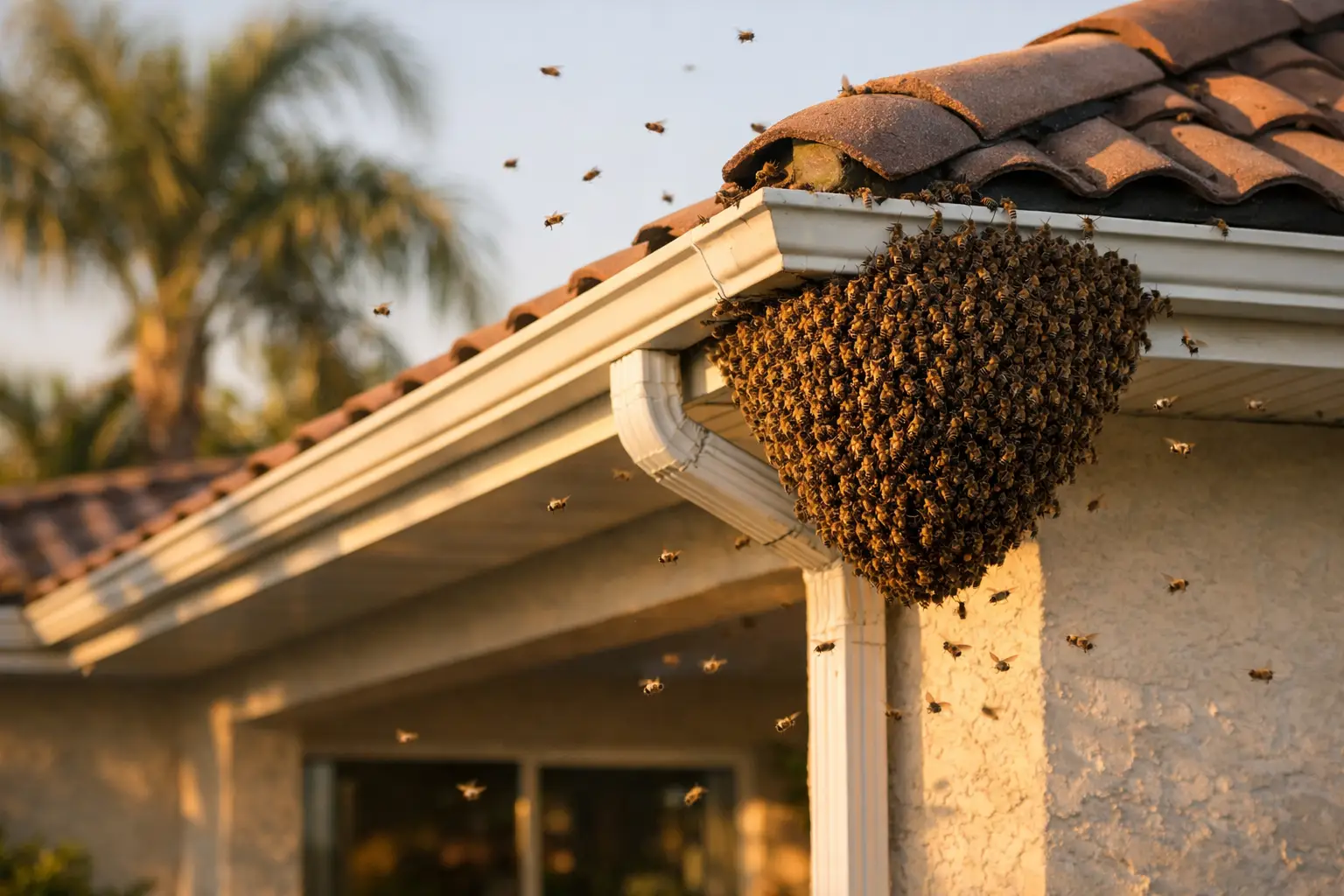

A moving cloud of honey bees can be alarming, especially when it gathers on a palm, fence, soffit, or patio fixture. Yet the difference between a swarm versus established colony changes both the urgency and the right response. One may be a temporary resting group looking for a permanent home. The other may already be living inside your structure, building comb, storing honey, and expanding behind walls or roofing.
For Southwest Florida property owners, that distinction matters. A swarm can sometimes move on without intervention. An established colony should be assessed promptly because the longer bees remain in a building, the greater the potential for honey, wax, moisture, and insect activity to affect the structure. The humane answer is not to spray first and ask questions later. It is to identify what is happening, protect people and pets, and use a removal plan that accounts for the bees and the property.
What Is a Honey Bee Swarm?
A swarm is a natural colony-splitting event. When an existing hive becomes crowded or conditions are favorable, the old queen leaves with a large share of the worker bees. They may form a dense, buzzing cluster on a tree limb, mailbox, exterior wall, vehicle, or other nearby surface while scout bees search for a suitable nesting site.
The cluster can look dramatic. Thousands of bees may hang together in a shape resembling a football, teardrop, or dark beard. But a swarm is usually focused on protecting its queen and finding shelter, not defending honey stores or brood. Because it has no established nest to defend, it is often less defensive than a colony that has lived in one place for weeks or months.
That does not mean a swarm is safe to touch. Any group of bees can sting when disturbed, crushed, sprayed, or trapped. Keep children, pets, and curious neighbors away. Avoid spraying water, insecticide, foam, or household chemicals on the cluster. Those actions can agitate the bees and make a simple relocation more difficult.
Why swarms often appear suddenly
Swarms may arrive with little warning during active bee seasons, particularly when warm weather and abundant blooms support rapid colony growth. They can settle for a few hours or remain for a few days. A visible cluster outside does not automatically mean bees have moved into the home.
However, a swarm near a roofline, attic vent, wall opening, or soffit deserves attention. Scout bees can find a small access point quickly, and once the group enters a cavity, the situation can shift from a relatively straightforward collection to a structural removal.
What Is an Established Bee Colony?
An established colony has selected a protected location and begun functioning as a permanent hive. The bees build wax comb, raise young, store pollen and honey, regulate the nest temperature, and defend their space. In a natural tree cavity, that process is beneficial. Inside a wall, chimney, roofline, shed, electrical box, or water meter enclosure, it can create a property problem as well as a safety concern.
Unlike a swarm, an established colony has resources to protect. Workers may use a consistent flight path through a crack or opening, often becoming more visible during warm parts of the day. You may notice bees entering the same gap in siding, brickwork, stucco, fascia, roof trim, or a utility penetration.
Other clues include a steady hum in a wall or ceiling, dark staining near an entrance, wax or honey odors, and bee activity that continues day after day. A colony does not have to be large to be established. Once comb is present, the bees have begun creating a nest that requires a more complete solution.
The hidden issue is the comb
The biggest difference is not simply the number of bees. It is what they leave behind. A swarm clustered on a branch typically has not built comb there. An established colony inside a structure may contain pounds of wax, pollen, honey, developing bees, and debris.
Killing bees without removing that material often creates a second problem. Honey can soften and leak in Florida heat. Wax and scent residue can attract ants, roaches, wax moths, rodents, and new bee colonies. The original entrance may also remain available to another swarm. For that reason, responsible structural removal addresses the living colony, the comb, and the access point.
Swarm Versus Established Colony: How to Tell
The simplest question is whether the bees are gathered openly or repeatedly entering a hidden space. A swarm is often clearly visible as one compact mass on an exterior object. An established colony usually has a small but continuous stream of bees flying to and from one opening.
Timing offers another clue. A swarm may appear suddenly and then disappear. An established colony shows ongoing activity across multiple days, usually with bees returning to the same entrance. If you see bees circling an area but cannot locate a cluster or a consistent entry point, observe from a safe distance rather than standing close to their flight path.
Behavior can help, but it is not a reliable test for homeowners. Bees may seem calm one moment and react strongly if a lawn mower, ladder, pressure washer, pet, or person disturbs the nest. In Southwest Florida, where defensive bee genetics can occur, it is wise not to judge risk by appearance alone. A professional assessment can determine whether the insects are honey bees, another stinging insect, or a colony requiring a more cautious approach.
Why the Right Response Depends on the Situation
A visible swarm on an accessible branch may be collected and relocated with minimal disruption. The goal is to safely contain the bees, protect the queen, and move the group to a managed location where it can establish a productive hive.
An established colony in a building requires more planning. The technician needs to locate the comb, understand the construction, remove the bees without spreading them through the structure, extract the comb and honey residue, and close the primary entry after removal. The work can involve access through soffits, siding, roofs, walls, or other building components. The least invasive approach is desirable, but leaving comb behind simply to avoid opening an area can be a costly shortcut.
Commercial properties and HOA-managed buildings have additional concerns. Bee activity near entrances, pool areas, playgrounds, outdoor dining, mail stations, or work zones can create liability and public-safety issues. A documented, professional removal plan helps property managers respond without treating living pollinators as disposable pests.
What Property Owners Should Do First
Start by giving the bees space. Keep people and animals away, especially from the direct path in and out of a suspected nest. Do not block the entrance, seal a hole, or caulk a gap while bees are active. Trapped bees may find another route into a wall or interior living space, while the remaining comb can still cause damage.
Do not use store-bought sprays, smoke bombs, gasoline, fire, or high-pressure water. These methods can provoke stinging, damage finishes, contaminate the area, and leave a dead colony inside the structure. They also do not solve the underlying issue of comb and honey.
If the bees are on an exterior surface, take a photo from a safe distance and note when you first saw them. If they are entering a structure, identify the general location without getting close. This information helps a live bee removal professional determine whether the situation is likely a swarm, an established colony, or another insect issue.
For an active cluster or colony in the Cape Coral and Southwest Florida area, Beeswild can evaluate the site and provide a humane removal approach designed around both safety and long-term property protection. A removal warranty for the same location also matters because proper exclusion is part of preventing a repeat problem.
A Better Outcome for Bees and Buildings
Honey bees are valuable pollinators, but they do not belong inside occupied walls, roofs, or shared public structures. Recognizing the difference between a temporary swarm and a settled colony prevents two common mistakes: panicking over a group that may be resting briefly, or waiting too long when a hidden hive is actively building inside a property.
When you are unsure, treat the bees with distance and respect, then get a qualified assessment. The best result protects your family, visitors, and building while giving healthy honey bees a chance to continue their work somewhere they can safely thrive.

No responses yet