
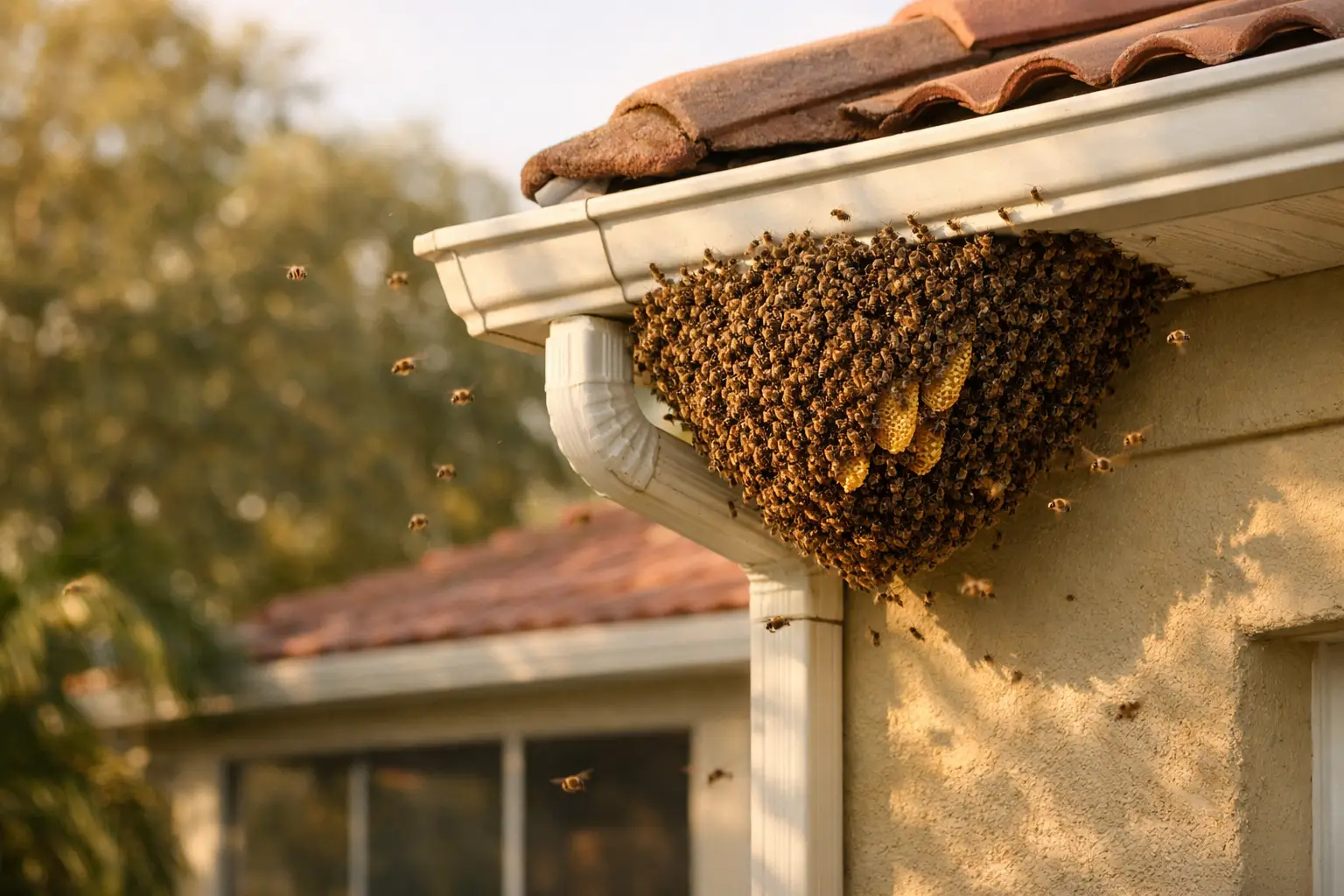

A few bees entering a gap near a soffit can look harmless at first. But if the traffic continues day after day, there may be a colony building comb inside the structure. Knowing how to identify honeycomb helps you respond before stored honey, wax, and bees create a larger problem behind a wall, roofline, shed, or utility box.
Honeycomb is not automatically an emergency, and it does not mean bees should be destroyed. It does mean the colony needs a careful assessment. In Southwest Florida, warm weather allows colonies to remain active for much of the year, so waiting for cold weather to solve the issue is rarely a reliable plan.
What Honeycomb Actually Looks Like
Honeycomb is a sheet or cluster of tightly connected wax cells. Each cell is usually six-sided, creating the familiar repeating hexagon pattern associated with honey bees. Fresh comb is often pale white, cream, or light yellow. As bees reuse it for raising brood and storing pollen, it can turn golden, brown, or nearly black.
The comb itself is made of beeswax. It may hold honey, pollen, developing bees, or a combination of all three. A healthy established colony generally builds several vertical comb sheets, often hanging parallel to one another in a protected cavity. In a wall or ceiling, you may never see the comb directly. Instead, you may see the evidence around the entrance.
Honeycomb differs from the papery, layered material made by wasps and hornets. Wasp nests have a gray or tan paper-like outer shell or exposed cells that resemble small cups. Honey bees do not create that paper covering. If you can safely see clear waxy hexagons, you are likely looking at bee comb.
Signs There Is Honeycomb Inside a Wall or Roof
The most dependable clue is consistent bee flight. Watch from a safe distance during daylight, preferably when temperatures are warm and bees are naturally active. An established colony has worker bees leaving and returning through the same small opening, such as a crack in siding, a roof vent, a soffit gap, or a hole around plumbing or electrical equipment.
A steady flight path matters more than the total number of bees you see at one moment. Some may fly out quickly while others arrive carrying pollen on their hind legs. Pollen-carrying bees are a strong sign that a colony is raising young nearby, because pollen is food for developing larvae.
You may also notice a low, persistent buzzing through drywall, especially in a quiet room or near the suspected entry point. On hot days, bees sometimes gather in a cluster near their entrance to help ventilate the colony. Brown or amber staining on a ceiling or wall can be a more serious late-stage sign, possibly indicating honey leakage, though moisture damage can look similar.
Other clues include a sweet, warm odor near a cavity, wax flakes below an opening, or bees appearing indoors near a light fixture, window, or vent. None of these signs should be investigated by opening the wall yourself. Disturbing a concealed colony can force bees farther into the building or cause honey to spread into insulation and drywall.
A swarm is not the same as a honeycomb colony
A swarm is a temporary cluster of honey bees, commonly seen on a branch, fence, mailbox, vehicle, or exterior wall. It often looks like a moving ball or curtain of bees. Swarming bees are typically searching for a permanent home and may remain in one place for only hours or a few days.
Because a swarm has not settled into a cavity, it usually has little or no built comb. A colony inside a wall, by contrast, has chosen the space as a home and is actively constructing or maintaining comb. The response should be different: a swarm may be collected directly, while an established structural colony requires locating the comb and removing it properly.
How to Tell Honey Bees From Look-Alikes
Many flying insects are called “bees” by homeowners, but correct identification affects safety and removal options. Honey bees have fuzzy thoraxes, oval bodies, and muted bands of brown, black, and golden tan. They are smaller and less glossy than many wasps. When they forage, they move between flowers and often carry visible pollen.
Yellowjackets have brighter yellow-and-black markings, smoother bodies, and a narrower waist. They may fly in and out of a ground hole, wall void, or roofline, but they do not make wax honeycomb. Paper wasps have long legs that dangle noticeably while they fly and build open, umbrella-shaped paper nests under eaves and patio covers.
Bumble bees are larger, rounder, and very fuzzy. They may nest in the ground or in sheltered outdoor spaces, but they do not usually establish the large wax comb colonies found in walls. Carpenter bees are solitary and commonly leave smooth, round holes in unfinished wood. They may cause damage over time, but they do not build honey-filled comb sheets.
Do not rely on color alone. Honey bee appearance varies, and defensive behavior cannot reliably identify a species or tell you whether a colony is Africanized. Any colony can become defensive when its nest is threatened. Keep people and pets away, avoid blocking the entrance, and let an experienced live bee removal professional assess the situation.
What an Active Honeycomb Colony Means for Your Property
An active colony can contain thousands of bees and many pounds of comb, depending on its age and location. The longer it remains inside a structure, the more likely it is to expand. Bees can fill voids between studs, rafters, ceilings, and exterior finishes with comb.
The immediate concern is not simply stings. A colony near a doorway, pool area, playground, outdoor dining space, or public walkway can create a safety concern for residents, visitors, employees, and pets. Inside the building, the greater long-term concern is what remains after the bees are gone.
If a colony is poisoned or sealed inside without comb removal, honey and wax remain in the cavity. In Florida heat, honey can soften, ferment, leak, or attract ants, roaches, wax moths, rodents, and other scavengers. The odor can linger, and a new swarm may be drawn to the same void later. That is why removing only the visible bees is not the same as resolving a honeycomb problem.
Safe Steps When You Identify Honeycomb
Once you suspect honeycomb, give the area space. Keep children, pets, and workers away from the entrance and avoid mowing, pressure washing, trimming, or striking the surface nearby. Vibrations and sudden disturbance can make even normally calm honey bees defensive.
Do not spray insecticide into an opening, fill it with foam, tape it shut, or light smoke or fire near it. These actions can trap bees inside the structure, push them into living areas, or leave a decaying colony and stored honey behind. They can also make a later removal more difficult and costly.
Take a photo or short video from a safe distance. Note where the bees are entering, how long you have seen activity, and whether bees are appearing indoors. For a commercial property or HOA, also document whether the entrance is near a public-facing area. This information helps a removal specialist plan access and protect the surrounding structure.
A proper live removal typically involves finding the full extent of the colony, carefully removing bees and comb, cleaning residual wax and honey, and closing the access point once all activity is addressed. The exact approach depends on the structure. Removing a colony from an accessible shed is very different from removing one behind stucco, tile roofing, or a second-story soffit.
Beeswild serves Southwest Florida property owners with live bee removal and relocation, with the goal of protecting both the building and the colony whenever conditions allow. Professional assessment is particularly valuable when bees are in a wall, roof, chimney, utility enclosure, or other concealed space.
When to Treat It as Urgent
Arrange prompt help if bees are entering the occupied part of a building, if someone has a known severe bee-sting allergy, or if the colony is near a high-traffic entrance. The same applies when you see rapidly increasing bee activity, hear loud buzzing through a wall, or notice sticky staining on a ceiling.
For public spaces, do not attempt to manage access by covering the entrance. Move people away from the area when possible and contact a qualified bee removal provider. A calm, controlled response protects people while giving a valuable pollinator colony its best chance of being relocated rather than destroyed.
Finding honeycomb is a useful warning sign, not a reason to panic. Watch from a distance, avoid quick fixes that leave wax and honey behind, and act early enough to protect the people around the property as well as the bees that found their way there.

No responses yet